
CHK1在wee1抑制剂MK - 1775对急性髓系白血病细胞的抗白血病活性中起关键作用。
CHK1 plays a critical role in the anti-leukemic activity of the wee1 inhibitor MK-1775 in acute myeloid leukemia cells.
作者信息
Qi Wenxiu, Xie Chengzhi, Li Chunhuai, Caldwell J Timothy, Edwards Holly, Taub Jeffrey W, Wang Yue, Lin Hai, Ge Yubin
机构信息
National Engineering Laboratory for AIDS Vaccine, Key Laboratory for Molecular Enzymology & Engineering, the Ministry of Education, and School of Life Sciences, Jilin University, Changchun, China.
出版信息
J Hematol Oncol. 2014 Aug 1;7:53. doi: 10.1186/s13045-014-0053-9.
BACKGROUND
Acute myeloid leukemia (AML) remains a difficult disease to treat and requires new therapies to improve treatment outcome. Wee1 inhibitors have been used to prevent activation of the G2 cell cycle checkpoint, thus enhancing the antitumor activity of DNA damaging agents. In this study, we investigated MK-1775 in AML cell lines and diagnostic blast samples to identify sensitive subtypes as well as possible mechanisms of resistance.
METHODS
In vitro MK-1775 cytotoxicities of AML cell lines and diagnostic blasts were measured using MTT assays. The effects of MK-1775 on cell cycle progression and related proteins were determined by propidium iodide (PI) staining and flow cytometry analysis and Western blotting. Drug-induced apoptosis was determined using annexin V/PI staining and flow cytometry analysis.
RESULTS
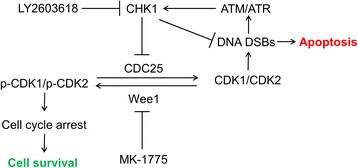
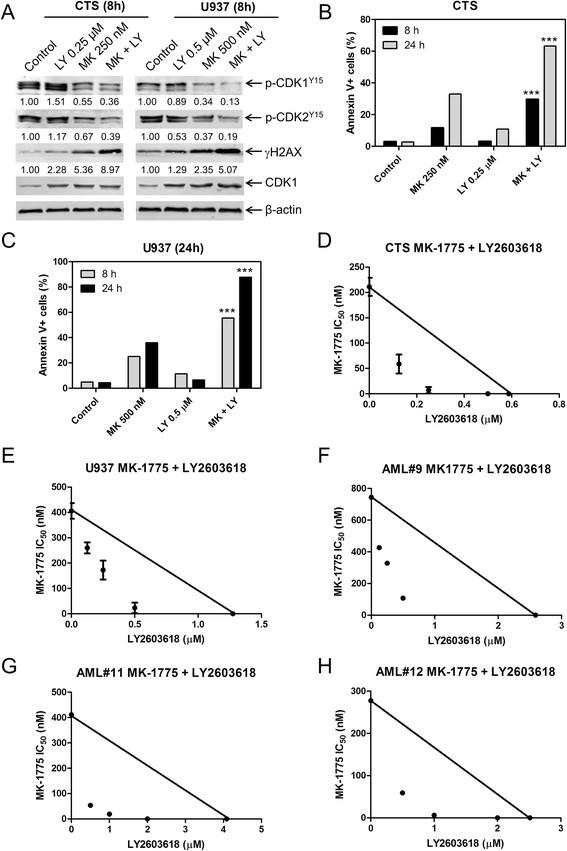
We found that newly diagnosed and relapsed patient samples were equally sensitive to MK-1775. In addition, patient samples harboring t(15;17) translocation were significantly more sensitive to MK-1775 than non-t(15;17) samples. MK-1775 induced apoptosis in both AML cell lines and diagnostic blast samples, accompanied by decreased phosphorylation of CDK1 and CDK2 on Tyr-15 and increased DNA double-strand breaks (DSBs). Time-course experiments, using AML cell lines, revealed a time-dependent increase in DNA DSBs, activation of CHK1 and subsequent apoptosis following MK-1775 treatment, which could be attenuated by a CDK1/2 inhibitor, Roscovitine. Simultaneous inhibition of CHK1 and Wee1 resulted in synergistic anti-leukemic activity in both AML cell lines and primary patient samples ex vivo.
CONCLUSIONS
Our study provides compelling evidence that CHK1 plays a critical role in the anti-leukemic activity of MK-1775 and highlights a possible mechanism of resistance to MK-1775. In addition, our study strongly supports the use of MK-1775 to treat both newly diagnosed and relapsed AML, especially cases with t(15;17) translocation, and supports the development of combination therapies with CHK1 inhibitors.
背景
急性髓系白血病(AML)仍然是一种难以治疗的疾病,需要新的疗法来改善治疗效果。Wee1抑制剂已被用于防止G2细胞周期检查点的激活,从而增强DNA损伤剂的抗肿瘤活性。在本研究中,我们在AML细胞系和诊断性原始细胞样本中研究了MK-1775,以确定敏感亚型以及可能的耐药机制。
方法
使用MTT法测定AML细胞系和诊断性原始细胞的体外MK-1775细胞毒性。通过碘化丙啶(PI)染色、流式细胞术分析和蛋白质免疫印迹法确定MK-1775对细胞周期进程和相关蛋白的影响。使用膜联蛋白V/PI染色和流式细胞术分析确定药物诱导的细胞凋亡。
结果
我们发现新诊断和复发患者样本对MK-1775同样敏感。此外,携带t(15;17)易位的患者样本对MK-1775的敏感性明显高于非t(15;17)样本。MK-1775在AML细胞系和诊断性原始细胞样本中均诱导细胞凋亡,同时伴有CDK1和CDK2在Tyr-15位点的磷酸化减少以及DNA双链断裂(DSB)增加。使用AML细胞系进行的时间进程实验显示,MK-1775处理后DNA DSB随时间增加、CHK1激活以及随后的细胞凋亡,这可被CDK1/2抑制剂Roscovitine减弱。在AML细胞系和原发性患者样本中,同时抑制CHK1和Wee1导致协同抗白血病活性。
结论
我们的研究提供了令人信服的证据,表明CHK1在MK-1775的抗白血病活性中起关键作用,并突出了对MK- 1775耐药的一种可能机制。此外,我们的研究强烈支持使用MK-1775治疗新诊断和复发的AML,特别是伴有t(15;17)易位的病例,并支持开发与CHK1抑制剂的联合疗法。


 Zotero 插件