
认知行为疗法对接受减肥手术患者进食功能障碍的疗效:一项随机对照试验。
Effectiveness of a cognitive behavioral therapy for dysfunctional eating among patients admitted for bariatric surgery: a randomized controlled trial.
作者信息
Gade Hege, Hjelmesæth Jøran, Rosenvinge Jan H, Friborg Oddgeir
机构信息
Morbid Obesity Center, Vestfold Hospital Trust, P.O. Box 3168, 3103 Tønsberg, Norway.
Department of Psychology, University of Tromsø, P.O. Box 6050 Langnes, 9037 Tromsø, Norway.
出版信息
J Obes. 2014;2014:127936. doi: 10.1155/2014/127936. Epub 2014 Jul 21.
OBJECTIVE
To examine whether cognitive behavioral therapy (CBT) alleviates dysfunctional eating (DE) patterns and symptoms of anxiety and depression in morbidly obese patients planned for bariatric surgery.
DESIGN AND METHODS
A total of 98 (68 females) patients with a mean (SD) age of 43 (10) years and BMI 43.5 (4.9) kg/m(2) were randomly assigned to a CBT-group or a control group receiving usual care (i.e., nutritional support and education). The CBT-group received ten weekly intervention sessions. DE, anxiety, and depression were assessed by the TFEQ R-21 and HADS, respectively.
RESULTS
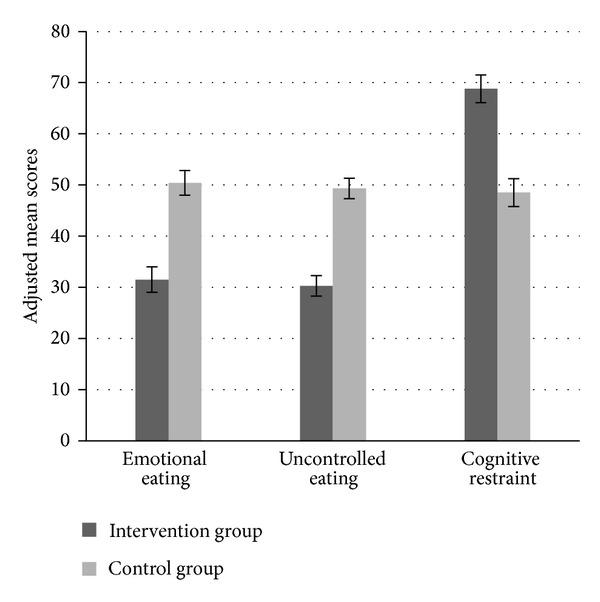
Compared with controls, the CBT-patients showed significantly less DE, affective symptoms, and a larger weight loss at follow-up. The effect sizes were large (DE-cognitive restraint, g = -.92, P ≤ .001; DE-uncontrolled eating, g = -.90, P ≤ .001), moderate (HADS-depression, g = -.73, P ≤ .001; DE-emotional eating, g = -.67, P ≤ .001; HADS-anxiety, g = -.62, P = .003), and low (BMI, g = -.24, P = .004).
CONCLUSION
This study supports the use of CBT in helping patients preparing for bariatric surgery to reduce DE and to improve mental health. This clinical trial is registered with NCT01403558.
目的
研究认知行为疗法(CBT)是否能缓解计划接受减肥手术的病态肥胖患者的功能失调性饮食(DE)模式以及焦虑和抑郁症状。
设计与方法
总共98名患者(68名女性),平均(标准差)年龄43(10)岁,体重指数(BMI)为43.5(4.9)kg/m²,被随机分配到CBT组或接受常规护理(即营养支持和教育)的对照组。CBT组接受为期十周的干预课程。分别通过TFEQ R-21和HADS评估DE、焦虑和抑郁情况。
结果
与对照组相比,CBT组患者在随访时表现出明显更少的DE、情感症状,且体重减轻更多。效应量较大(DE-认知抑制,g = -0.92,P≤0.001;DE-无节制饮食,g = -0.90,P≤0.001),中等(HADS-抑郁,g = -0.73,P≤0.001;DE-情绪化进食,g = -0.67,P≤0.001;HADS-焦虑,g = -0.62,P = 0.003),较小(BMI,g = -0.24,P = 0.004)。
结论
本研究支持使用CBT帮助准备接受减肥手术的患者减少DE并改善心理健康。该临床试验已在NCT01403558注册。


 Zotero 插件