
CDDO-Me诱导胰腺癌细胞凋亡涉及通过表观遗传途径抑制端粒酶。
Induction of Apoptosis in Pancreatic Cancer Cells by CDDO-Me Involves Repression of Telomerase through Epigenetic Pathways.
作者信息
Deeb Dorrah, Brigolin Chris, Gao Xiaohua, Liu Yongbo, Pindolia Kirit R, Gautam Subhash C
机构信息
Department of Surgery, Henry Ford Health System, Detroit, USA.
Department of Medical Genetics, Henry Ford Health System, Detroit, USA.
出版信息
J Carcinog Mutagen. 2014 May 31;5:177. doi: 10.4172/2157-2518.1000177.
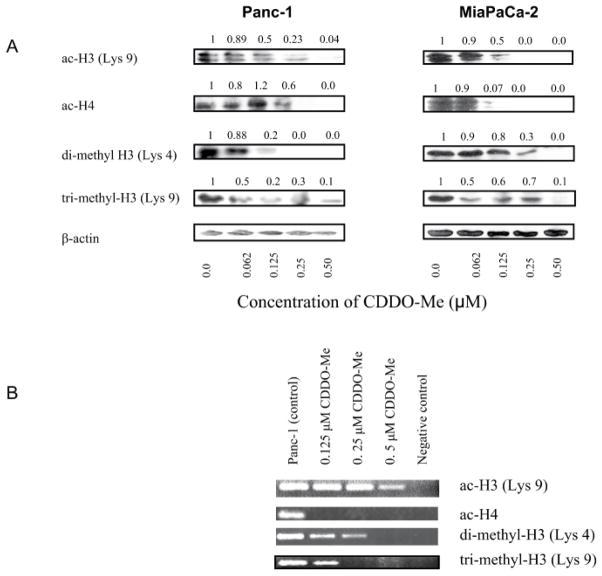
Reactivation of telomerase in cancers provides an attractive target for developing novel agents to selectively destroy tumor cells. Methyl-2-cyano-3,12-dioxooleana-1,9(11)-dien-28-oate (CDDO-Me), a synthetic oleanane triterpenoid, inhibited cell proliferation and induced apoptosis in pancreatic cancer cells at very low concentrations. The antiproliferative and apoptosis-inducing effects of CDDO-Me were associated with the inhibition of human telomerase reverse transcriptase (hTERT) mRNA, hTERT protein and reduction in hTERT telomerase activity. CDDO-Me inhibited multiple transcription factors that regulate hTERT expression positively (Sp1, c-Myc and NF-κB) and negatively (CTCF, E2F-1 and MAD1). CDDO-Me inhibited protein levels of DNA methyl transferases DNMT1 and DNMT3a, which also resulted in hypomethylation of hTERT promoter. In addition, transcriptionally active chromatin markers, such as acetylated histone H3 (Lys 9), acetylated histone H4, di-methyl H3 (Lys 4) and tri-methyl H3 (Lys 9) were all reduced in pancreatic cancer cells treated with CDDO-Me. Chromatin immunoprecipitation analysis showed decreased histone deacetylation and histone demethylation at hTERT promoter. Collectively, these results indicate that down-regulation of telomerase through epigenetic mechanisms plays a critical role in induction of apoptosis in pancreatic cancer cells by CDDO-Me.
癌症中端粒酶的重新激活为开发选择性破坏肿瘤细胞的新型药物提供了一个有吸引力的靶点。甲基-2-氰基-3,12-二氧代齐墩果-1,9(11)-二烯-28-酸酯(CDDO-Me),一种合成的齐墩果烷三萜类化合物,在极低浓度下就能抑制胰腺癌细胞的增殖并诱导其凋亡。CDDO-Me的抗增殖和诱导凋亡作用与抑制人类端粒酶逆转录酶(hTERT)mRNA、hTERT蛋白以及降低hTERT端粒酶活性有关。CDDO-Me抑制了多种正向(Sp1、c-Myc和NF-κB)和负向(CTCF、E2F-1和MAD1)调节hTERT表达的转录因子。CDDO-Me抑制了DNA甲基转移酶DNMT1和DNMT3a的蛋白水平,这也导致了hTERT启动子的低甲基化。此外,在用CDDO-Me处理的胰腺癌细胞中,转录活性染色质标记物,如乙酰化组蛋白H3(赖氨酸9)、乙酰化组蛋白H4、二甲基H3(赖氨酸4)和三甲基H3(赖氨酸9)均有所降低。染色质免疫沉淀分析表明,hTERT启动子处的组蛋白去乙酰化和组蛋白去甲基化减少。总体而言,这些结果表明,通过表观遗传机制下调端粒酶在CDDO-Me诱导胰腺癌细胞凋亡中起关键作用。


 Zotero 插件