
参与远距离DNA相互作用的染色质绝缘子因子及其在果蝇基因组折叠中的作用。
Chromatin insulator factors involved in long-range DNA interactions and their role in the folding of the Drosophila genome.
作者信息
Vogelmann Jutta, Le Gall Antoine, Dejardin Stephanie, Allemand Frederic, Gamot Adrien, Labesse Gilles, Cuvier Olivier, Nègre Nicolas, Cohen-Gonsaud Martin, Margeat Emmanuel, Nöllmann Marcelo
机构信息
Centre National de la Recherche Scientifique, Unité Mixte de Recherche 5048, Centre de Biochimie Structurale, Montpellier, France; Institut National de la Santé et la Recherche Médicale, Unité 1054, Montpellier, France; Universités Montpellier I et II, Montpellier, France.
Laboratoire de Biologie Moléculaire Eucaryote, CNRS and Université de Toulouse, Toulouse; France.
出版信息
PLoS Genet. 2014 Aug 28;10(8):e1004544. doi: 10.1371/journal.pgen.1004544. eCollection 2014 Aug.
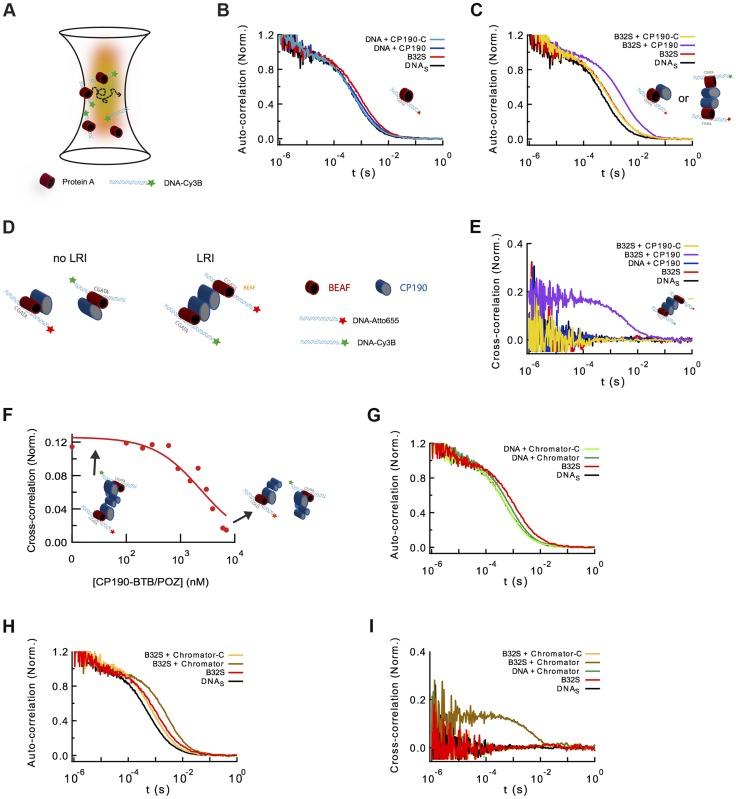
Chromatin insulators are genetic elements implicated in the organization of chromatin and the regulation of transcription. In Drosophila, different insulator types were characterized by their locus-specific composition of insulator proteins and co-factors. Insulators mediate specific long-range DNA contacts required for the three dimensional organization of the interphase nucleus and for transcription regulation, but the mechanisms underlying the formation of these contacts is currently unknown. Here, we investigate the molecular associations between different components of insulator complexes (BEAF32, CP190 and Chromator) by biochemical and biophysical means, and develop a novel single-molecule assay to determine what factors are necessary and essential for the formation of long-range DNA interactions. We show that BEAF32 is able to bind DNA specifically and with high affinity, but not to bridge long-range interactions (LRI). In contrast, we show that CP190 and Chromator are able to mediate LRI between specifically-bound BEAF32 nucleoprotein complexes in vitro. This ability of CP190 and Chromator to establish LRI requires specific contacts between BEAF32 and their C-terminal domains, and dimerization through their N-terminal domains. In particular, the BTB/POZ domains of CP190 form a strict homodimer, and its C-terminal domain interacts with several insulator binding proteins. We propose a general model for insulator function in which BEAF32/dCTCF/Su(HW) provide DNA specificity (first layer proteins) whereas CP190/Chromator are responsible for the physical interactions required for long-range contacts (second layer). This network of organized, multi-layer interactions could explain the different activities of insulators as chromatin barriers, enhancer blockers, and transcriptional regulators, and suggest a general mechanism for how insulators may shape the organization of higher-order chromatin during cell division.
染色质绝缘子是与染色质组织和转录调控相关的遗传元件。在果蝇中,不同类型的绝缘子通过其绝缘子蛋白和辅助因子的位点特异性组成来表征。绝缘子介导间期细胞核三维组织和转录调控所需的特定远距离DNA接触,但这些接触形成的潜在机制目前尚不清楚。在这里,我们通过生化和生物物理方法研究绝缘子复合物不同组分(BEAF32、CP190和Chromator)之间的分子关联,并开发了一种新颖的单分子检测方法来确定远距离DNA相互作用形成所需的必要和关键因素。我们表明,BEAF32能够特异性且高亲和力地结合DNA,但不能介导远距离相互作用(LRI)。相比之下,我们表明CP190和Chromator能够在体外介导特异性结合的BEAF32核蛋白复合物之间的LRI。CP190和Chromator建立LRI的这种能力需要BEAF32与其C末端结构域之间的特定接触,以及通过其N末端结构域进行二聚化。特别是,CP190的BTB/POZ结构域形成严格的同源二聚体,其C末端结构域与几种绝缘子结合蛋白相互作用。我们提出了一个绝缘子功能的通用模型,其中BEAF32/dCTCF/Su(HW)提供DNA特异性(第一层蛋白),而CP190/Chromator负责远距离接触所需的物理相互作用(第二层)。这种有组织的多层相互作用网络可以解释绝缘子作为染色质屏障、增强子阻断剂和转录调节因子的不同活性,并提出了一种绝缘子在细胞分裂过程中如何塑造高阶染色质组织的通用机制。


 Zotero 插件