
碳纳米管在纳米多孔氧化铝上:从表面垫料到孔的完全填充。
Carbon nanotubes on nanoporous alumina: from surface mats to conformal pore filling.
机构信息
Plasma Nanoscience Laboratories, Manufacturing Flagship, CSIRO, P.O. Box 218, Lindfield, NSW 2070, Australia ; School of Physics, University of Melbourne, Parkville, VIC 3010, Australia.
Plasma Nanoscience Laboratories, Manufacturing Flagship, CSIRO, P.O. Box 218, Lindfield, NSW 2070, Australia ; Complex Systems, School of Physics, The University of Sydney, Sydney, NSW 2006, Australia.
出版信息
Nanoscale Res Lett. 2014 Aug 12;9(1):390. doi: 10.1186/1556-276X-9-390. eCollection 2014.
UNLABELLED
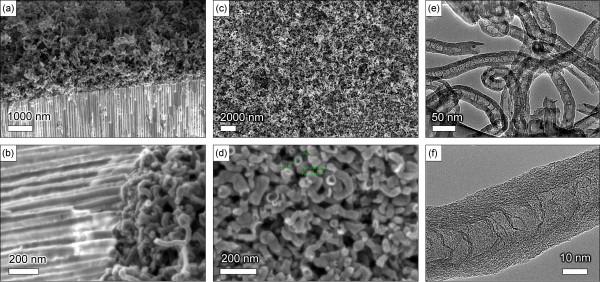
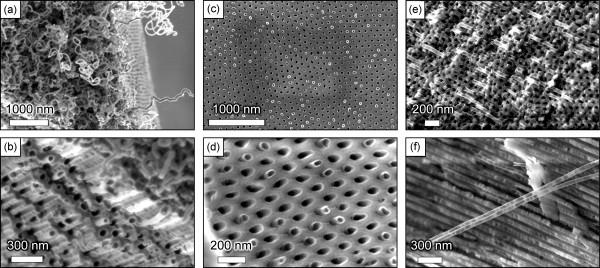
Control over nucleation and growth of multi-walled carbon nanotubes in the nanochannels of porous alumina membranes by several combinations of posttreatments, namely exposing the membrane top surface to atmospheric plasma jet and application of standard S1813 photoresist as an additional carbon precursor, is demonstrated. The nanotubes grown after plasma treatment nucleated inside the channels and did not form fibrous mats on the surface. Thus, the nanotube growth mode can be controlled by surface treatment and application of additional precursor, and complex nanotube-based structures can be produced for various applications. A plausible mechanism of nanotube nucleation and growth in the channels is proposed, based on the estimated depth of ion flux penetration into the channels.
PACS
63.22.Np Layered systems; 68. Surfaces and interfaces; Thin films and nanosystems (structure and non-electronic properties); 81.07.-b Nanoscale materials and structures: fabrication and characterization.
未加标签
通过几种后处理组合,即在多孔氧化铝膜的纳米通道中控制多壁碳纳米管的成核和生长,即在膜的上表面暴露于大气压等离子射流并应用标准 S1813 光致抗蚀剂作为额外的碳前体,已得到证明。经过等离子体处理后生长的纳米管在通道内成核,而不在表面形成纤维垫。因此,可以通过表面处理和应用额外的前体来控制纳米管的生长模式,并可以生产出用于各种应用的复杂的基于纳米管的结构。基于估计的离子通量进入通道的深度,提出了纳米管在通道中成核和生长的合理机制。
理组
分层系统;68. 表面和界面;薄膜和纳米系统(结构和非电子性质);81.07.b 纳米尺度材料和结构:制造和特性。


 Zotero 插件