
基于一项全国性调查的6至36个月丹麦婴幼儿的麸质摄入量。
Gluten intake in 6-36-month-old Danish infants and children based on a national survey.
作者信息
Hoppe Camilla, Trolle Ellen, Gondolf Ulla H, Husby Steffen
机构信息
Division of Nutrition , National Food Institute, Technical University of Denmark , Mørkhøj Bygade 19, DK-2860 Søborg , Denmark.
Hans Christian Andersen Children's Hospital at Odense University Hospital , University of Southern Denmark , DK-5000 Odense C , Denmark.
出版信息
J Nutr Sci. 2013 Feb 26;2:e7. doi: 10.1017/jns.2013.1. eCollection 2013.
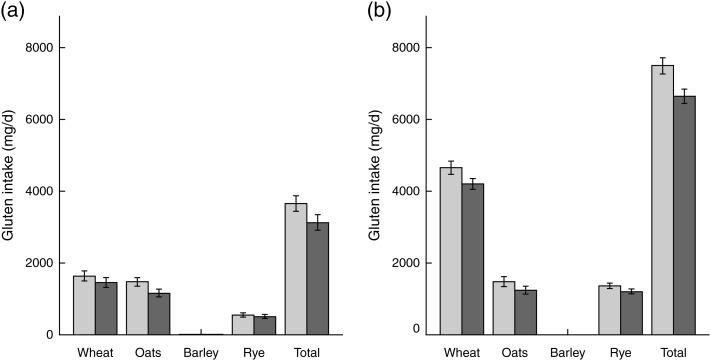
Coeliac disease (CD) affects about 1 % of the general population. Information concerning gluten intake in the general population is scarce. In particular, variation in gluten intake during the complementary feeding period may be an independent risk factor in CD pathogenesis. We determined the intake of gluten from wheat, barley, rye and oats in a cross-sectional National Danish Survey of Dietary Habits among Infants and Young Children (2006-2007). The study population comprised a random sample of 1743 children aged 6-36 months, recruited from the National Danish Civil Registry. The protein contents from wheat, rye, barley and oats were found in the National Danish Food Composition Table, and multiplied with the amounts in the recipes. The amounts of gluten were calculated as the amount of cereal protein × 0·80 for wheat and oats, ×0·65 for rye and ×0·50 for barley. Dietary intake was recorded daily for seven consecutive days in pre-coded food records supplemented with open-answer possibilities. Gluten intake increased with age (P < 0·0001). Oats were introduced first, rapidly outpaced by wheat, the intake of which continued to increase with age, whereas oats started to decrease at 12 months. Boys had a higher intake of energy (P ≤ 0·0001) and all types of gluten, except for barley (P ≤ 0·87). In 8-10-month-old (P < 0·0001) and 10-12-month-old (P = 0·007), but not in 6-8-month-old infants (P = 0·331), non-breast-fed infants had higher total gluten intake than partially breast-fed infants. In conclusion, this study presents representative population-based data on gluten intake in Danish infants and young children.
乳糜泻(CD)影响着约1%的普通人群。关于普通人群麸质摄入量的信息匮乏。尤其是,辅食添加期麸质摄入量的变化可能是CD发病机制中的一个独立风险因素。我们在一项丹麦全国婴幼儿饮食习惯横断面调查(2006 - 2007年)中确定了小麦、大麦、黑麦和燕麦中麸质的摄入量。研究人群包括从丹麦国家民事登记处随机抽取的1743名6 - 36个月大的儿童。小麦、黑麦、大麦和燕麦的蛋白质含量来自丹麦国家食品成分表,并与食谱中的含量相乘。麸质含量通过谷物蛋白量计算得出:小麦和燕麦为谷物蛋白量×0·80,黑麦为×0·65,大麦为×0·50。连续七天每天通过预先编码的食物记录并补充开放式回答选项来记录饮食摄入量。麸质摄入量随年龄增加(P < 0·0001)。首先引入燕麦,但很快被小麦超过,小麦的摄入量随年龄持续增加,而燕麦在12个月时开始减少。男孩的能量摄入量(P ≤ 0·0001)和除大麦外所有类型的麸质摄入量更高(P ≤ 0·87)。在8 - 10个月大(P < 0·0001)和10 - 12个月大(P = 0·007)的婴儿中,而非6 - 8个月大的婴儿(P = 0·331),非母乳喂养的婴儿总麸质摄入量高于部分母乳喂养的婴儿。总之,本研究提供了关于丹麦婴幼儿麸质摄入量的具有代表性的基于人群的数据。

 Zotero 插件