
利用纹理基元根据晶体可能的存在情况对结晶液滴进行排序。
Using textons to rank crystallization droplets by the likely presence of crystals.
作者信息
Ng Jia Tsing, Dekker Carien, Kroemer Markus, Osborne Michael, von Delft Frank
机构信息
Structural Genomics Consortium, University of Oxford, Roosevelt Drive, Oxford OX3 7DQ, England.
Novartis Institute for Biomedical Research, Novartis Campus, Postfach, CH-4056 Basel, Switzerland.
出版信息
Acta Crystallogr D Biol Crystallogr. 2014 Oct;70(Pt 10):2702-18. doi: 10.1107/S1399004714017581. Epub 2014 Sep 27.
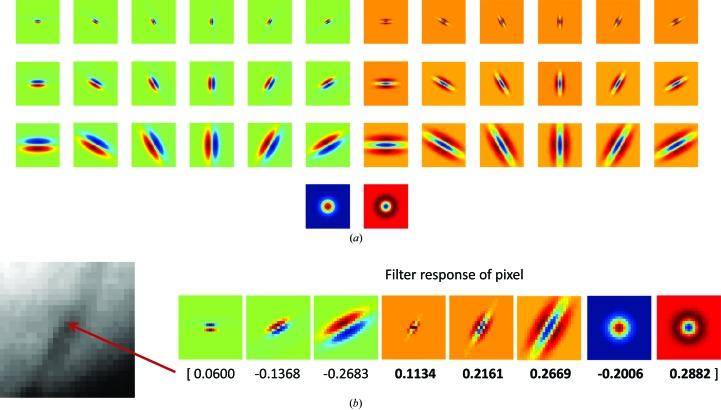
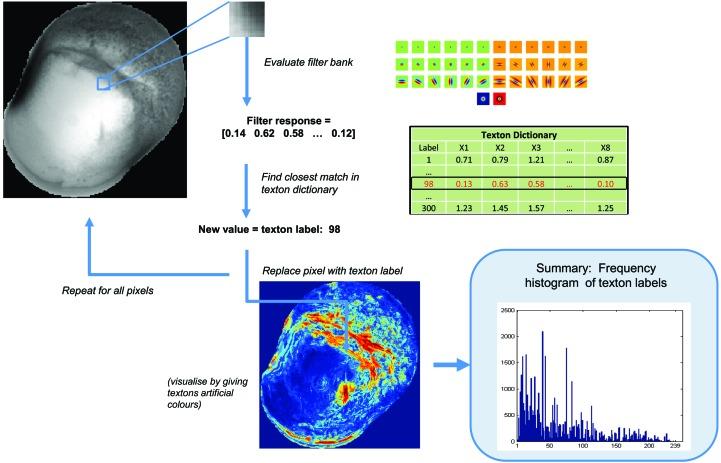
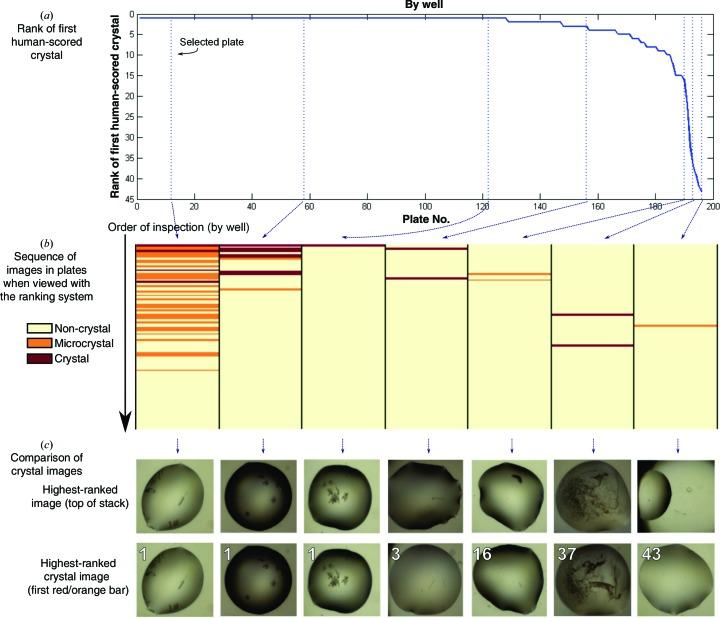
The visual inspection of crystallization experiments is an important yet time-consuming and subjective step in X-ray crystallography. Previously published studies have focused on automatically classifying crystallization droplets into distinct but ultimately arbitrary experiment outcomes; here, a method is described that instead ranks droplets by their likelihood of containing crystals or microcrystals, thereby prioritizing for visual inspection those images that are most likely to contain useful information. The use of textons is introduced to describe crystallization droplets objectively, allowing them to be scored with the posterior probability of a random forest classifier trained against droplets manually annotated for the presence or absence of crystals or microcrystals. Unlike multi-class classification, this two-class system lends itself naturally to unidirectional ranking, which is most useful for assisting sequential viewing because images can be arranged simply by using these scores: this places droplets with probable crystalline behaviour early in the viewing order. Using this approach, the top ten wells included at least one human-annotated crystal or microcrystal for 94% of the plates in a data set of 196 plates imaged with a Minstrel HT system. The algorithm is robustly transferable to at least one other imaging system: when the parameters trained from Minstrel HT images are applied to a data set imaged by the Rock Imager system, human-annotated crystals ranked in the top ten wells for 90% of the plates. Because rearranging images is fundamental to the approach, a custom viewer was written to seamlessly support such ranked viewing, along with another important output of the algorithm, namely the shape of the curve of scores, which is itself a useful overview of the behaviour of the plate; additional features with known usefulness were adopted from existing viewers. Evidence is presented that such ranked viewing of images allows faster but more accurate evaluation of drops, in particular for the identification of microcrystals.
在X射线晶体学中,结晶实验的目视检查是一个重要但耗时且主观的步骤。先前发表的研究主要集中于将结晶液滴自动分类为不同但最终任意的实验结果;本文描述了一种方法,该方法根据液滴包含晶体或微晶的可能性对其进行排序,从而将最有可能包含有用信息的图像优先用于目视检查。引入纹理基元来客观地描述结晶液滴,通过针对有晶体或微晶存在与否进行人工标注的液滴训练的随机森林分类器的后验概率对它们进行评分。与多类分类不同,这种两类系统自然适用于单向排序,这对于辅助顺序查看最为有用,因为可以简单地使用这些分数来排列图像:这使得具有可能结晶行为的液滴在查看顺序中排在靠前位置。使用这种方法,在使用Minstrel HT系统成像的196个板的数据集里,对于94%的板,排名前十的孔中至少包含一个人工标注的晶体或微晶。该算法可稳健地转移到至少另一个成像系统:当将从Minstrel HT图像训练的参数应用于由Rock Imager系统成像的数据集时,对于90%的板,人工标注的晶体排在前十的孔中。由于重新排列图像是该方法的基础,因此编写了一个自定义查看器以无缝支持这种排序查看,以及该算法的另一个重要输出,即分数曲线的形状,其本身就是板行为的有用概述;从现有查看器中采用了其他已知有用的功能。有证据表明,这种对图像的排序查看可以更快但更准确地评估液滴,特别是用于微晶的识别。







 Zotero 插件