
CCR2 在 CD14(+)CD16(+)单核细胞上的表达是 HIV 相关神经认知障碍的生物标志物。
CCR2 on CD14(+)CD16(+) monocytes is a biomarker of HIV-associated neurocognitive disorders.
机构信息
Departments of Pathology (D.W.W., J.W.B.), Medicine and Epidemiology & Population Health (K.A.), and Microbiology and Immunology (J.W.B.), The Albert Einstein College of Medicine, Bronx, NY; Departments of Neurology (D.B., S.M.), Neuroscience (S.M.), and Pathology (S.M.), The Icahn School of Medicine at Mount Sinai, New York, NY; and Department of Psychiatry (L.H.R.), University of Illinois at Chicago, IL.
出版信息
Neurol Neuroimmunol Neuroinflamm. 2014 Oct 9;1(3):e36. doi: 10.1212/NXI.0000000000000036. eCollection 2014 Oct.
OBJECTIVE
To evaluate C-C chemokine receptor type 2 (CCR2) on monocyte subsets as a prognostic peripheral blood biomarker of HIV-associated neurocognitive disorders (HAND).
METHODS
We characterized monocyte populations in HIV-infected individuals with and without HAND from 2 cohorts and assessed their transmigration across an in vitro model of the human blood-brain barrier (BBB). We examined CCR2 expression among the monocyte populations as a prognostic/predictive biomarker of HAND and its functional consequences in facilitating monocyte diapedesis.
RESULTS
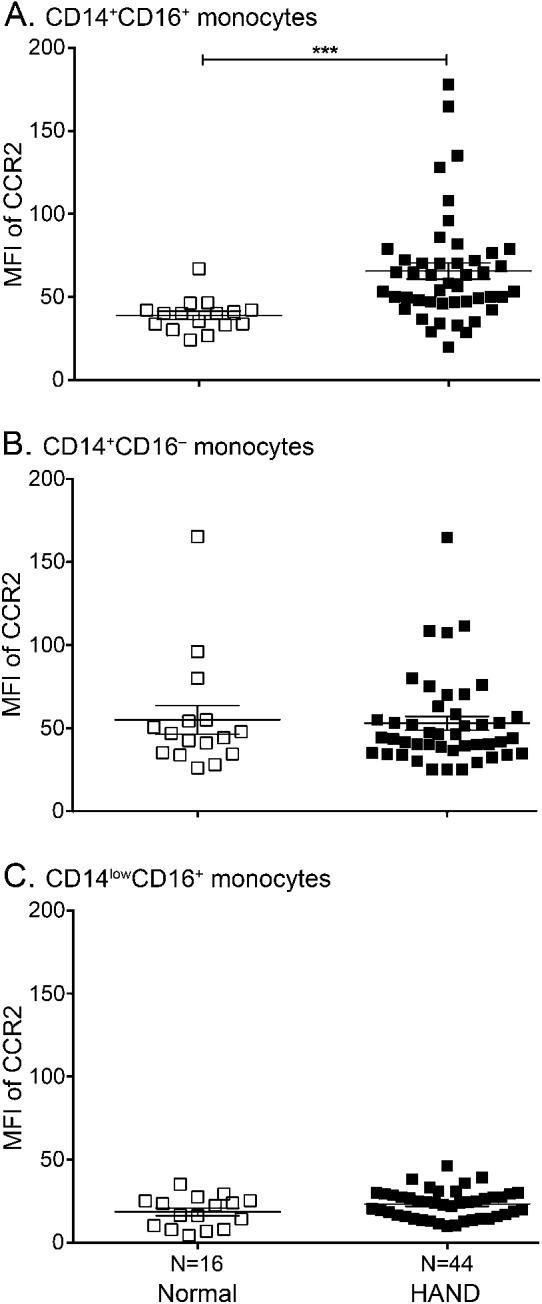
We determined that CCR2 was significantly increased on CD14(+)CD16(+) monocytes in individuals with HAND compared to infected people with normal cognition. CCR2 remained elevated irrespective of the severity of cognitive impairment, combined antiretroviral therapy status, viral load, and current or nadir CD4 T-cell count. There was no association between CCR2 on other monocyte populations and HAND. There was a functional consequence to the increase in CCR2, as CD14(+)CD16(+) monocytes from individuals with HAND transmigrated across our model of the human BBB in significantly higher numbers in response to its ligand chemokine (C-C) motif ligand 2 (CCL2) compared to the cell migration that occurred in people with no cognitive deficits. It should be noted that our study had the limitation of a smaller sample size of unimpaired individuals. In contrast, there was no difference in the transmigration of other monocyte subsets across the BBB in response to CCL2 in seropositive individuals with or without HAND.
CONCLUSIONS
Our findings indicate CCR2 on CD14(+)CD16(+) monocytes is a novel peripheral blood biomarker of HAND.
目的
评估 C-C 趋化因子受体 2(CCR2)在单核细胞亚群上作为 HIV 相关神经认知障碍(HAND)的预后外周血生物标志物的作用。
方法
我们从两个队列中描述了 HAND 患者和无 HAND 的 HIV 感染者的单核细胞群体,并评估了它们在体外血脑屏障(BBB)模型中的迁移能力。我们检查了单核细胞群体上的 CCR2 表达作为 HAND 的预后/预测生物标志物及其在促进单核细胞穿内皮迁移中的功能后果。
结果
我们发现与认知正常的感染者相比,HAND 患者的 CD14(+)CD16(+)单核细胞上 CCR2 显著增加。无论认知障碍的严重程度、联合抗逆转录病毒治疗状态、病毒载量以及当前或最低 CD4 T 细胞计数如何,CCR2 仍然升高。其他单核细胞群体上的 CCR2 与 HAND 之间没有关联。CCR2 的增加具有功能后果,因为 HAND 患者的 CD14(+)CD16(+)单核细胞对其配体趋化因子(C-C)基序配体 2(CCL2)的反应迁移穿过我们的人类 BBB 模型的数量明显高于没有认知缺陷的人的细胞迁移。应该指出的是,我们的研究存在无认知障碍个体样本量较小的局限性。相比之下,在 HAND 患者和无 HAND 的血清阳性个体中,其他单核细胞亚群对 CCL2 的迁移穿过 BBB 没有差异。
结论
我们的研究结果表明,CD14(+)CD16(+)单核细胞上的 CCR2 是 HAND 的新型外周血生物标志物。



 Zotero 插件