
从薄壳山核桃中分离出的产油内生枯草芽孢杆菌 HB1310 及其利用棉秆水解液生产油脂。
An oleaginous endophyte Bacillus subtilis HB1310 isolated from thin-shelled walnut and its utilization of cotton stalk hydrolysate for lipid production.
机构信息
Key Laboratory of Biomass Chemical Engineering of Ministry of Education, Department of Chemical and Biological Engineering, Zhejiang University, Hangzhou, 310027 China ; College of Life Science, Tarim University, Alaer, 843300 Xinjiang China ; Xinjiang Production & Construction Corps Key Laboratory of Protection and Utilization of Biological Resources in Tarim Basin, Tarim University, Alaer, 843300 Xinjiang China.
College of Life Science, Tarim University, Alaer, 843300 Xinjiang China ; Xinjiang Production & Construction Corps Key Laboratory of Protection and Utilization of Biological Resources in Tarim Basin, Tarim University, Alaer, 843300 Xinjiang China.
出版信息
Biotechnol Biofuels. 2014 Oct 14;7(1):152. doi: 10.1186/s13068-014-0152-4. eCollection 2014.
BACKGROUND
Third generation biodiesel processing from microbial lipids using low-cost lignocellulosic feedstocks has attracted much attention. Endophytes isolated from oleaginous plants possibly have the capacity to accumulate lipids similar to the hosts. However, little work has been reported in terms of endophytic bacteria isolation from oleaginous plants and their lipid production using lignocellulosic hydrolysate as substrate.
RESULTS
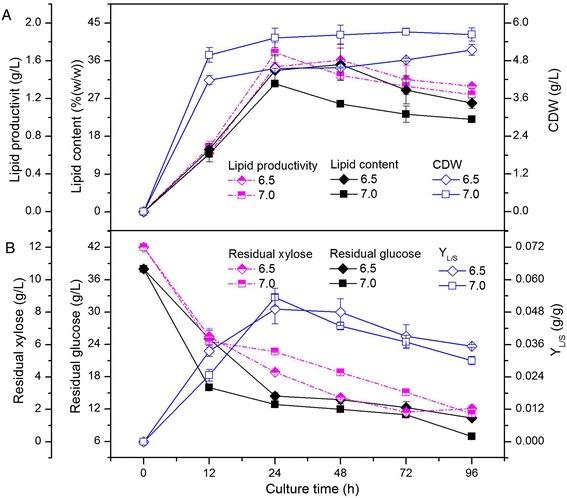
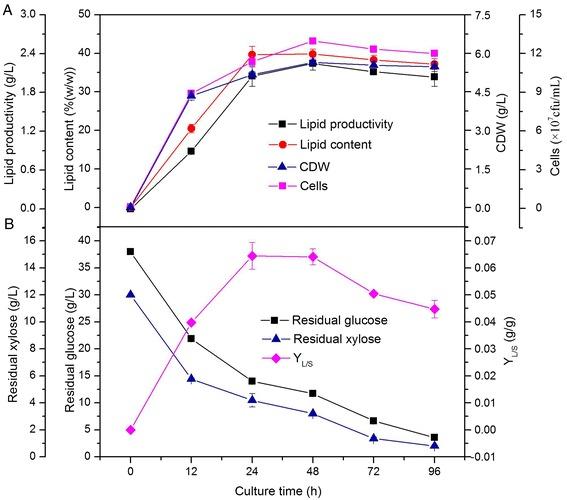
A new oleaginous endophyte HB1310 has been isolated from the thin-shelled walnut, and identified as Bacillus subtilis on the basis of both 16S rDNA gene sequencing and examination of its physiological and biochemical properties. This strain effectively accumulates cellular lipids using cotton stalk hydrolysate as a substrate. The optimum C/N ratio, culture temperature, and pH value were determined to be 50/1, 30°C, and 6.5, respectively. Batch fermentation was conducted in a bioreactor using these parameters. Satisfactory production, with a maximum lipid productivity of 2.3 g/L, lipid content of 39.8% (w/w), and cell dry weight (CDW) of 5.7 g/L, was obtained at a culture time of 48 h. Variations in the fluorescent intensity and lipid inclusion formation of cells collected at different sampling times illustrate the potential of this bacterium to be useful for cellular lipid production. The fatty acid profile of the produced bacterial lipids showed that the major constituents are myristic, palmitic, stearic, oleic, and linoleic acids with an estimated cetane number of about 61.8, indicating that this strain may be suitable for biodiesel production.
CONCLUSIONS
The present investigation is the first report of an oleaginous endophytic bacterium isolated from the thin-shelled walnut. This strain is capable of producing high lipid contents rapidly using cotton stalk hydrolysate as a substrate, and its lipids are suitable for use as the feedstock for biodiesel production.
背景
利用低成本的木质纤维素原料从微生物油脂中生产第三代生物柴油引起了广泛关注。从产油植物中分离出的内生菌可能具有与宿主相似的积累油脂的能力。然而,从产油植物中分离内生细菌并利用木质纤维素水解物作为底物生产油脂的工作报道较少。
结果
从薄壳核桃中分离到一株新的产油内生菌 HB1310,并根据 16S rDNA 基因测序和生理生化特性鉴定为枯草芽孢杆菌。该菌株能有效地利用棉秆水解物作为底物积累细胞油脂。确定了最佳 C/N 比、培养温度和 pH 值分别为 50/1、30°C 和 6.5。在生物反应器中使用这些参数进行分批发酵。在 48 小时的培养时间内,获得了满意的生产结果,最大脂生产率为 2.3 g/L,脂含量为 39.8%(w/w),细胞干重(CDW)为 5.7 g/L。不同取样时间收集的细胞荧光强度和脂滴形成的变化表明,该细菌具有用于细胞脂生产的潜力。所产生的细菌脂的脂肪酸组成表明,主要成分是肉豆蔻酸、棕榈酸、硬脂酸、油酸和亚油酸,估算的十六烷值约为 61.8,表明该菌株可能适合生产生物柴油。
结论
本研究首次从薄壳核桃中分离出一株产油内生细菌。该菌株能利用棉秆水解物作为底物快速生产高含量的油脂,其油脂适合用作生物柴油生产的原料。



 Zotero 插件