
犬细小病毒的系统发育和全基因组深度测序分析揭示了与野外变体的共同感染以及一种近期重组毒株的出现。
Phylogenetic and genome-wide deep-sequencing analyses of canine parvovirus reveal co-infection with field variants and emergence of a recent recombinant strain.
作者信息
Pérez Ruben, Calleros Lucía, Marandino Ana, Sarute Nicolás, Iraola Gregorio, Grecco Sofia, Blanc Hervé, Vignuzzi Marco, Isakov Ofer, Shomron Noam, Carrau Lucía, Hernández Martín, Francia Lourdes, Sosa Katia, Tomás Gonzalo, Panzera Yanina
机构信息
Sección Genética Evolutiva, Instituto de Biología, Facultad de Ciencias, Universidad de la República, Montevideo, Uruguay.
Institut Pasteur, Viral Populations and Pathogenesis Unit, Centre National de la Recherche Scientifique, Paris, France.
出版信息
PLoS One. 2014 Nov 3;9(11):e111779. doi: 10.1371/journal.pone.0111779. eCollection 2014.
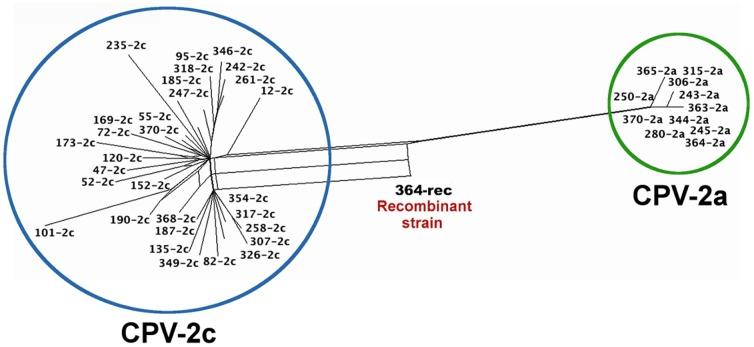
Canine parvovirus (CPV), a fast-evolving single-stranded DNA virus, comprises three antigenic variants (2a, 2b, and 2c) with different frequencies and genetic variability among countries. The contribution of co-infection and recombination to the genetic variability of CPV is far from being fully elucidated. Here we took advantage of a natural CPV population, recently formed by the convergence of divergent CPV-2c and CPV-2a strains, to study co-infection and recombination. Complete sequences of the viral coding region of CPV-2a and CPV-2c strains from 40 samples were generated and analyzed using phylogenetic tools. Two samples showed co-infection and were further analyzed by deep sequencing. The sequence profile of one of the samples revealed the presence of CPV-2c and CPV-2a strains that differed at 29 nucleotides. The other sample included a minor CPV-2a strain (13.3% of the viral population) and a major recombinant strain (86.7%). The recombinant strain arose from inter-genotypic recombination between CPV-2c and CPV-2a strains within the VP1/VP2 gene boundary. Our findings highlight the importance of deep-sequencing analysis to provide a better understanding of CPV molecular diversity.
犬细小病毒(CPV)是一种快速进化的单链DNA病毒,包含三种抗原变体(2a、2b和2c),在不同国家具有不同的频率和遗传变异性。共感染和重组对CPV遗传变异性的贡献尚未完全阐明。在此,我们利用一个由不同的CPV-2c和CPV-2a毒株汇聚而成的天然CPV群体,来研究共感染和重组。我们生成了40个样本的CPV-2a和CPV-2c毒株病毒编码区的完整序列,并使用系统发育工具进行分析。两个样本显示存在共感染,并通过深度测序进一步分析。其中一个样本的序列图谱显示存在CPV-2c和CPV-2a毒株,它们在29个核苷酸处存在差异。另一个样本包括一个次要的CPV-2a毒株(占病毒群体的13.3%)和一个主要的重组毒株(86.7%)。该重组毒株源自VP1/VP2基因边界内CPV-2c和CPV-2a毒株之间的基因型间重组。我们的研究结果突出了深度测序分析对于更好地理解CPV分子多样性的重要性。

 Zotero 插件