
一些新型来曲唑类似物的设计、合成、对接研究及细胞毒性活性评估
Design, synthesis, docking study and cytotoxic activity evaluation of some novel letrozole analogs.
作者信息
Vosooghi Mohsen, Firoozpour Loghman, Rodaki Abolfazl, Pordeli Mahboobeh, Safavi Maliheh, Ardestani Sussan K, Dadgar Armin, Asadipour Ali, Moshafi Mohammad Hassan, Foroumadi Alireza
机构信息
Department of Medicinal Chemistry, Faculty of Pharmacy, Tehran University of Medical Sciences, Tehran, Iran.
Drug Design and Development Research Center, Tehran University of Medical Sciences, Tehran, Iran.
出版信息
Daru. 2014 Dec 24;22(1):83. doi: 10.1186/s40199-014-0083-4.
BACKGROUND
Breast cancer is the most common type of female cancer. One class of hormonal therapy for breast cancer drugs -non steroidal aromatase inhibitors- are triazole analogues. In this work, some derivatives of these drugs was designed and synthesized. All synthesized compounds were evaluated for their cytotoxic activities on breast cancer cell lines (MDA-MB-231, T47D and MCF-7).
METHODS
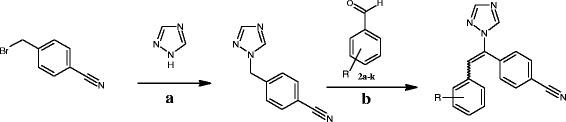
Our synthetic route for designed compounds started from 4-bromotolunitrile which was reacted with 1H-1,2,4-triazole to afford 4-(4-cyanobenzyl)-1,2,4-triazole. The reaction of later compound with aromatic aldehydes led to formation of the designed compounds. Eleven novel derivatives 1a-k were tested for their cytotoxic activities on three human breast cancer cell lines.
RESULTS
Among the synthesized compound, 4-[2-(3-chlorophenyl)-1-(1H-1,2,4-triazol-1-yl)ethenyl]benzonitrile (1c) showed the highest activity against MCF-7 and MDA-MB-231 cell lines and 4-[2-(4-methoxyphenyl)-1-(1H-1,2,4-triazol-1-yl)ethenyl]benzonitrile (1 h) exhibited highest activity against T47D cell line. According to cytotoxic activities results, compound 4-[2-(4-dimethylamino)-1-(1H-1,2,4-triazol-1-yl)ethenyl]benzonitrile (1 k) showed comparative activity against T47D and MDA-MB-231 cell lines with compound (1 h) and our reference drug Etoposide.
CONCLUSION
In the process of anti-cancer drug discovery, to find new potential anti-breast cancer agents, we designed and synthesized a novel series of letrozole analogs. Cytotoxicity evaluation revealed that compounds (1c) and (1 k) were the most potent compounds with comparative activity with Etoposide. The results revealed that π-π interactions are responsible for the enzyme inhibitions of compounds (1 c) and (1 k).
背景
乳腺癌是女性最常见的癌症类型。一类用于乳腺癌治疗的激素药物——非甾体芳香酶抑制剂——是三唑类似物。在本研究中,设计并合成了这些药物的一些衍生物。对所有合成化合物进行了针对乳腺癌细胞系(MDA-MB-231、T47D和MCF-7)的细胞毒性活性评估。
方法
我们设计化合物的合成路线从4-溴甲苯腈开始,其与1H-1,2,4-三唑反应得到4-(4-氰基苄基)-1,2,4-三唑。后一种化合物与芳香醛反应生成设计的化合物。测试了11种新型衍生物1a-k对三种人乳腺癌细胞系的细胞毒性活性。
结果
在合成的化合物中,4-[2-(3-氯苯基)-1-(1H-1,2,4-三唑-1-基)乙烯基]苄腈(1c)对MCF-7和MDA-MB-231细胞系表现出最高活性,4-[2-(4-甲氧基苯基)-1-(1H-1,2,4-三唑-1-基)乙烯基]苄腈(1h)对T47D细胞系表现出最高活性。根据细胞毒性活性结果,化合物4-[2-(4-二甲基氨基)-1-(1H-1,2,4-三唑-1-基)乙烯基]苄腈(1k)对T47D和MDA-MB-231细胞系表现出与化合物(1h)和我们的参考药物依托泊苷相当的活性。
结论
在抗癌药物发现过程中,为寻找新的潜在抗乳腺癌药物,我们设计并合成了一系列新型来曲唑类似物。细胞毒性评估显示,化合物(1c)和(1k)是最有效的化合物,与依托泊苷具有相当的活性。结果表明,π-π相互作用是化合物(1c)和(1k)抑制酶活性的原因。


 Zotero 插件