
通过对免疫球蛋白G1进行[(13)C,(15)N]-N-乙酰葡糖胺标记,在多个N-聚糖重塑步骤中观察到的分子内N-聚糖/多肽相互作用。
Intramolecular N-glycan/polypeptide interactions observed at multiple N-glycan remodeling steps through [(13)C,(15)N]-N-acetylglucosamine labeling of immunoglobulin G1.
作者信息
Barb Adam W
机构信息
Roy J. Carver Department of Biochemistry, Biophysics and Molecular Biology, Iowa State University , Ames, Iowa 50011, United States.
出版信息
Biochemistry. 2015 Jan 20;54(2):313-22. doi: 10.1021/bi501380t. Epub 2014 Dec 31.
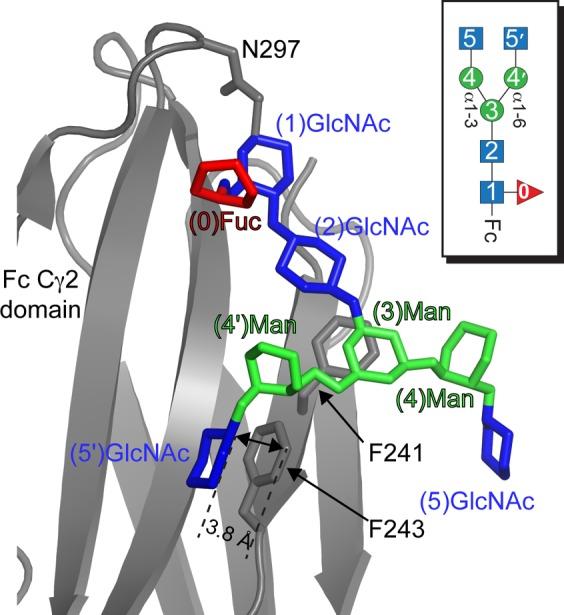
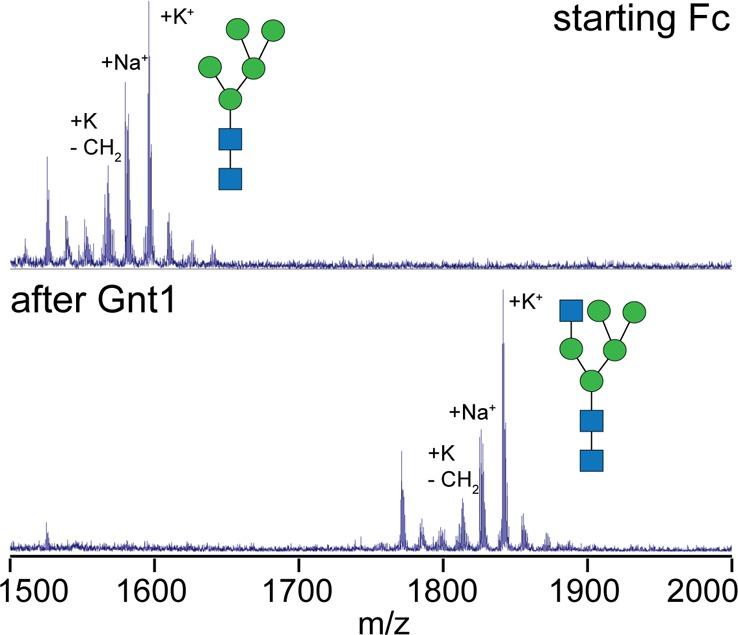
Asparagine-linked (N) glycosylation is a common eukaryotic protein modification that affects protein folding, function, and stability through intramolecular interactions between N-glycan and polypeptide residues. Attempts to characterize the structure-activity relationship of each N-glycan are hindered by inherent properties of the glycoprotein, including glycan conformational and compositional heterogeneity. These limitations can be addressed by using a combination of nuclear magnetic resonance techniques following enzymatic glycan remodeling to simultaneously generate homogeneous glycoforms. However, widely applicable methods do not yet exist. To address this technological gap, immature glycoforms of the immunoglobulin G1 fragment crystallizable (Fc) were isolated in a homogeneous state and enzymatically remodeled with [(13)C,(15)N]-N-acetylglucosamine (GlcNAc). UDP-[(13)C,(15)N]GlcNAc was synthesized enzymatically in a one-pot reaction from [(13)C]glucose and [(15)N-amido]glutamine. Modifying Fc with recombinantly expressed glycosyltransferases (Gnt1 and Gnt2) and UDP-[(13)C,(15)N]GlcNAc resulted in complete glycoform conversion as judged by mass spectrometry. Two-dimensional heteronuclear single-quantum coherence spectra of the Gnt1 product, containing a single [(13)C,(15)N]GlcNAc residue on each N-glycan, showed that the N-glycan is stabilized through interactions with polypeptide residues. Similar spectra of homogeneous glycoforms, halted at different points along the N-glycan remodeling pathway, revealed the presence of an increased level of interaction between the N-glycan and polypeptide at each step, including mannose trimming, as the N-glycan was converted to a complex-type, biantennary form. Thus, conformational restriction increases as Fc N-glycan maturation proceeds. Gnt1 and Gnt2 catalyze fundamental reactions in the synthesis of every glycoprotein with a complex-type N-glycan; thus, the strategies presented herein can be applied to a broad range of glycoprotein studies.
天冬酰胺连接的(N)糖基化是一种常见的真核生物蛋白质修饰,它通过N-聚糖与多肽残基之间的分子内相互作用影响蛋白质折叠、功能和稳定性。由于糖蛋白的固有特性,包括聚糖构象和组成的异质性,对每个N-聚糖的结构-活性关系进行表征的尝试受到阻碍。通过在酶促聚糖重塑后使用核磁共振技术组合来同时生成均一糖型,可以解决这些限制。然而,尚未存在广泛适用的方法。为了弥补这一技术差距,免疫球蛋白G1片段可结晶(Fc)的未成熟糖型以均一状态分离,并用[(13)C,(15)N]-N-乙酰葡糖胺(GlcNAc)进行酶促重塑。UDP-[(13)C,(15)N]GlcNAc通过[(13)C]葡萄糖和[(15)N-酰胺基]谷氨酰胺在一锅反应中酶促合成。用重组表达的糖基转移酶(Gnt1和Gnt2)和UDP-[(13)C,(15)N]GlcNAc修饰Fc,通过质谱判断导致了完全的糖型转化。Gnt1产物的二维异核单量子相干谱,每个N-聚糖上含有一个[(13)C,(15)N]GlcNAc残基,表明N-聚糖通过与多肽残基的相互作用而稳定。沿着N-聚糖重塑途径在不同点停止的均一糖型的类似谱显示,随着N-聚糖转化为复合型双天线形式,在每个步骤中,包括甘露糖修剪,N-聚糖与多肽之间的相互作用水平增加。因此,随着Fc N-聚糖成熟的进行,构象限制增加。Gnt1和Gnt2催化每个具有复合型N-聚糖的糖蛋白合成中的基本反应;因此,本文提出的策略可应用于广泛的糖蛋白研究。




 Zotero 插件