
乌干达鼠疫疫源地小型哺乳动物和跳蚤群落的季节性波动:有证据表明尼罗多齿巨鼠和麝鼩属物种是鼠疫耶尔森菌传播的关键宿主。
Seasonal fluctuations of small mammal and flea communities in a Ugandan plague focus: evidence to implicate Arvicanthis niloticus and Crocidura spp. as key hosts in Yersinia pestis transmission.
作者信息
Moore Sean M, Monaghan Andrew, Borchert Jeff N, Mpanga Joseph T, Atiku Linda A, Boegler Karen A, Montenieri John, MacMillan Katherine, Gage Kenneth L, Eisen Rebecca J
机构信息
National Center for Atmospheric Research, 3090 Center Green Drive, Boulder, 80301, CO, USA.
Division of Vector-Borne Diseases, Centers for Disease Control and Prevention, 3156 Rampart Road, Fort Collins, 80522, CO, USA.
出版信息
Parasit Vectors. 2015 Jan 8;8:11. doi: 10.1186/s13071-014-0616-1.
BACKGROUND
The distribution of human plague risk is strongly associated with rainfall in the tropical plague foci of East Africa, but little is known about how the plague bacterium is maintained during periods between outbreaks or whether environmental drivers trigger these outbreaks. We collected small mammals and fleas over a two year period in the West Nile region of Uganda to examine how the ecological community varies seasonally in a region with areas of both high and low risk of human plague cases.
METHODS
Seasonal changes in the small mammal and flea communities were examined along an elevation gradient to determine whether small mammal and flea populations exhibit differences in their response to seasonal fluctuations in precipitation, temperature, and crop harvests in areas within (above 1300 m) and outside (below 1300 m) of a model-defined plague focus.
RESULTS
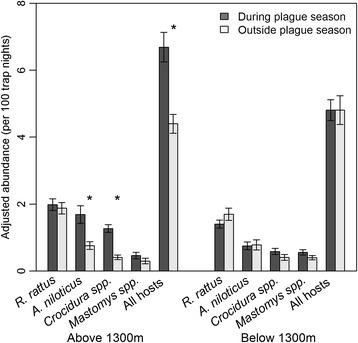
The abundance of two potential enzootic host species (Arvicanthis niloticus and Crocidura spp.) increased during the plague season within the plague focus, but did not show the same increase at lower elevations outside this focus. In contrast, the abundance of the domestic rat population (Rattus rattus) did not show significant seasonal fluctuations regardless of locality. Arvicanthis niloticus abundance was negatively associated with monthly precipitation at a six month lag and positively associated with current monthly temperatures, and Crocidura spp. abundance was positively associated with precipitation at a three month lag and negatively associated with current monthly temperatures. The abundance of A. niloticus and Crocidura spp. were both positively correlated with the harvest of millet and maize.
CONCLUSIONS
The association between the abundance of several small mammal species and rainfall is consistent with previous models of the timing of human plague cases in relation to precipitation in the West Nile region. The seasonal increase in the abundance of key potential host species within the plague focus, but not outside of this area, suggests that changes in small mammal abundance may create favorable conditions for epizootic transmission of Y. pestis which ultimately may increase risk of human cases in this region.
背景
在东非热带鼠疫疫源地,人类鼠疫风险分布与降雨密切相关,但对于鼠疫杆菌在疫情间歇期如何维持,以及环境驱动因素是否引发这些疫情,人们了解甚少。我们在乌干达西尼罗河地区进行了为期两年的小型哺乳动物和跳蚤采集,以研究在一个存在人类鼠疫病例高风险和低风险区域的地区,生态群落如何随季节变化。
方法
沿着海拔梯度研究小型哺乳动物和跳蚤群落的季节性变化,以确定在模型定义的鼠疫疫源地内(海拔1300米以上)和外(海拔1300米以下)的区域,小型哺乳动物和跳蚤种群对降水、温度和作物收成季节性波动的反应是否存在差异。
结果
在鼠疫疫源地内,两种潜在的动物疫源宿主物种(尼罗多齿鼠和麝鼩属)的数量在鼠疫季节有所增加,但在该疫源地以外的低海拔地区未出现同样的增加。相比之下,家鼠(褐家鼠)种群数量无论在何处都未表现出明显的季节性波动。尼罗多齿鼠的数量与滞后六个月的月降水量呈负相关,与当月温度呈正相关,而麝鼩属的数量与滞后三个月的降水量呈正相关,与当月温度呈负相关。尼罗多齿鼠和麝鼩属的数量均与小米和玉米的收成呈正相关。
结论
几种小型哺乳动物物种数量与降雨之间的关联与西尼罗河地区先前关于人类鼠疫病例发生时间与降水关系的模型一致。鼠疫疫源地内关键潜在宿主物种数量的季节性增加,而该区域以外则没有,这表明小型哺乳动物数量的变化可能为鼠疫耶尔森菌的动物间传播创造有利条件,最终可能增加该地区人类感染病例的风险。


 Zotero 插件