
强制利尿(18)F - 氟脱氧葡萄糖正电子发射断层扫描/对比增强在膀胱憩室癌检测中的应用
Forced diuresis (18)F-fluorodeoxyglucose positron emission tomography/contrast enhanced in detection of carcinoma of urinary bladder diverticulum.
作者信息
Soundararajan Ramya, Singh Harmandeep, Arora Saurabh, Nayak Brusabhanu, Shamim Shamim Ahmed, Bal Chandrasekhar, Kumar Rakesh
机构信息
Department of Nuclear Medicine, All India Institute of Medical Sciences, Ansari Nagar, New Delhi, India.
出版信息
Indian J Nucl Med. 2015 Jan-Mar;30(1):86-8. doi: 10.4103/0972-3919.147559.
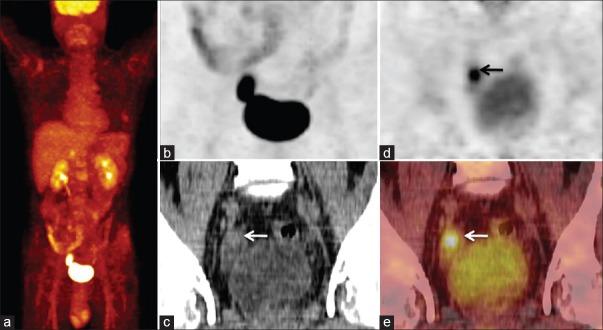
Urinary bladder diverticular carcinomas are uncommon with a lesser incidence of 0.8-10% and its diagnosis still remains a challenge. Cystoscopy is the most reliable method, but evaluating diverticulum with narrow orifices is difficult. Before the initiation of appropriate treatment, proper detection of bladder diverticular carcinoma and its locoregional and distant sites of involvement is necessary. Here, we present a case of 48-year-old male with urinary bladder diverticular carcinoma detected by forced diuretic (18)F-fluorodeoxyglucose positron emission tomography/computerized tomography ((18)F-FDG PET/CT). This case also highlights the significance of forced diuretic (18)F-FDG PET/CT in the detection, staging, and response evaluation of bladder diverticular carcinoma.
膀胱憩室癌并不常见,发病率较低,为0.8%-10%,其诊断仍然是一项挑战。膀胱镜检查是最可靠的方法,但评估开口狭窄的憩室很困难。在开始适当治疗之前,正确检测膀胱憩室癌及其局部和远处受累部位是必要的。在此,我们报告一例48岁男性膀胱憩室癌患者,通过强制利尿(18)F-氟脱氧葡萄糖正电子发射断层扫描/计算机断层扫描((18)F-FDG PET/CT)检测到。该病例还突出了强制利尿(18)F-FDG PET/CT在膀胱憩室癌检测、分期及疗效评估中的重要性。

 Zotero 插件