
拔牙后种植术中的数字设备:一例临床病例报告
Digital device in postextraction implantology: a clinical case presentation.
作者信息
Borgonovo A E, Rigaldo F, Battaglia D, Re D, Giannì A B
机构信息
School of Oral Surgery, Istituto Stomatologico Italiano, University of Milan, Milan, Italy.
Department of Oral Rehabilitation, Istituto Stomatologico Italiano, Milan, Italy.
出版信息
Case Rep Dent. 2014;2014:327368. doi: 10.1155/2014/327368. Epub 2014 Dec 29.
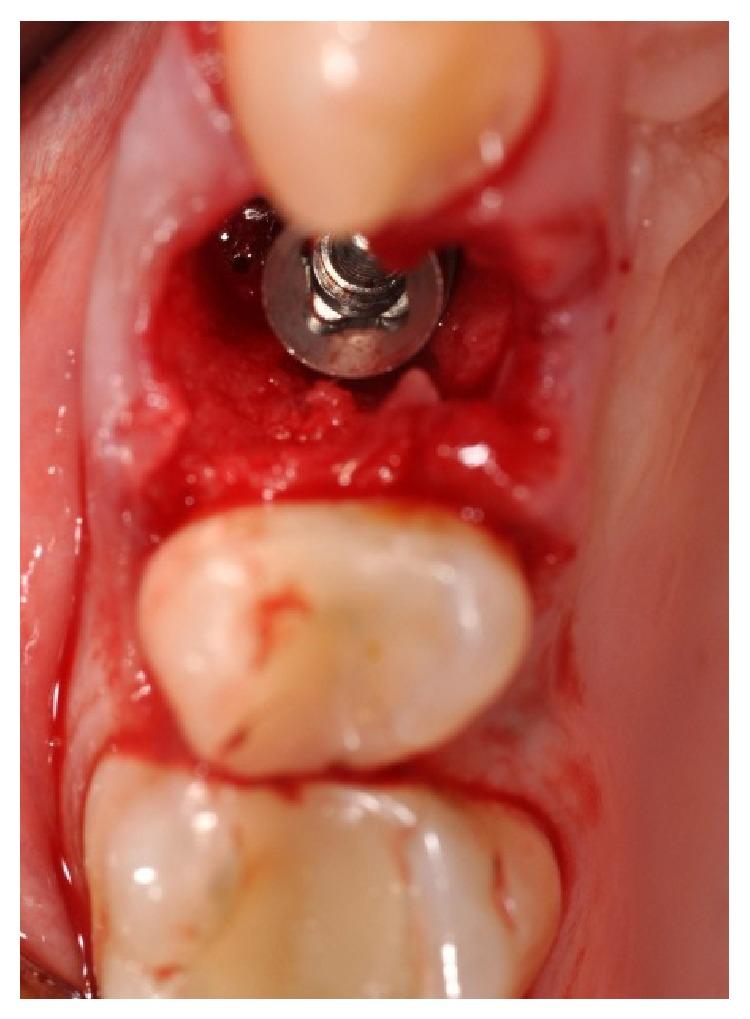
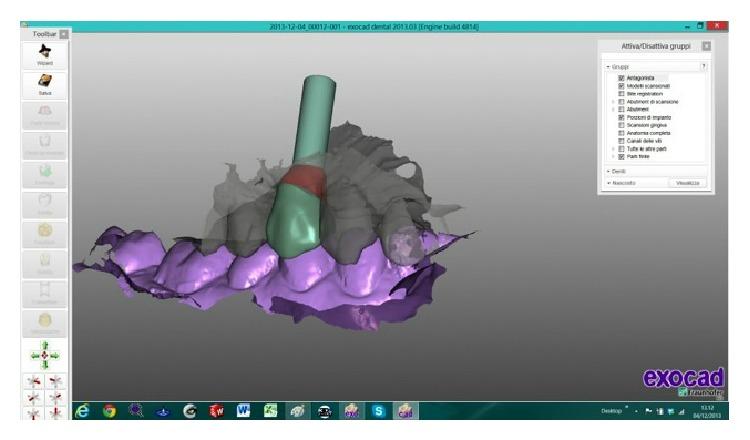
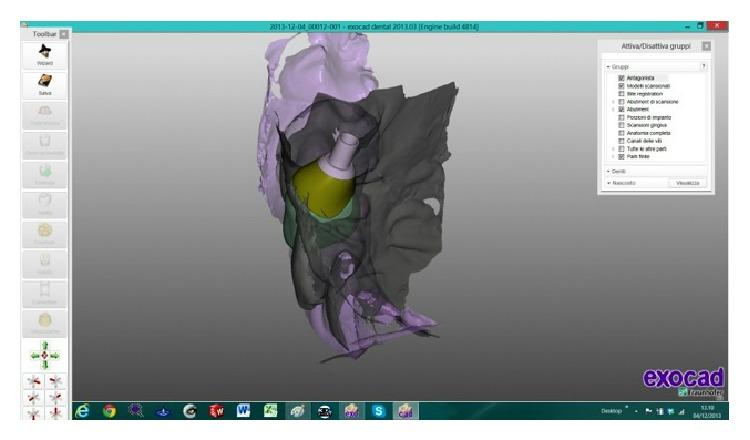
Aim. The aim of this work is to describe a case of immediate implant placement after extraction of the upper right first premolar, with the use of CAD/CAM technology, which allows an early digital impression of the implant site with an intraoral scanner (MHT 3D Progress, Verona, Italy). Case Report. A 46-year-old female was referred with a disorder caused by continuous debonding of the prosthetic crown on the upper right first premolar. Clinically, there were no signs, and the evaluation of the periapical radiograph showed a fracture of the root, with a mesial well-defined lesion of the hard tissue of the upper right first premolar, as the radiolucent area affected the root surface of the tooth. It was decided, in accordance with the patient, that the tooth would be extracted and the implant (Primer, Edierre implant system, Genoa, Italy) with diameter of 4.2 mm and length of 13 mm would be inserted. After the insertion of the implant, it was screwed to the scan abutment, and a scan was taken using an intraoral scanner (MHT 3D Progress, Verona, Italy). The scanned images were processed with CAD/CAM software (Exocad DentalCAD, Darmstadt, Germany) and the temporary crown was digitally drawn (Dental Knowledge, Milan, Italy) and then sent to the milling machine for production with a composite monoblock. After 4 months, when the implant was osteointegrated, it was not necessary to take another dental impression, and the definitive crown could be screwed in. Conclusion. The CAD/CAM technology is especially helpful in postextraction implant for aesthetic rehabilitation, as it is possible to immediately fix a provisional crown with an anatomic shape that allows an optimal healing process of the tissues. Moreover, the removal of healing abutments, and the use of impression copings, impression materials, and dental stone became unnecessary, enabling the reduction of the chair time, component cost, and patient's discomfort. However, it is still necessary for scientific research to continue to carry out studies on this procedure, in order to improve the accuracy, the reliability, and the reproducibility of the results.
目的。本研究旨在描述一例右上第一前磨牙拔除后即刻种植的病例,采用计算机辅助设计/计算机辅助制造(CAD/CAM)技术,该技术可通过口腔内扫描仪(MHT 3D Progress,意大利维罗纳)对种植部位进行早期数字化印模。病例报告。一名46岁女性因右上第一前磨牙修复冠持续脱粘导致的病症前来就诊。临床检查无异常体征,根尖片评估显示牙根骨折,右上第一前磨牙硬组织近中边界清晰的病变,因为透射区累及牙根表面。经与患者商议,决定拔除患牙并植入直径4.2毫米、长度13毫米的种植体(Primer,Edierre种植系统,意大利热那亚)。种植体植入后,旋紧扫描基台,使用口腔内扫描仪(MHT 3D Progress,意大利维罗纳)进行扫描。扫描图像用CAD/CAM软件(Exocad DentalCAD,德国达姆施塔特)处理,临时冠通过数字化方式绘制(Dental Knowledge,意大利米兰),然后发送至铣床用复合整体块制作。4个月后,种植体实现骨整合,无需再次取牙印模,即可旋入最终冠。结论。CAD/CAM技术在拔牙后种植的美学修复中特别有用,因为可以立即固定具有解剖形状的临时冠,有利于组织的最佳愈合过程。此外,无需移除愈合基台,也无需使用印模帽、印模材料和牙科石膏,从而减少了椅旁时间、部件成本和患者不适。然而,为了提高结果的准确性、可靠性和可重复性,仍有必要继续对此方法开展科学研究。






 Zotero 插件