
齐墩果酸对单核细胞增生李斯特菌、粪肠球菌和屎肠球菌的抗菌作用。
Antimicrobial action of oleanolic acid on Listeria monocytogenes, Enterococcus faecium, and Enterococcus faecalis.
作者信息
Kim Sejeong, Lee Heeyoung, Lee Soomin, Yoon Yohan, Choi Kyoung-Hee
机构信息
Department of Food and Nutrition, Sookmyung Women's University, Seoul, Korea.
Department of Oral Microbiology, College of Dentistry, Wonkwang University, Iksan, Jeonbuk, South Korea.
出版信息
PLoS One. 2015 Mar 10;10(3):e0118800. doi: 10.1371/journal.pone.0118800. eCollection 2015.
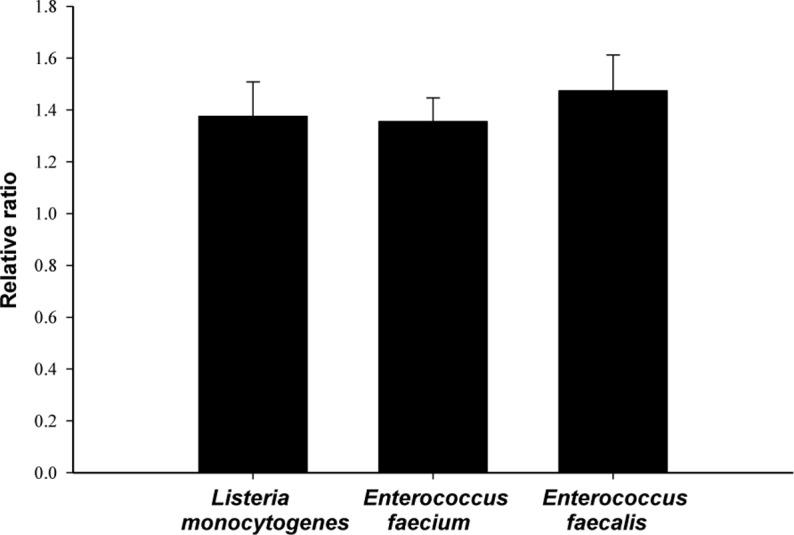
This study investigated the antimicrobial action of oleanolic acid against Listeria monocytogenes, Enterococcus faecium, and Enterococcus faecalis. To determine the cytotoxicity of oleanolic acid, HEp-2 cells were incubated with oleanolic acid at 37°C. MICs (minimal inhibition concentrations) for L. monocytogenes, E. faecium, and E. faecalis were determined using two-fold microdilutions of oleanolic acid, and bacterial cell viability was then assessed by exposing the bacteria to oleanolic acid at 2 × MIC. To investigate the mode of antimicrobial action of oleanolic acid, we measured leakage of compounds absorbing at 280 nm, along with propidium iodide uptake. Scanning electron microscope (SEM) images were also analysed. The viability of HEp-2 cells decreased (P < 0.05) at oleanolic acid concentrations greater than 128 μg mL(-1). The MICs were 16-32 μg mL(-1) for L. monocytogenes and 32-64 μg mL(-1) for E. faecium and E. faecalis, and bacterial cell viability decreased (P < 0.05) about 3-4 log CFU mL(-1) after exposure to 2 × MIC of oleanolic acid. Leakage of 280 nm absorbing materials and propidium iodide uptake was higher in oleanolic acid -treated cells than in the control. The cell membrane was damaged in oleanolic acid-treated cells, but the control group had intact cell membrane in SEM images. The results indicate that oleanolic acid can kill L. monocytogenes, E. faecium, and E. faecalis by destroying the bacterial cell membrane.
本研究调查了齐墩果酸对单核细胞增生李斯特菌、粪肠球菌和屎肠球菌的抗菌作用。为确定齐墩果酸的细胞毒性,将人喉表皮样癌细胞(HEp-2细胞)与齐墩果酸在37℃下孵育。使用齐墩果酸的两倍微量稀释法测定单核细胞增生李斯特菌、粪肠球菌和屎肠球菌的最低抑菌浓度(MICs),然后通过将细菌暴露于2×MIC的齐墩果酸中来评估细菌细胞活力。为研究齐墩果酸的抗菌作用模式,我们测量了在280nm处有吸收的化合物的泄漏情况以及碘化丙啶的摄取情况。还分析了扫描电子显微镜(SEM)图像。当齐墩果酸浓度大于128μg mL⁻¹时,HEp-2细胞的活力下降(P < 0.05)。单核细胞增生李斯特菌的MICs为16 - 32μg mL⁻¹,粪肠球菌和屎肠球菌的MICs为32 - 64μg mL⁻¹,在暴露于2×MIC的齐墩果酸后,细菌细胞活力下降(P < 0.05)约3 - 4 log CFU mL⁻¹。在经齐墩果酸处理的细胞中,280nm吸收物质的泄漏和碘化丙啶的摄取高于对照组。在扫描电子显微镜图像中,经齐墩果酸处理的细胞的细胞膜受损,但对照组的细胞膜完整。结果表明,齐墩果酸可通过破坏细菌细胞膜杀死单核细胞增生李斯特菌、粪肠球菌和屎肠球菌。



 Zotero 插件