
钠氢交换体1型诱导的骨桥蛋白表达促进心肌细胞肥大。
Na+/H+ exchanger isoform 1-induced osteopontin expression facilitates cardiomyocyte hypertrophy.
作者信息
Mohamed Iman A, Gadeau Alain-Pierre, Fliegel Larry, Lopaschuk Gary, Mlih Mohamed, Abdulrahman Nabeel, Fillmore Natasha, Mraiche Fatima
机构信息
College of Pharmacy, Qatar University, Doha, Qatar.
University of Bordeaux, Adaptation Cardiovasculaire à L'ischémie, UMR1034, Pessac, France.
出版信息
PLoS One. 2015 Apr 17;10(4):e0123318. doi: 10.1371/journal.pone.0123318. eCollection 2015.
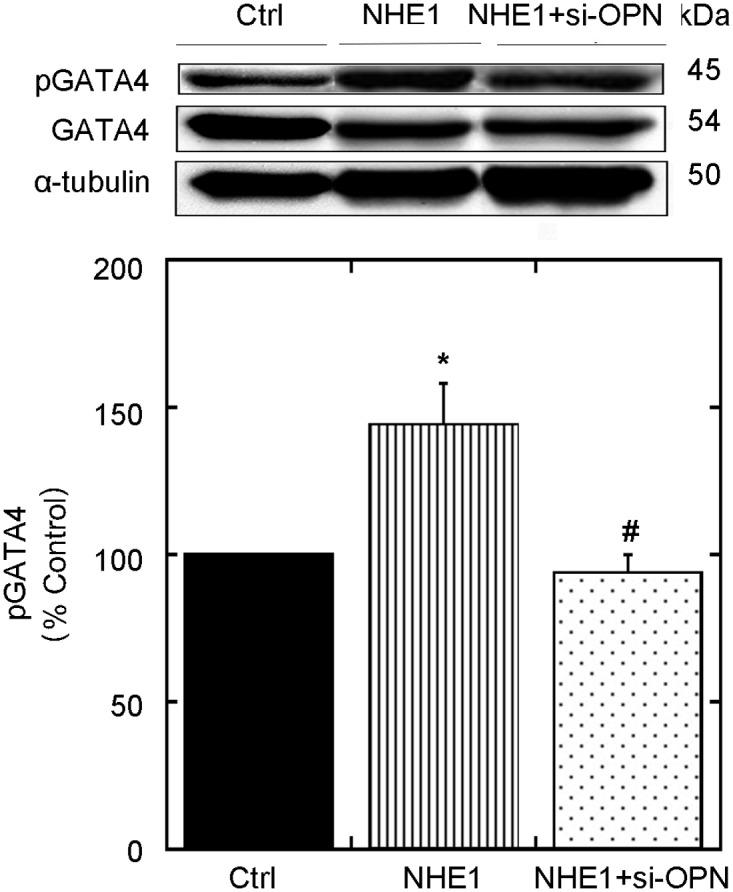
Enhanced expression and activity of the Na+/H+ exchanger isoform 1 (NHE1) has been implicated in cardiomyocyte hypertrophy in various experimental models. The upregulation of NHE1 was correlated with an increase in osteopontin (OPN) expression in models of cardiac hypertrophy (CH), and the mechanism for this remains to be delineated. To determine whether the expression of active NHE1-induces OPN and contributes to the hypertrophic response in vitro, cardiomyocytes were infected with the active form of the NHE1 adenovirus or transfected with OPN silencing RNA (siRNA-OPN) and characterized for cardiomyocyte hypertrophy. Expression of NHE1 in cardiomyocytes resulted in a significant increase in cardiomyocyte hypertrophy markers: cell surface area, protein content, ANP mRNA and expression of phosphorylated-GATA4. NHE1 activity was also significantly increased in cardiomyocytes expressing active NHE1. Interestingly, transfection of cardiomyocytes with siRNA-OPN significantly abolished the NHE1-induced cardiomyocyte hypertrophy. siRNA-OPN also significantly reduced the activity of NHE1 in cardiomyocytes expressing NHE1 (68.5±0.24%; P<0.05), confirming the role of OPN in the NHE1-induced hypertrophic response. The hypertrophic response facilitated by NHE1-induced OPN occurred independent of the extracellular-signal-regulated kinases and Akt, but required p90-ribosomal S6 kinase (RSK). The ability of OPN to facilitate the NHE1-induced hypertrophic response identifies OPN as a potential therapeutic target to reverse the hypertrophic effect induced by the expression of active NHE1.
在各种实验模型中,钠氢交换体1(NHE1)亚型的表达增强和活性增加与心肌细胞肥大有关。在心脏肥大(CH)模型中,NHE1的上调与骨桥蛋白(OPN)表达的增加相关,其机制仍有待阐明。为了确定活性NHE1的表达是否诱导OPN并在体外促成肥大反应,用NHE1腺病毒的活性形式感染心肌细胞,或用OPN沉默RNA(siRNA-OPN)转染心肌细胞,并对心肌细胞肥大进行表征。心肌细胞中NHE1的表达导致心肌细胞肥大标志物显著增加:细胞表面积、蛋白质含量、心房钠尿肽(ANP)mRNA以及磷酸化GATA4的表达。在表达活性NHE1的心肌细胞中,NHE1活性也显著增加。有趣的是,用siRNA-OPN转染心肌细胞可显著消除NHE1诱导的心肌细胞肥大。siRNA-OPN还显著降低了表达NHE1的心肌细胞中NHE1的活性(68.5±0.24%;P<0.05),证实了OPN在NHE1诱导的肥大反应中的作用。NHE1诱导的OPN促成的肥大反应独立于细胞外信号调节激酶和Akt发生,但需要p90核糖体S6激酶(RSK)。OPN促成NHE1诱导的肥大反应的能力将OPN确定为一个潜在的治疗靶点,以逆转由活性NHE1表达诱导的肥大效应。



 Zotero 插件