
用于极低质量抗疟药物推定检测的纸质测试卡。
Paper test cards for presumptive testing of very low quality antimalarial medications.
作者信息
Weaver Abigail A, Lieberman Marya
出版信息
Am J Trop Med Hyg. 2015 Jun;92(6 Suppl):17-23. doi: 10.4269/ajtmh.14-0384. Epub 2015 Apr 20.
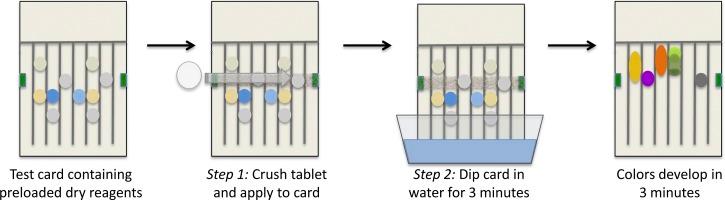
Carrying out chemical analysis of antimalarials to detect low-quality medications before they reach a patient is a costly venture. Here, we show that a library of chemical color tests embedded on a paper card can presumptively identify formulations corresponding to very low quality antimalarial drugs. The presence or absence of chloroquine (CQ), doxycycline (DOX), quinine, sulfadoxine, pyrimethamine, and primaquine antimalarial medications, in addition to fillers used in low-quality pharmaceuticals, are indicated by patterns of colors that are generated on the test cards. Test card sensitivity for detection of these pure components ranges from 90% to 100% with no false positives in the absence of pharmaceutical. The color intensities from reactions characteristic of CQ or DOX allowed visual detection of formulations of these medications cut with 60% or 100% filler, although samples cut with 30% filler could not be reliably detected colorimetrically. However, the addition of unexpected fillers, even in 30% quantities, or substitute pharmaceuticals, could sometimes be detected by other color reactions on the test cards. Tests are simple and inexpensive enough to be carried out in clinics, pharmacies, and ports of entry and could provide a screening method to presumptively indicate very low quality medicines throughout the supply chain.
在抗疟药物到达患者手中之前对其进行化学分析以检测低质量药物是一项成本高昂的工作。在此,我们表明,嵌入在纸卡上的一系列化学颜色测试能够初步识别与极低质量抗疟药物相对应的制剂。除了低质量药品中使用的填充剂外,氯喹(CQ)、多西环素(DOX)、奎宁、磺胺多辛、乙胺嘧啶和伯氨喹等抗疟药物的存在与否通过测试卡上产生的颜色图案显示出来。检测这些纯成分时测试卡的灵敏度范围为90%至100%,在没有药品的情况下无假阳性。CQ或DOX特征反应的颜色强度能够目视检测出这些药物与60%或100%填充剂混合的制剂,不过与30%填充剂混合的样品无法通过比色法可靠检测。然而,即使添加30%的意外填充剂或替代药物,有时也能通过测试卡上的其他颜色反应检测出来。这些测试简单且成本低廉,足以在诊所、药店和入境口岸进行,并可为在整个供应链中初步指示极低质量药品提供一种筛查方法。



 Zotero 插件