
MAT IIα 的乙酰化抑制肿瘤细胞生长,且在人类肝细胞癌中降低。
Acetylation of MAT IIα represses tumour cell growth and is decreased in human hepatocellular cancer.
作者信息
Yang Hong-Bin, Xu Ying-Ying, Zhao Xiang-Ning, Zou Shao-Wu, Zhang Ye, Zhang Min, Li Jin-Tao, Ren Feng, Wang Li-Ying, Lei Qun-Ying
机构信息
Key Laboratory of Metabolism and Molecular Medicine, Ministry of Education, and Department of Biochemistry and Molecular Biology, School of Basic Medical Sciences, Fudan University, Shanghai 200032, China.
Department of Hepatopancreatobiliary Surgery, Shanghai 10th People's Hospital, Tong Ji University, Shanghai 200072, China.
出版信息
Nat Commun. 2015 Apr 30;6:6973. doi: 10.1038/ncomms7973.
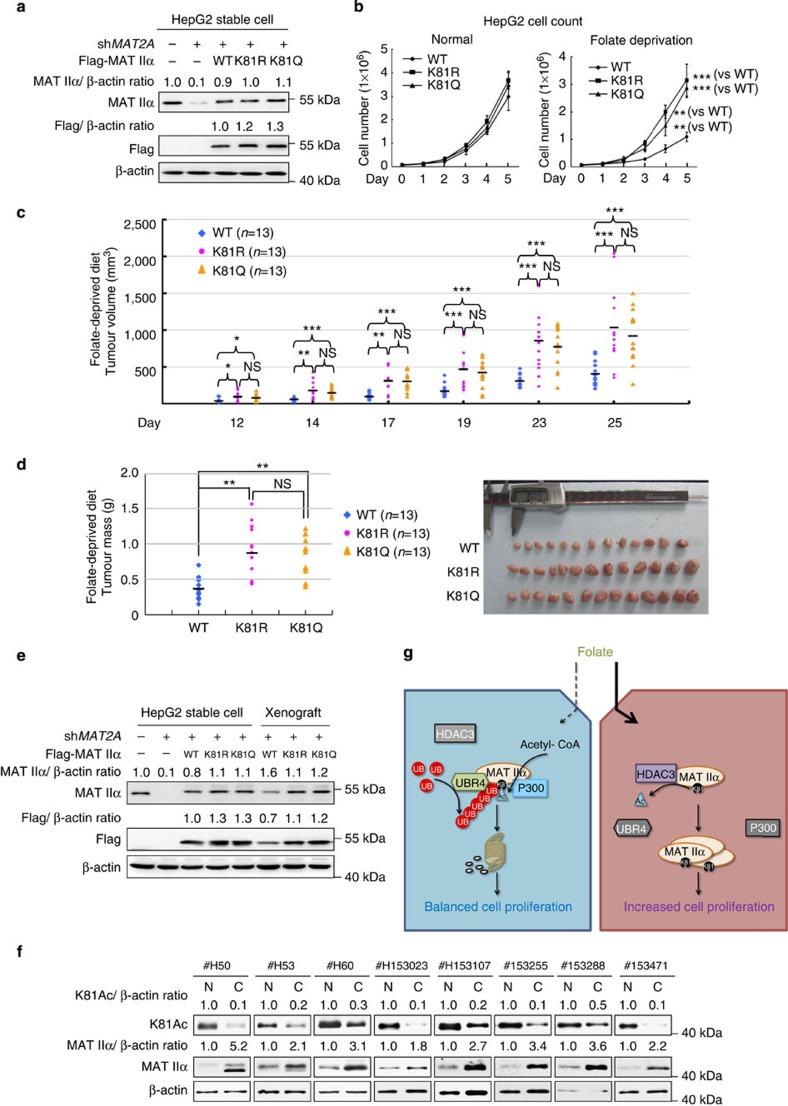
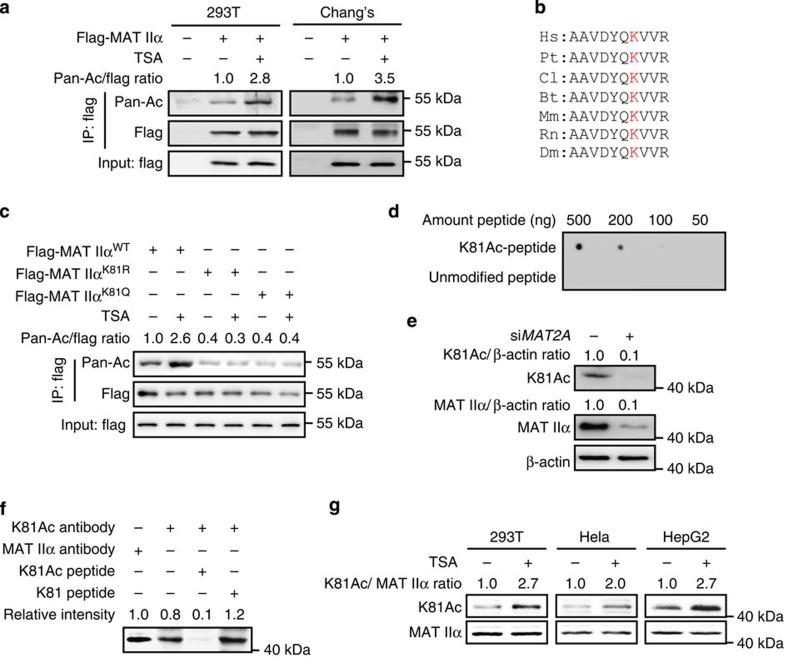
Metabolic alteration is a hallmark of cancer. Dysregulation of methionine metabolism is implicated in human liver cancer. Methionine adenosyltransferase IIα (MAT IIα) is a key enzyme in the methionine cycle, catalysing the production of S-adenosylmethionine (SAM), a key methyl donor in cellular processes, and is associated with uncontrolled cell proliferation in cancer. Here we show that P300 acetylates MAT IIα at lysine residue 81 and destabilizes MAT IIα by promoting its ubiquitylation and subsequent proteasomal degradation. Conversely, histone deacetylase-3 deacetylates and stabilizes MAT IIα by preventing its proteasomal degradation. Folate deprivation upregulates K81 acetylation and destabilizes MAT IIα to moderate cell proliferation, whereas a single mutation at K81 reverses the proliferative disadvantage of cancer cells upon folate deprivation. Moreover, MAT IIα K81 acetylation is decreased in human hepatocellular cancer. Collectively, our study reveals a novel mechanism of MAT IIα regulation by acetylation and ubiquitylation, and a direct functional link of this regulation to cancer development.
代谢改变是癌症的一个标志。甲硫氨酸代谢失调与人类肝癌有关。甲硫氨酸腺苷转移酶IIα(MAT IIα)是甲硫氨酸循环中的关键酶,催化S-腺苷甲硫氨酸(SAM)的产生,SAM是细胞过程中的关键甲基供体,并且与癌症中不受控制的细胞增殖有关。在此,我们表明P300使MAT IIα的赖氨酸残基81乙酰化,并通过促进其泛素化及随后的蛋白酶体降解使MAT IIα不稳定。相反,组蛋白脱乙酰酶-3通过防止MAT IIα的蛋白酶体降解使其去乙酰化并稳定。叶酸缺乏会上调K81乙酰化并使MAT IIα不稳定,从而适度调节细胞增殖,而K81处的单个突变可逆转叶酸缺乏时癌细胞的增殖劣势。此外,MAT IIα K81乙酰化在人类肝细胞癌中降低。总体而言,我们的研究揭示了通过乙酰化和泛素化调节MAT IIα的新机制,以及这种调节与癌症发展的直接功能联系。


 Zotero 插件