
斯托氏喙椎鱼(离片椎目,平卧吻螈类)的显微CT研究及两个新属的描述
Micro-CT Study of Rhynchonkos stovalli (Lepospondyli, Recumbirostra), with Description of Two New Genera.
作者信息
Szostakiwskyj Matt, Pardo Jason D, Anderson Jason S
机构信息
Department of Biological Sciences, University of Calgary, Calgary, Alberta, Canada.
Department of Comparative Biology and Experimental Medicine, University of Calgary, Calgary, Alberta, Canada.
出版信息
PLoS One. 2015 Jun 10;10(6):e0127307. doi: 10.1371/journal.pone.0127307. eCollection 2015.
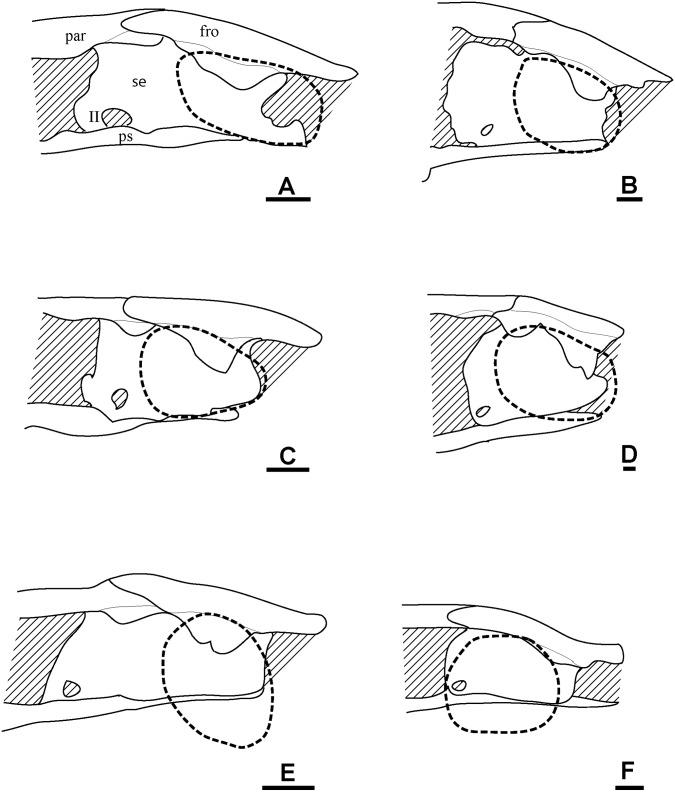
The Early Permian recumbirostran lepospondyl Rhynchonkos stovalli has been identified as a possible close relative of caecilians due to general similarities in skull shape as well as similar robustness of the braincase, a hypothesis that implies the polyphyly of extant lissamphibians. In order to better assess this phylogenetic hypothesis, we studied the morphology of the holotype and three specimens previously attributed to R. stovalli. With the use of micro-computed x-ray tomography (μCT) we are able to completely describe the external and internal cranial morphology of these specimens, dramatically revising our knowledge of R. stovalli and recognizing two new taxa, Aletrimyti gaskillae gen et sp. n. and Dvellacanus carrolli gen et sp. n. The braincases of R. stovalli, A. gaskillae, and D. carrolli are described in detail, demonstrating detailed braincase morphology and new information on the recumbirostran supraoccipital bone. All three taxa show fossorial adaptations in the braincase, sutural articulations of skull roof bones, and in the lower jaw, but variation in cranial morphology between these three taxa may reflect different modes of head-first burrowing behaviors and capabilities. We revisit the homology of the supraoccipital, median anterior bone, and temporal bone of recumbirostrans, and discuss implications of alternate interpretations of the homology of these elements. Finally, we evaluate the characteristics previously used to unite Rhynchonkos stovalli with caecilians in light of these new data. These proposed similarities are more ambiguous than previous descriptions suggest, and result from the composite nature of previous descriptions, ambiguities in external morphology, and functional convergence between recumbirostrans and caecilians for head-first burrowing.
早二叠世的平卧喙头类离片锥目动物斯托瓦尔氏喙头螈,因其头骨形状的总体相似性以及脑壳的相似粗壮程度,被认定为蚓螈可能的近亲,这一假说暗示了现存滑体两栖动物的多系起源。为了更好地评估这一系统发育假说,我们研究了正模标本以及先前归为斯托瓦尔氏喙头螈的三个标本的形态。通过使用微计算机断层扫描(μCT),我们能够完整描述这些标本的颅内外形态,极大地修正了我们对斯托瓦尔氏喙头螈的认识,并识别出两个新分类单元,即加斯凯拉氏阿莱螈(Aletrimyti gaskillae)属及种新名和卡罗利氏德维拉螈(Dvellacanus carrolli)属及种新名。详细描述了斯托瓦尔氏喙头螈、加斯凯拉氏阿莱螈和卡罗利氏德维拉螈的脑壳,展示了详细的脑壳形态以及关于平卧喙头类上枕骨的新信息。所有这三个分类单元在脑壳、颅顶骨的缝合关节以及下颌都表现出穴居适应性,但这三个分类单元之间颅形态的差异可能反映了不同的头先入式挖掘行为模式和能力。我们重新审视了平卧喙头类上枕骨、中前骨和颞骨的同源性,并讨论了对这些元素同源性的不同解释所带来的影响。最后,根据这些新数据,我们评估了先前用于将斯托瓦尔氏喙头螈与蚓螈归为一类的特征。这些所提出的相似性比先前描述所暗示的更为模糊,是由先前描述的综合性质、外部形态的模糊性以及平卧喙头类和蚓螈在头先入式挖掘方面的功能趋同导致的。


 Zotero 插件