
数字健康社交网络中的幂律分布映射:方法、解读及实际意义
Mapping Power Law Distributions in Digital Health Social Networks: Methods, Interpretations, and Practical Implications.
作者信息
van Mierlo Trevor, Hyatt Douglas, Ching Andrew T
机构信息
Research Associate, Henley Business School, University of Reading, Oxfordshire, United Kingdom.
出版信息
J Med Internet Res. 2015 Jun 25;17(6):e160. doi: 10.2196/jmir.4297.
BACKGROUND
Social networks are common in digital health. A new stream of research is beginning to investigate the mechanisms of digital health social networks (DHSNs), how they are structured, how they function, and how their growth can be nurtured and managed. DHSNs increase in value when additional content is added, and the structure of networks may resemble the characteristics of power laws. Power laws are contrary to traditional Gaussian averages in that they demonstrate correlated phenomena.
OBJECTIVES
The objective of this study is to investigate whether the distribution frequency in four DHSNs can be characterized as following a power law. A second objective is to describe the method used to determine the comparison.
METHODS
Data from four DHSNs—Alcohol Help Center (AHC), Depression Center (DC), Panic Center (PC), and Stop Smoking Center (SSC)—were compared to power law distributions. To assist future researchers and managers, the 5-step methodology used to analyze and compare datasets is described.
RESULTS
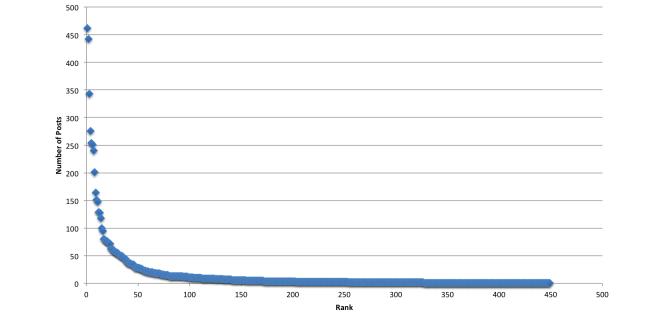
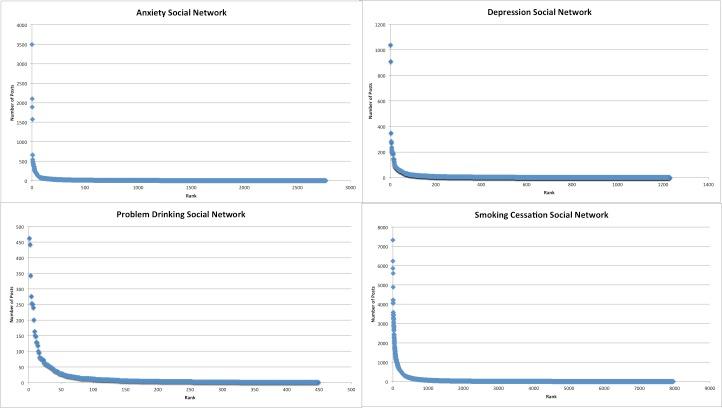
All four DHSNs were found to have right-skewed distributions, indicating the data were not normally distributed. When power trend lines were added to each frequency distribution, R(2) values indicated that, to a very high degree, the variance in post frequencies can be explained by actor rank (AHC .962, DC .975, PC .969, SSC .95). Spearman correlations provided further indication of the strength and statistical significance of the relationship (AHC .987. DC .967, PC .983, SSC .993, P<.001).
CONCLUSIONS
This is the first study to investigate power distributions across multiple DHSNs, each addressing a unique condition. Results indicate that despite vast differences in theme, content, and length of existence, DHSNs follow properties of power laws. The structure of DHSNs is important as it gives insight to researchers and managers into the nature and mechanisms of network functionality. The 5-step process undertaken to compare actor contribution patterns can be replicated in networks that are managed by other organizations, and we conjecture that patterns observed in this study could be found in other DHSNs. Future research should analyze network growth over time and examine the characteristics and survival rates of superusers.
背景
社交网络在数字健康领域很常见。一股新的研究潮流开始探究数字健康社交网络(DHSN)的机制、其结构如何、如何运作以及如何培育和管理其增长。当添加更多内容时,DHSN的价值会增加,并且网络结构可能类似于幂律特征。幂律与传统高斯平均值相反,因为它们展示了相关现象。
目的
本研究的目的是调查四个DHSN中的分布频率是否可以表征为遵循幂律。第二个目的是描述用于确定比较的方法。
方法
将来自四个DHSN的数据——酒精帮助中心(AHC)、抑郁中心(DC)、恐慌中心(PC)和戒烟中心(SSC)——与幂律分布进行比较。为了帮助未来的研究人员和管理人员,描述了用于分析和比较数据集的五步方法。
结果
发现所有四个DHSN都具有右偏分布,表明数据不是正态分布。当将幂趋势线添加到每个频率分布时,R(2)值表明,在非常高的程度上,帖子频率的方差可以由参与者排名来解释(AHC为0.962,DC为0.975,PC为0.969,SSC为0.95)。斯皮尔曼相关性进一步表明了这种关系的强度和统计显著性(AHC为0.987,DC为0.967,PC为0.983,SSC为0.993,P<0.001)。
结论
这是第一项调查多个DHSN中幂律分布的研究,每个DHSN都针对一种独特情况。结果表明,尽管在主题、内容和存在时间长度方面存在巨大差异,但DHSN遵循幂律特性。DHSN 的结构很重要,因为它能让研究人员和管理人员深入了解网络功能的本质和机制。用于比较参与者贡献模式的五步过程可以在由其他组织管理的网络中复制,并且我们推测在本研究中观察到的模式可能在其他DHSN中也能找到。未来的研究应该分析网络随时间的增长,并研究超级用户的特征和存活率。



 Zotero 插件