
一种基于荧光原位杂交(FISH)的预筛选方法,用于检测小鼠胚胎干细胞中的CRISPR/Cas9脱靶效应。
A pre-screening FISH-based method to detect CRISPR/Cas9 off-targets in mouse embryonic stem cells.
作者信息
Paulis Marianna, Castelli Alessandra, Lizier Michela, Susani Lucia, Lucchini Franco, Villa Anna, Vezzoni Paolo
机构信息
1] Milan Unit, Istituto di Ricerca Genetica e Biomedica, Consiglio Nazionale delle Ricerche, Milan, Italy [2] Humanitas Clinical and Research Center, Rozzano, Milan, Italy.
Catholic University of the Sacred Heart, Cremona, Italy.
出版信息
Sci Rep. 2015 Jul 24;5:12327. doi: 10.1038/srep12327.
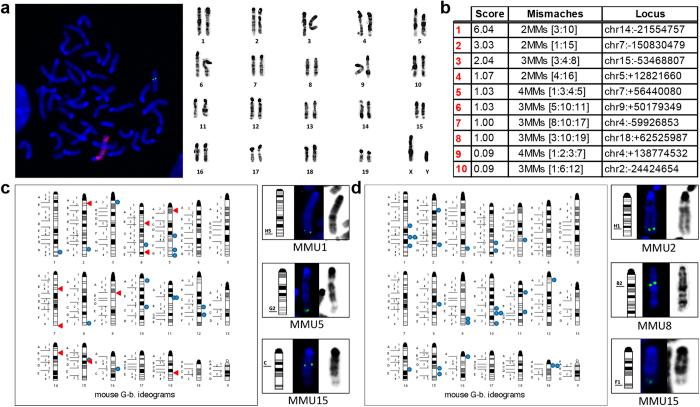
The clustered regularly interspaced short palindromic repeat (CRISPR)/associated 9 (Cas9) technology has been recently added to the tools allowing efficient and easy DNA targeting, representing a very promising approach to gene engineering. Using the CRISPR/Cas9 system we have driven the integration of exogenous DNA sequences to the X-linked Hprt gene of mouse embryonic stem cells. We show here that a simple fluorescence in situ hybridization (FISH)-based strategy allows the detection and the frequency evaluation of non-specific integrations of a given plasmid. FISH analysis revealed that these integrations do not match the software predicted off-target loci. We conclude that the frequency of these CRISPR-mediated off-target DNA cuts is negligible, since, due to the occurrence of spontaneous double-strand breaks, we observed more aspecific plasmid integrations than those corresponding to predicted off-target sites.
成簇规律间隔短回文重复序列(CRISPR)/相关蛋白9(Cas9)技术最近已被添加到可实现高效且简便的DNA靶向的工具中,这是一种非常有前景的基因工程方法。利用CRISPR/Cas9系统,我们已促使外源DNA序列整合到小鼠胚胎干细胞的X连锁次黄嘌呤磷酸核糖转移酶(Hprt)基因中。我们在此表明,一种基于简单荧光原位杂交(FISH)的策略可用于检测给定质粒非特异性整合的情况并评估其频率。FISH分析显示,这些整合与软件预测的脱靶位点不匹配。我们得出结论,这些由CRISPR介导的脱靶DNA切割频率可忽略不计,因为由于自发双链断裂的发生,我们观察到的非特异性质粒整合比对应于预测脱靶位点的整合更多。


 Zotero 插件