
基线C反应蛋白升高作为动脉瘤性蛛网膜下腔出血后预后的预测指标:来自动脉瘤性蛛网膜下腔出血辛伐他汀治疗(STASH)试验的数据。
Elevated Baseline C-Reactive Protein as a Predictor of Outcome After Aneurysmal Subarachnoid Hemorrhage: Data From the Simvastatin in Aneurysmal Subarachnoid Hemorrhage (STASH) Trial.
作者信息
Turner Carole L, Budohoski Karol, Smith Christopher, Hutchinson Peter J, Kirkpatrick Peter J, Murray G D
机构信息
Academic Division of Neurosurgery, Cambridge University Hospitals NHS Foundation Trust, Cambridge, United Kingdom.
出版信息
Neurosurgery. 2015 Nov;77(5):786-92; discussion 792-3. doi: 10.1227/NEU.0000000000000963.
BACKGROUND
There remains a proportion of patients with unfavorable outcomes after aneurysmal subarachnoid hemorrhage, of particular relevance in those who present with a good clinical grade. A forewarning of those at risk provides an opportunity towards more intensive monitoring, investigation, and prophylactic treatment prior to the clinical manifestation of advancing cerebral injury.
OBJECTIVE
To assess whether biochemical markers sampled in the first days after the initial hemorrhage can predict poor outcome.
METHODS
All patients recruited to the multicenter Simvastatin in Aneurysmal Hemorrhage Trial (STASH) were included. Baseline biochemical profiles were taken between time of ictus and day 4 post ictus. The t-test compared outcomes, and a backwards stepwise binary logistic regression was used to determine the factors providing independent prediction of an unfavorable outcome.
RESULTS
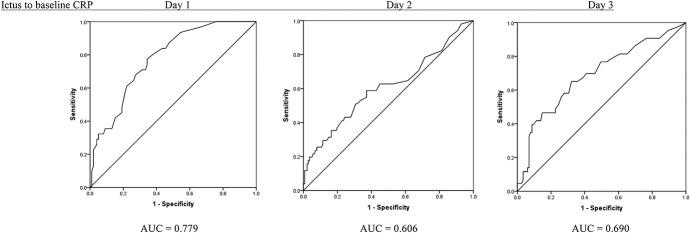
Baseline biochemical data were obtained in approximately 91% of cases from 803 patients. On admission, 73% of patients were good grade (World Federation of Neurological Surgeons grades 1 or 2); however, 84% had a Fisher grade 3 or 4 on computed tomographic scan. For patients presenting with good grade on admission, higher levels of C-reactive protein, glucose, and white blood cells and lower levels of hematocrit, albumin, and hemoglobin were associated with poor outcome at discharge. C-reactive protein was found to be an independent predictor of outcome for patients presenting in good grade.
CONCLUSION
Early recording of C-reactive protein may prove useful in detecting those good grade patients who are at greater risk of clinical deterioration and poor outcome.
背景
动脉瘤性蛛网膜下腔出血后仍有一部分患者预后不佳,这在临床分级良好的患者中尤为突出。对高危患者进行预警,可为在脑损伤进展的临床表现出现之前进行更强化的监测、检查和预防性治疗提供机会。
目的
评估首次出血后最初几天采集的生化标志物是否能预测不良预后。
方法
纳入多中心动脉瘤性出血试验(STASH)中招募的所有患者。在发病时和发病后第4天之间采集基线生化指标。采用t检验比较预后情况,并使用向后逐步二元逻辑回归来确定能够独立预测不良预后的因素。
结果
在803例患者中,约91%的病例获得了基线生化数据。入院时,73%的患者分级良好(世界神经外科联合会分级为1或2级);然而,84%的患者在计算机断层扫描上显示为Fisher 3或4级。对于入院时分级良好的患者,较高水平的C反应蛋白、葡萄糖和白细胞以及较低水平的血细胞比容、白蛋白和血红蛋白与出院时的不良预后相关。发现C反应蛋白是分级良好患者预后的独立预测指标。
结论
早期记录C反应蛋白可能有助于检测那些临床恶化和预后不良风险较高的分级良好的患者。
 Zotero 插件