
以色列的一种具有人群结构的HIV流行:风险因素与种族的作用
A Population-Structured HIV Epidemic in Israel: Roles of Risk and Ethnicity.
作者信息
Grossman Zehava, Avidor Boaz, Mor Zohar, Chowers Michal, Levy Itzchak, Shahar Eduardo, Riesenberg Klaris, Sthoeger Zev, Maayan Shlomo, Shao Wei, Lorber Margalit, Olstein-Pops Karen, Elbirt Daniel, Elinav Hila, Asher Ilan, Averbuch Diana, Istomin Valery, Gottesman Bat Sheva, Kedem Eynat, Girshengorn Shirley, Kra-Oz Zipi, Shemer Avni Yonat, Radian Sade Sara, Turner Dan, Maldarelli Frank
机构信息
School of Public Health, Tel-Aviv University, Tel-Aviv, Israel; National Cancer Institute, Frederick, MD, United States of America.
Crusaid Kobler AIDS Center, Tel Aviv Sourasky Medical Center, Tel Aviv, Israel; Laboratory of Viruses and Molecular Biology, Tel-Aviv Sourasky Medical Center, Tel Aviv, Israel.
出版信息
PLoS One. 2015 Aug 24;10(8):e0135061. doi: 10.1371/journal.pone.0135061. eCollection 2015.
BACKGROUND
HIV in Israel started with a subtype-B epidemic among men who have sex with men, followed in the 1980s and 1990s by introductions of subtype C from Ethiopia (predominantly acquired by heterosexual transmission) and subtype A from the former Soviet Union (FSU, most often acquired by intravenous drug use). The epidemic matured over the last 15 years without additional large influx of exogenous infections. Between 2005 and 2013 the number of infected men who have sex with men (MSM) increased 2.9-fold, compared to 1.6-fold and 1.3-fold for intravenous drug users (IVDU) and Ethiopian-origin residents. Understanding contemporary spread is essential for effective public health planning.
METHODS
We analyzed demographic and virologic data from 1,427 HIV-infected individuals diagnosed with HIV-I during 1998-2012. HIV phylogenies were reconstructed with maximum-likelihood and Bayesian methods.
RESULTS
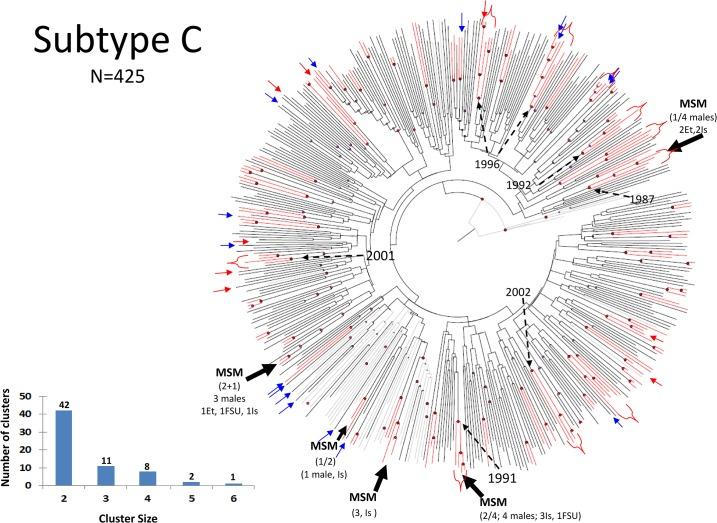
Subtype-B viruses, but not A or C, demonstrated a striking number of large clusters with common ancestors having posterior probability ≥0.95, including some suggesting presence of transmission networks. Transmitted drug resistance was highest in subtype B (13%). MSM represented a frequent risk factor in cross-ethnic transmission, demonstrated by the presence of Israeli-born with non-B virus infections and FSU immigrants with non-A subtypes.
CONCLUSIONS
Reconstructed phylogenetic trees demonstrated substantial grouping in subtype B, but not in non-MSM subtype-A or in subtype-C, reflecting differences in transmission dynamics linked to HIV transmission categories. Cross-ethnic spread occurred through multiple independent introductions, with MSM playing a prevalent role in the transmission of the virus. Such data provide a baseline to track epidemic trends and will be useful in informing and quantifying efforts to reduce HIV transmission.
背景
以色列的艾滋病病毒疫情始于男男性行为者中的B亚型流行,随后在20世纪80年代和90年代,来自埃塞俄比亚的C亚型(主要通过异性传播感染)以及来自前苏联的A亚型(最常见于通过静脉注射吸毒感染)传入。在过去15年中,疫情逐渐成熟,没有大量新的外来感染输入。2005年至2013年期间,感染艾滋病病毒的男男性行为者(MSM)数量增长了2.9倍,而静脉注射吸毒者(IVDU)和埃塞俄比亚裔居民的数量分别增长了1.6倍和1.3倍。了解当代传播情况对于有效的公共卫生规划至关重要。
方法
我们分析了1998年至2012年期间确诊感染HIV-1的1427名艾滋病病毒感染者的人口统计学和病毒学数据。采用最大似然法和贝叶斯方法重建了HIV系统发育树。
结果
B亚型病毒,而非A或C亚型,表现出大量具有共同祖先且后验概率≥0.95的大簇,其中一些表明存在传播网络。传播性耐药在B亚型中最高(13%)。MSM是跨种族传播中的常见危险因素,这体现在出生于以色列但感染非B型病毒的人群以及感染非A亚型的前苏联移民中。
结论
重建的系统发育树显示B亚型存在大量聚类,但非MSM的A亚型或C亚型则没有,这反映了与HIV传播类别相关的传播动态差异。跨种族传播通过多次独立传入发生,MSM在病毒传播中起主要作用。这些数据为追踪疫情趋势提供了基线,将有助于为减少HIV传播的努力提供信息并进行量化。




 Zotero 插件