
运用时间序列逆方法估计盒水母(Carybdea marsupialis)的动力学及管理策略
Use of an Inverse Method for Time Series to Estimate the Dynamics of and Management Strategies for the Box Jellyfish Carybdea marsupialis.
作者信息
Bordehore Cesar, Fuentes Verónica L, Segarra Jose G, Acevedo Melisa, Canepa Antonio, Raventós Josep
机构信息
Department of Ecology and Multidisciplinary Institute for Environmental Studies "Ramon Margalef", University of Alicante, Alicante, Spain.
Institute of Marine Sciences, CSIC, Barcelona, Spain.
出版信息
PLoS One. 2015 Sep 16;10(9):e0137272. doi: 10.1371/journal.pone.0137272. eCollection 2015.
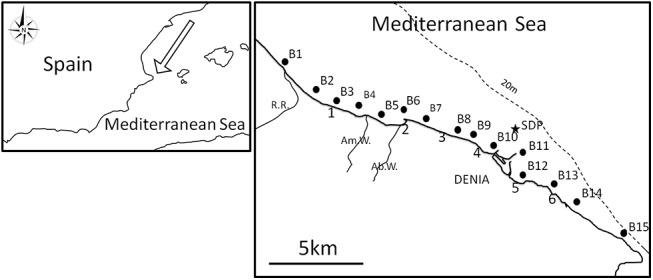
Frequently, population ecology of marine organisms uses a descriptive approach in which their sizes and densities are plotted over time. This approach has limited usefulness for design strategies in management or modelling different scenarios. Population projection matrix models are among the most widely used tools in ecology. Unfortunately, for the majority of pelagic marine organisms, it is difficult to mark individuals and follow them over time to determine their vital rates and built a population projection matrix model. Nevertheless, it is possible to get time-series data to calculate size structure and densities of each size, in order to determine the matrix parameters. This approach is known as a "demographic inverse problem" and it is based on quadratic programming methods, but it has rarely been used on aquatic organisms. We used unpublished field data of a population of cubomedusae Carybdea marsupialis to construct a population projection matrix model and compare two different management strategies to lower population to values before year 2008 when there was no significant interaction with bathers. Those strategies were by direct removal of medusae and by reducing prey. Our results showed that removal of jellyfish from all size classes was more effective than removing only juveniles or adults. When reducing prey, the highest efficiency to lower the C. marsupialis population occurred when prey depletion affected prey of all medusae sizes. Our model fit well with the field data and may serve to design an efficient management strategy or build hypothetical scenarios such as removal of individuals or reducing prey. TThis This sdfsdshis method is applicable to other marine or terrestrial species, for which density and population structure over time are available.
通常,海洋生物的种群生态学采用一种描述性方法,即绘制其大小和密度随时间的变化情况。这种方法在管理设计策略或模拟不同情景方面的实用性有限。种群预测矩阵模型是生态学中使用最广泛的工具之一。不幸的是,对于大多数海洋浮游生物来说,很难标记个体并长期跟踪它们以确定其生命率,从而构建种群预测矩阵模型。然而,有可能获得时间序列数据来计算大小结构和每个大小的密度,以便确定矩阵参数。这种方法被称为“人口统计学逆问题”,它基于二次规划方法,但很少用于水生生物。我们使用了未发表的卡里布水母(Carybdea marsupialis)种群的野外数据来构建种群预测矩阵模型,并比较两种不同的管理策略,即将种群数量降低到2008年之前与游泳者没有显著相互作用时的水平。这些策略是直接清除水母和减少猎物。我们的结果表明,从所有大小类别的水母中清除比只清除幼体或成体更有效。当减少猎物时,在猎物减少影响所有大小水母的猎物时,降低卡里布水母种群数量的效率最高。我们的模型与野外数据拟合良好,可用于设计有效的管理策略或构建假设情景,如清除个体或减少猎物。这种方法适用于其他海洋或陆地物种,对于这些物种,可以获得随时间变化的密度和种群结构数据。 (注:原文中存在一些拼写错误,如“TThis This sdfsdshis”,翻译时尽量按照正确理解进行了翻译。)



 Zotero 插件