
由与同一辅助病毒物种接种的菜豆金色花叶病毒属β卫星密切相关的分离物引起的疾病表型差异的决定因素。
Determinants of Disease Phenotype Differences Caused by Closely-Related Isolates of Begomovirus Betasatellites Inoculated with the Same Species of Helper Virus.
作者信息
Zhang Jie, Dang Mingqing, Huang Qingqing, Qian Yajuan
机构信息
Institute of Biotechnology, Zhejiang University, Hangzhou 310058, China.
Institute of Plant Virology, Fujian Agriculture and Forestry University, Fuzhou 350002, China.
出版信息
Viruses. 2015 Sep 14;7(9):4945-59. doi: 10.3390/v7092853.
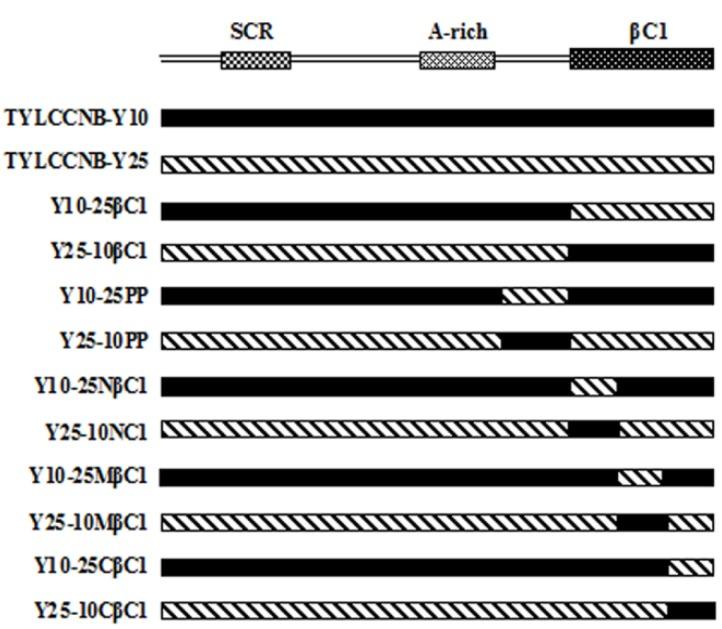
Tomato yellow leaf curl China virus (TYLCCNV) is a monopartite begomovirus associated with different betasatellites. In this study, we investigate two different isolates of Tomato yellow leaf curl China betasatellite (TYLCCNB) to determine what features of the viral genome are required for induction of characteristic phenotypic differences between closely-related betasatellite. When co-agroinoculated with TYLCCNV into Nicotiana spp. and tomato plants, TYLCCNB-Y25 induced only leaf curling on all hosts, while TYLCCNB-Y10 also induced enations, vein yellowing, and shoot distortions. Further assays showed that βC1 of TYLCCNB-Y25 differs from that of TYLCCNB-Y10 in symptom induction and transcriptional modulating. Hybrid satellites were constructed in which the βC1 gene or 200 nt partial promoter-like fragment upstream of the βC1 were exchanged. Infectivity assays showed that a TYLCCNB-Y25 hybrid with the intact TYLCCNB-Y10 βC1 gene was able to induce vein yellowing, shoot distortions, and a reduced size and number of enations. A TYLCCNB-Y10 hybrid with the intact TYLCCNB-Y25 βC1 gene produced only leaf curling. In contrast, the TYLCCNB-Y25 and TYLCCNB-Y10 hybrids with swapped partial promoter-like regions had little effect on the phenotypes induced by wild-type betasatellites. Further experiments showed that the TYLCCNB-Y25 hybrid carrying the C-terminal region of TYLCCNB-Y10 βC1 induced TYLCCNB-Y10-like symptoms. These findings indicate that the βC1 protein is the major symptom determinant and that the C-terminal region of βC1 plays an important role in symptom induction.
中国番茄黄化曲叶病毒(TYLCCNV)是一种与不同β卫星相关的单分体双生病毒。在本研究中,我们调查了两种不同的中国番茄黄化曲叶β卫星(TYLCCNB)分离物,以确定病毒基因组的哪些特征是诱导密切相关的β卫星之间特征性表型差异所必需的。当与TYLCCNV共同农杆菌接种到烟草属植物和番茄植株中时,TYLCCNB-Y25在所有宿主上仅诱导叶片卷曲,而TYLCCNB-Y10还诱导瘤状突起、叶脉黄化和枝条畸变。进一步的试验表明,TYLCCNB-Y25的βC1在症状诱导和转录调控方面与TYLCCNB-Y10的βC1不同。构建了杂交卫星,其中βC1基因或βC1上游200 nt的部分启动子样片段被交换。感染性试验表明,具有完整TYLCCNB-Y10 βC1基因的TYLCCNB-Y25杂交体能够诱导叶脉黄化、枝条畸变,并减少瘤状突起的大小和数量。具有完整TYLCCNB-Y25 βC1基因的TYLCCNB-Y10杂交体仅产生叶片卷曲。相反,具有交换的部分启动子样区域的TYLCCNB-Y25和TYLCCNB-Y10杂交体对野生型β卫星诱导的表型影响很小。进一步的实验表明,携带TYLCCNB-Y10 βC1 C末端区域的TYLCCNB-Y25杂交体诱导出类似TYLCCNB-Y10的症状。这些发现表明,βC1蛋白是主要的症状决定因素,并且βC1的C末端区域在症状诱导中起重要作用。


 Zotero 插件