
胞质二硫键还原酶系统与Nrf2/Keap1信号通路之间的相互作用。
Interplay between cytosolic disulfide reductase systems and the Nrf2/Keap1 pathway.
作者信息
Schmidt Edward E
机构信息
Department of Microbiology & Immunology, Lewis Hall, Montana State University, Bozeman, MT 59718, U.S.A.
出版信息
Biochem Soc Trans. 2015 Aug;43(4):632-8. doi: 10.1042/BST20150021. Epub 2015 Aug 3.
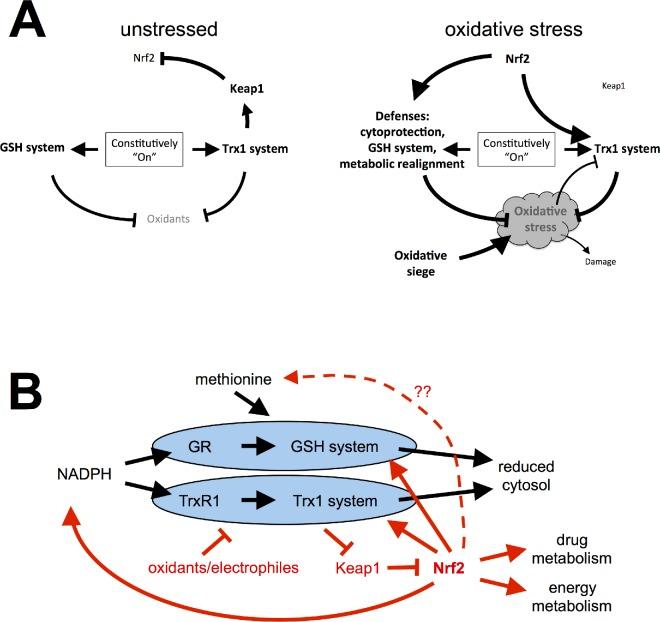
NADPH transfers reducing power from bioenergetic pathways to thioredoxin reductase-1 (TrxR1) and glutathione reductase (GR) to support essential reductive systems. Surprisingly, it was recently shown that mouse livers lacking both TrxR1 and GR ('TR/GR-null') can sustain redox (reduction-oxidation) homoeostasis using a previously unrecognized NADPH-independent source of reducing power fuelled by dietary methionine. The NADPH-dependent systems are robustly redundant in liver, such that disruption of either TrxR1 or GR alone does not cause oxidative stress. However, disruption of TrxR1 induces transcription factor Nrf2 (nuclear factor erythroid-derived 2-like-2) whereas disruption of GR does not. This suggests the Nrf2 pathway responds directly to the status of the thioredoxin-1 (Trx1) system. The proximal regulator of Nrf2 is Keap1 (Kelch-like ECH-associated protein-1), a cysteine (Cys)-rich protein that normally interacts transiently with Nrf2, targeting it for degradation. During oxidative stress, this interaction is stabilized, preventing degradation of newly synthesized Nrf2, thereby allowing Nrf2 accumulation. Within the Trx1 system, TrxR1 and peroxiredoxins (Prxs) contain some of the most reactive nucleophilic residues in the cell, making them likely targets for oxidants or electrophiles. We propose that Keap1 activity and therefore Nrf2 is regulated by interactions of Trx1 system enzymes with oxidants. In TR/GR-null livers, Nrf2 activity is further induced, revealing that TrxR-independent systems also repress Nrf2 and these might be induced by more extreme challenges.
烟酰胺腺嘌呤二核苷酸磷酸(NADPH)将生物能量途径中的还原力传递给硫氧还蛋白还原酶-1(TrxR1)和谷胱甘肽还原酶(GR),以支持重要的还原系统。令人惊讶的是,最近有研究表明,同时缺乏TrxR1和GR的小鼠肝脏(“TR/GR基因敲除小鼠肝脏”)能够利用由膳食蛋氨酸提供的、此前未被认识的不依赖NADPH的还原力来源维持氧化还原(还原-氧化)稳态。NADPH依赖系统在肝脏中具有强大的冗余性,以至于单独破坏TrxR1或GR都不会导致氧化应激。然而,破坏TrxR1会诱导转录因子Nrf2(核因子红细胞衍生2样2),而破坏GR则不会。这表明Nrf2途径直接对硫氧还蛋白-1(Trx1)系统的状态作出反应。Nrf2的近端调节因子是Keap1( Kelch样ECH相关蛋白-1),一种富含半胱氨酸(Cys)的蛋白质,它通常与Nrf2短暂相互作用,使其靶向降解。在氧化应激期间,这种相互作用会稳定下来,防止新合成的Nrf对2的降解,从而使Nrf2积累。在Trx1系统中,TrxR1和过氧化物酶(Prxs)含有细胞中一些反应性最强的亲核残基,这使得它们很可能成为氧化剂或亲电试剂的靶点。我们提出,Keap1的活性以及因此Nrf2是由Trx1系统酶与氧化剂的相互作用调节的。在TR/GR基因敲除小鼠肝脏中,Nrf2活性进一步诱导,这表明不依赖TrxR的系统也会抑制Nrf2,并且这些系统可能由更极端的挑战所诱导。

 Zotero 插件