
可溶性β淀粉样蛋白引起脑去甲肾上腺素水平改变:一氧化氮和白细胞介素-1的作用。
Soluble beta amyloid evokes alteration in brain norepinephrine levels: role of nitric oxide and interleukin-1.
作者信息
Morgese Maria G, Colaianna Marilena, Mhillaj Emanuela, Zotti Margherita, Schiavone Stefania, D'Antonio Palma, Harkin Andrew, Gigliucci Valentina, Campolongo Patrizia, Trezza Viviana, De Stradis Angelo, Tucci Paolo, Cuomo Vincenzo, Trabace Luigia
机构信息
Department of Clinical and Experimental Medicine, University of Foggia Foggia, Italy.
Department of Clinical and Experimental Medicine, University of Foggia Foggia, Italy ; Department of Pathology and Immunology, University of Geneva Geneva, Switzerland.
出版信息
Front Neurosci. 2015 Nov 5;9:428. doi: 10.3389/fnins.2015.00428. eCollection 2015.
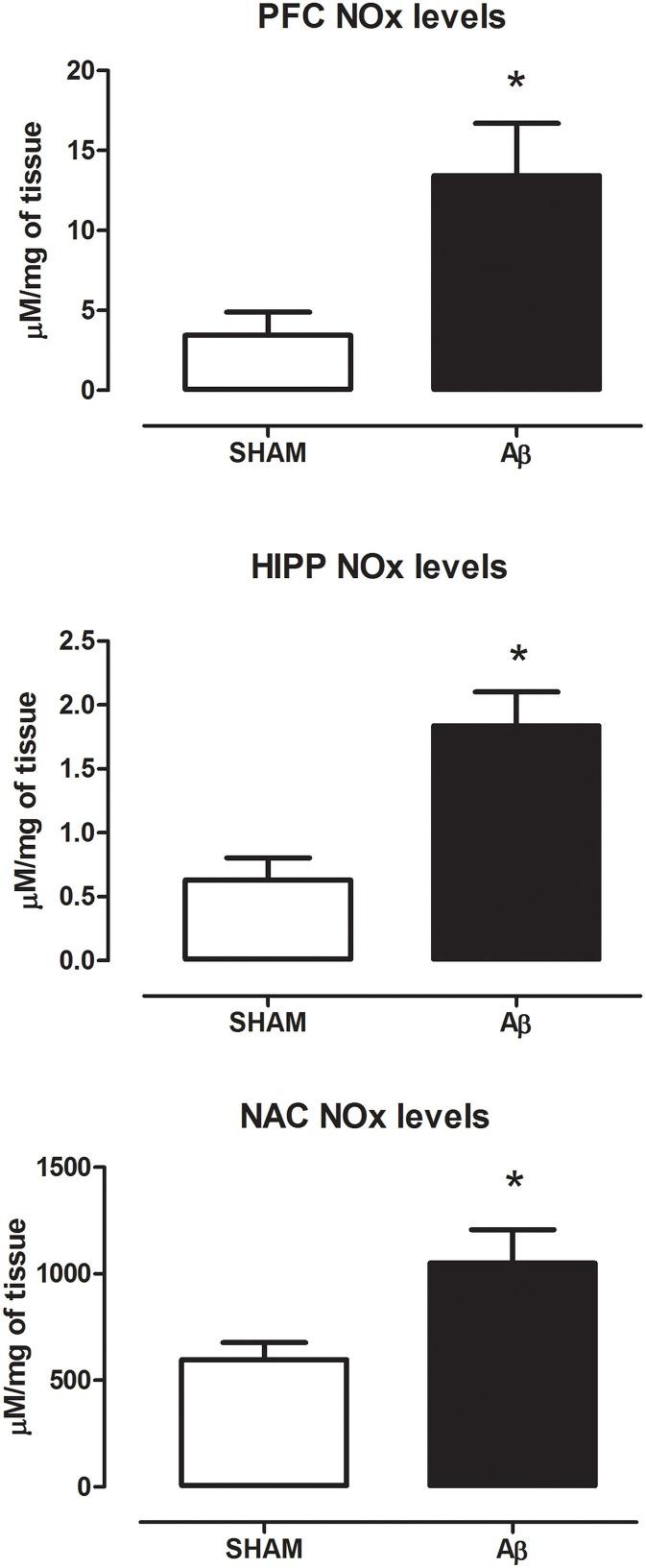
Strong evidence showed neurotoxic properties of beta amyloid (Aβ) and its pivotal role in the Alzheimer's disease (AD) pathogenesis. Beside, experimental data suggest that Aβ may have physiological roles considering that such soluble peptide is produced and secreted during normal cellular activity. There is now suggestive evidence that neurodegenerative conditions, like AD, involve nitric oxide (NO) in their pathogenesis. Nitric oxide also possess potent neuromodulatory actions in brain regions, such as prefrontal cortex (PFC), hippocampus (HIPP), and nucleus accumbens (NAC). In the present study, we evaluated the effect of acute Aβ injection on norepinephrine (NE) content before and after pharmacological manipulations of nitrergic system in above mentioned areas. Moreover, effects of the peptide on NOS activity were evaluated. Our data showed that 2 h after i.c.v. soluble Aβ administration, NE concentrations were significantly increased in the considered areas along with increased iNOS activity. Pre-treatment with NOS inhibitors, 7-Nitroindazole (7-NI), and N6-(1-iminoethyl)-L-lysine-dihydrochloride (L-NIL), reversed Aβ-induced changes. Ultimately, pharmacological block of interleukin1 (IL-1) receptors prevented NE increase in all brain regions. Taken together our findings suggest that NO and IL-1 are critically involved in regional noradrenergic alterations induced by soluble Aβ injection.
有力证据表明β淀粉样蛋白(Aβ)具有神经毒性特性,且在阿尔茨海默病(AD)发病机制中起关键作用。此外,实验数据表明,鉴于这种可溶性肽在正常细胞活动期间产生并分泌,Aβ可能具有生理作用。目前有提示性证据表明,神经退行性疾病,如AD,在其发病机制中涉及一氧化氮(NO)。一氧化氮在大脑区域,如前额叶皮质(PFC)、海马体(HIPP)和伏隔核(NAC),也具有强大的神经调节作用。在本研究中,我们评估了急性注射Aβ对上述区域硝化能系统进行药理学操作前后去甲肾上腺素(NE)含量的影响。此外,还评估了该肽对一氧化氮合酶(NOS)活性的影响。我们的数据显示,脑室内注射可溶性Aβ 2小时后,上述区域的NE浓度显著增加,同时诱导型一氧化氮合酶(iNOS)活性增强。用NOS抑制剂7-硝基吲唑(7-NI)和N6-(1-亚氨基乙基)-L-赖氨酸二盐酸盐(L-NIL)预处理可逆转Aβ诱导的变化。最终,白细胞介素1(IL-1)受体的药理学阻断可防止所有脑区NE增加。综上所述,我们的研究结果表明,NO和IL-1在可溶性Aβ注射诱导的局部去甲肾上腺素能改变中起关键作用。


 Zotero 插件