
某些噻唑基-羰基-硫代氨基脲和噻唑基-唑类化合物的结构、亲脂性与生物活性之间的关系研究
Study of the Relationships between the Structure, Lipophilicity and Biological Activity of Some Thiazolyl-carbonyl-thiosemicarbazides and Thiazolyl-azoles.
作者信息
Tamaian Radu, Moţ Augustin, Silaghi-Dumitrescu Radu, Ionuţ Ioana, Stana Anca, Oniga Ovidiu, Nastasă Cristina, Benedec Daniela, Tiperciuc Brînduşa
机构信息
National Research and Development Institute for Cryogenic and Isotopic Technologies, 4th Uzinei Street, Râmnicu Vâlcea 240050, Romania.
3Nano-SAE Research Centre, Faculty of Physics, University of Bucharest, P. O. Box MG-38, Bucharest-Măgurele RO-077125, Romania.
出版信息
Molecules. 2015 Dec 11;20(12):22188-201. doi: 10.3390/molecules201219841.
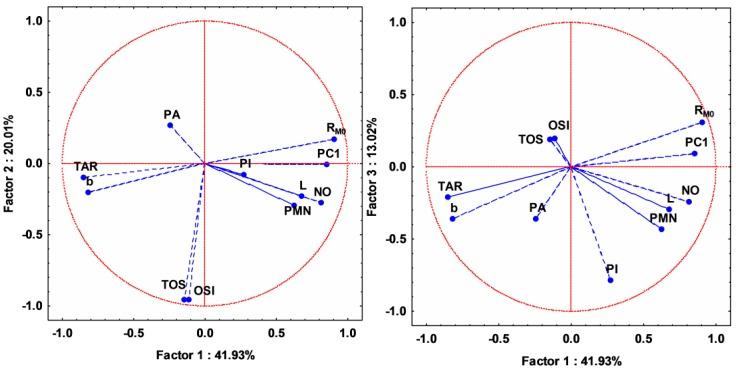
Lipophilicity, as one of the most important physicochemical parameters of bioactive molecules, was investigated for twenty-two thiazolyl-carbonyl-thiosemicarbazides and thiazolyl-azoles. The determination was carried out by reversed-phase thin-layer chromatography, using a binary isopropanol-water mobile phase. Chromatographically obtained lipophilicity parameters were correlated with calculated log P and log D and with some biological parameters, determined in order to evaluate the anti-inflammatory and antioxidant potential of the investigated compounds, by using principal component analysis (PCA). The PCA grouped the compounds based on the nature of their substituents (X, R and Y), indicating that their nature, electronic effects and molar volumes influence the lipophilicity parameters and their anti-inflammatory and antioxidant effects. Also, the results of the PCA analysis applied on all the experimental and computed parameters show that the best anti-inflammatory and antioxidant compounds were correlated with medium values of the lipophilicity parameters. On the other hand, the knowledge of the grouping patterns of the tested variables allows the reduction of the number of parameters, determined in order to establish the biological activity.
亲脂性作为生物活性分子最重要的物理化学参数之一,对二十二种噻唑基 - 羰基 - 硫代氨基脲和噻唑基 - 唑类进行了研究。采用反相薄层色谱法,使用二元异丙醇 - 水流动相进行测定。通过主成分分析(PCA),将色谱法获得的亲脂性参数与计算得到的log P和log D以及一些生物学参数相关联,这些生物学参数是为了评估所研究化合物的抗炎和抗氧化潜力而测定的。PCA根据取代基(X、R和Y)的性质对化合物进行分组,表明它们的性质、电子效应和摩尔体积会影响亲脂性参数及其抗炎和抗氧化作用。此外,对所有实验和计算参数进行PCA分析的结果表明,最佳的抗炎和抗氧化化合物与亲脂性参数的中等值相关。另一方面,了解测试变量的分组模式有助于减少为确定生物活性而测定的参数数量。



 Zotero 插件