
对来自埃塞俄比亚西北部采采蝇出没地区和非采采蝇地区的间日锥虫分离株进行实验性感染的年轻泽布牛(Bos indicus)的临床病理比较观察。
Comparative clinico-pathological observations in young Zebu (Bos indicus) cattle experimentally infected with Trypanosoma vivax isolates from tsetse infested and non-tsetse areas of Northwest Ethiopia.
作者信息
Dagnachew Shimelis, Terefe Getachew, Abebe Getachew, Sirak Asegedech, Bollo Enrico, Barry Dave, Goddeeris Bruno
机构信息
Addis Ababa University, College of Veterinary Medicine and Agriculture, Debre Zeit, Ethiopia.
Food and Agriculture Organization of the United Nations, Addis Ababa, Ethiopia.
出版信息
BMC Vet Res. 2015 Dec 23;11:307. doi: 10.1186/s12917-015-0625-0.
BACKGROUND
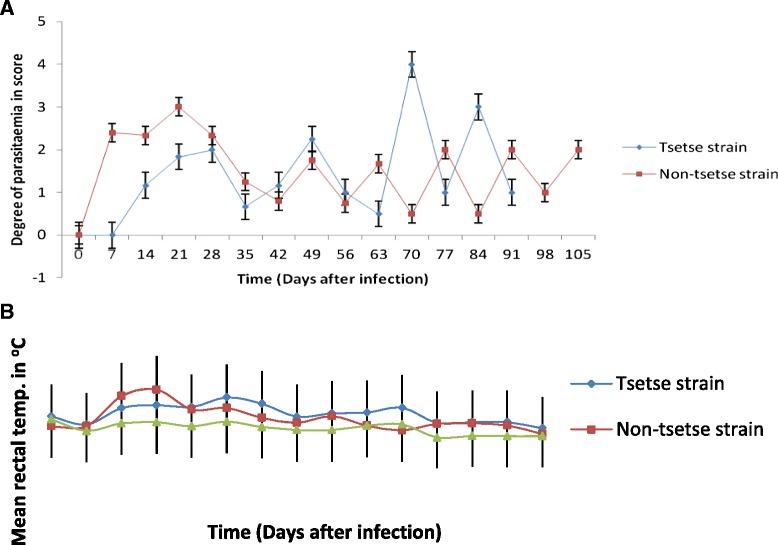
The Northwest region of Ethiopia is affected by both tsetse and non-tsetse transmitted trypanosomosis with a huge impact on livestock productivity. The objective of this experimental study was to determine clinical and pathological findings in young Zebu cattle experimentally infected with Trypanosoma vivax isolates from tsetse infested and non-tsetse infested areas of Northwest Ethiopia. A total of 18 cattle (Bos indicus) aged between 6 and 12 months, purchased from a trypanosome-free and confirmed to be trypanosome negative divided into three groups of six animals were used. Animals in the first two groups (Group TT: tsetse infested isolate infected and Group NT: non-tsetse infested isolate infected) received 2 mL of infected blood from donor animals at 10(6) trypanosomes/mL, and the remaining group was non-infected control (NIC). Each group was observed for a period of eight consecutive weeks, daily for clinical signs and once per week for parasitaemia. Postmortem examinations were done on euthanized animals, and tissue samples were taken for histopathological analysis.
RESULTS
The prepatent period of the disease was earlier in the NT group 6 days post infection (dpi) than TT group 12 dpi. The infection was characterized by reduced feed intake, intermittent pyrexia and parasitaemia, enlarged lymph nodes, lacrimation, reduced feed intake and emaciation. Less frequently diarrhea, oedema and nervous signs were observed in both groups of infected animals. At necropsy, infected animals showed enlarged spleen, enlarged lymph nodes, pneumonic and emphysematous lung, enlarged liver, and haemorrhages on the brain and intestine. Histopathological analysis revealed lymphoid hyperplasia of the spleen, necrosis of the liver, encephalitis and hyperplasia of lymph nodes.
CONCLUSION
Trpanosoma vivax isolates from both tsetse infested and non-tsetse areas showed a variety of virulence factors leading to the development of acute clinical signs, gross and histopathological lesions. However, the parasitaemia and clinical signs appeared earlier in the NT compared to TT infected groups.
背景
埃塞俄比亚西北部地区受采采蝇传播和非采采蝇传播的锥虫病影响,对牲畜生产力造成巨大冲击。本实验研究的目的是确定用来自埃塞俄比亚西北部采采蝇滋生区和非采采蝇滋生区的间日锥虫分离株实验性感染的年轻泽布牛的临床和病理表现。总共使用了18头6至12个月大的牛(印度瘤牛),这些牛购自无锥虫地区并经确认锥虫阴性,分为三组,每组6头动物。前两组动物(TT组:采采蝇滋生区分离株感染组和NT组:非采采蝇滋生区分离株感染组)接受每毫升含10(6)个锥虫的2毫升供体动物感染血液,其余组为未感染对照组(NIC)。每组连续观察八周,每天观察临床症状,每周检测一次寄生虫血症。对安乐死的动物进行尸检,并采集组织样本进行组织病理学分析。
结果
疾病的潜伏期在NT组感染后6天(dpi)比TT组12 dpi更早。感染的特征是采食量减少、间歇性发热和寄生虫血症、淋巴结肿大、流泪、采食量减少和消瘦。两组感染动物中较少出现腹泻、水肿和神经症状。尸检时,感染动物表现为脾脏肿大、淋巴结肿大、肺呈肺炎性和肺气肿、肝脏肿大以及脑和肠道出血。组织病理学分析显示脾脏淋巴样增生、肝脏坏死、脑炎和淋巴结增生。
结论
来自采采蝇滋生区和非采采蝇区的间日锥虫分离株显示出多种毒力因子,导致急性临床症状、大体和组织病理学病变的发展。然而,与TT感染组相比,NT组的寄生虫血症和临床症状出现得更早。



 Zotero 插件