
腺病毒载体转导设计核酸酶后无需筛选的基因修复:在杜氏肌营养不良症(DMD)肌肉细胞群体中恢复肌营养不良蛋白的合成
Selection-free gene repair after adenoviral vector transduction of designer nucleases: rescue of dystrophin synthesis in DMD muscle cell populations.
作者信息
Maggio Ignazio, Stefanucci Luca, Janssen Josephine M, Liu Jin, Chen Xiaoyu, Mouly Vincent, Gonçalves Manuel A F V
机构信息
Department of Molecular Cell Biology, Leiden University Medical Center, Leiden, Einthovenweg 20, 2333 ZC Leiden, The Netherlands.
Department of Molecular Cell Biology, Leiden University Medical Center, Leiden, Einthovenweg 20, 2333 ZC Leiden, The Netherlands Facoltà di Scienze Matematiche Fisiche e Naturali, Universitá di Roma Tor Vergata, Rome, Italy.
出版信息
Nucleic Acids Res. 2016 Feb 18;44(3):1449-70. doi: 10.1093/nar/gkv1540. Epub 2016 Jan 13.
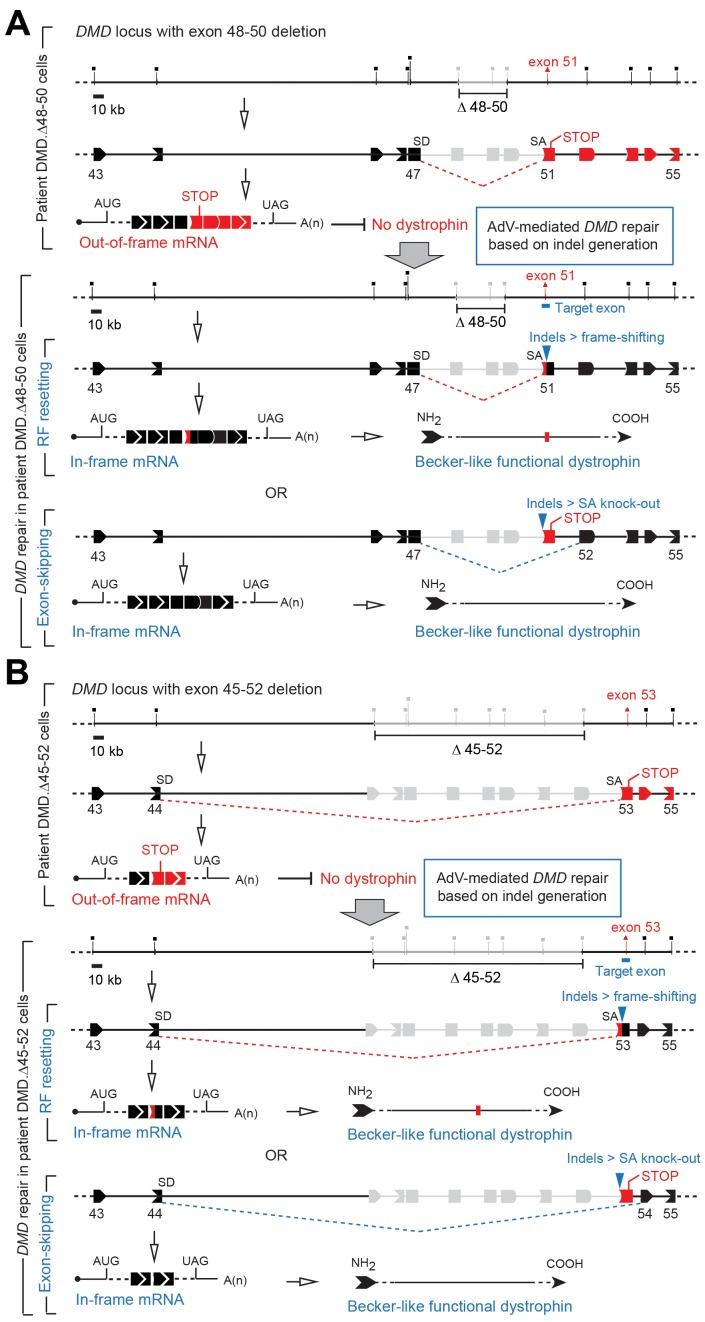
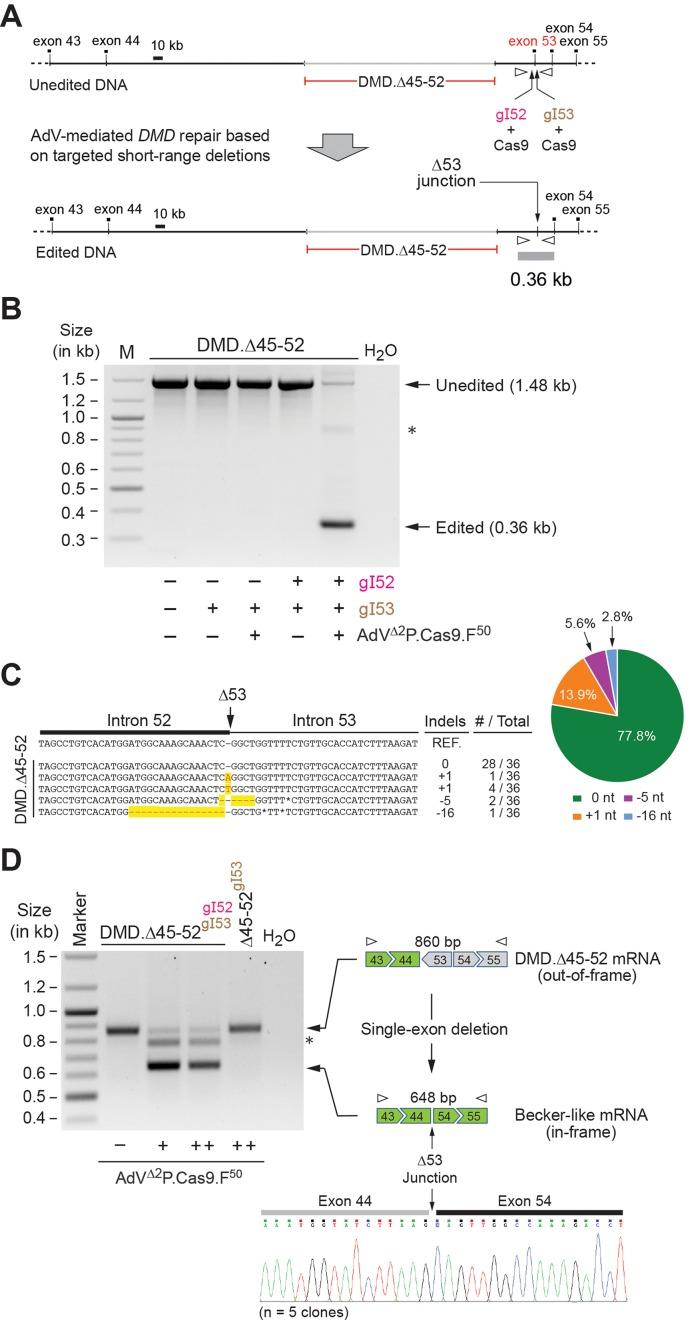
Duchenne muscular dystrophy (DMD) is a fatal X-linked muscle-wasting disorder caused by mutations in the 2.4 Mb dystrophin-encoding DMD gene. The integration of gene delivery and gene editing technologies based on viral vectors and sequence-specific designer nucleases, respectively, constitutes a potential therapeutic modality for permanently repairing defective DMD alleles in patient-derived myogenic cells. Therefore, we sought to investigate the feasibility of combining adenoviral vectors (AdVs) with CRISPR/Cas9 RNA-guided nucleases (RGNs) alone or together with transcriptional activator-like effector nucleases (TALENs), for endogenous DMD repair through non-homologous end-joining (NHEJ). The strategies tested involved; incorporating small insertions or deletions at out-of-frame sequences for reading frame resetting, splice acceptor knockout for DNA-level exon skipping, and RGN-RGN or RGN-TALEN multiplexing for targeted exon(s) removal. We demonstrate that genome editing based on the activation and recruitment of the NHEJ DNA repair pathway after AdV delivery of designer nuclease genes, is a versatile and robust approach for repairing DMD mutations in bulk populations of patient-derived muscle progenitor cells (up to 37% of corrected DMD templates). These results open up a DNA-level genetic medicine strategy in which viral vector-mediated transient designer nuclease expression leads to permanent and regulated dystrophin synthesis from corrected native DMD alleles.
杜兴氏肌营养不良症(DMD)是一种致命的X连锁肌肉萎缩性疾病,由编码肌营养不良蛋白的2.4 Mb DMD基因突变引起。基于病毒载体和序列特异性设计核酸酶的基因递送和基因编辑技术的整合,分别构成了一种潜在的治疗方式,用于永久修复患者源性成肌细胞中缺陷的DMD等位基因。因此,我们试图研究将腺病毒载体(AdV)与CRISPR/Cas9 RNA引导核酸酶(RGN)单独或与转录激活样效应核酸酶(TALEN)联合使用,通过非同源末端连接(NHEJ)进行内源性DMD修复的可行性。所测试的策略包括:在移码序列处引入小的插入或缺失以重置阅读框,敲除剪接受体以实现DNA水平的外显子跳跃,以及使用RGN-RGN或RGN-TALEN多路复用去除靶向外显子。我们证明,在AdV递送设计核酸酶基因后,基于NHEJ DNA修复途径的激活和募集进行基因组编辑,是一种通用且强大的方法,可用于修复患者源性肌肉祖细胞大量群体中的DMD突变(校正后的DMD模板高达37%)。这些结果开辟了一种DNA水平的遗传医学策略,其中病毒载体介导的瞬时设计核酸酶表达可导致从校正后的天然DMD等位基因中永久且受调控地合成肌营养不良蛋白。





 Zotero 插件