
沙特阿拉伯食品药品管理局:与澳大利亚、加拿大和新加坡相比,对沙特阿拉伯注册流程及良好审评规范的评估
The Saudi Arabia Food and Drug Authority: An Evaluation of the Registration Process and Good Review Practices in Saudi Arabia in Comparison with Australia, Canada and Singapore.
作者信息
Hashan Hajed, Aljuffali Ibrahim, Patel Prisha, Walker Stuart
机构信息
Licensing Department, Saudi Food and Drug Authority, North Ring Road, Al Nafal Unit (1), Riyadh, 13312-6288 Saudi Arabia.
Saudi Food and Drug Authority, North Ring Road, Al Nafal Unit (1), Riyadh, 13312-6288 Saudi Arabia ; Department of Pharmaceutics, College of Pharmacy, King Saud University, Riyadh, Saudi Arabia.
出版信息
Pharmaceut Med. 2016;30:37-47. doi: 10.1007/s40290-015-0124-4. Epub 2015 Nov 6.
OBJECTIVE
This study compares the current regulatory review process and good review practices at the Saudi Food and Drug Authority (SFDA) with those of regulatory agencies in Australia, Canada, and Singapore and identifies opportunities for developing the SFDA as a Regional Centre of Excellence.
METHODS
A questionnaire completed by the SFDA included data regarding the organisation, key milestones, review timelines, and good review practices of the agency. Similar information was obtained within the same timeframe (2014/2015) through the same standard questionnaire regarding the processes and practices for Health Canada, Singapore's Health Sciences Authority, and Australia's Therapeutic Goods Administration.
RESULTS
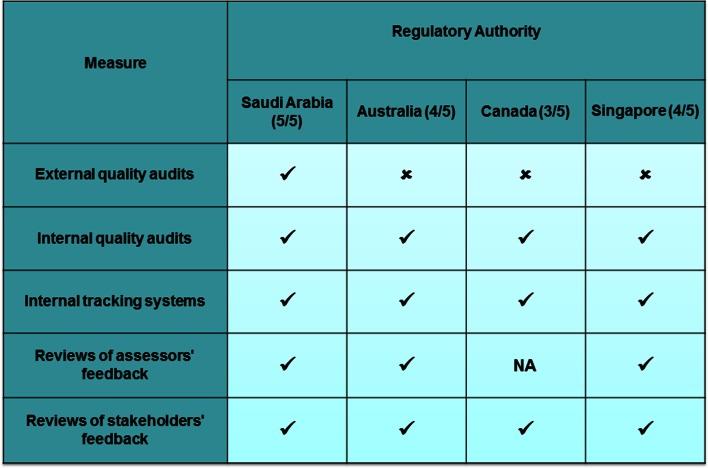
All four regulatory agencies have established target times for scientific assessment and regulatory review, examine dossier sections in parallel, and separate company response time from overall timing. Additionally, all four agencies have instituted good review practices including standard operating procedures, templates, dossier monitoring, and continuous improvement processes, and assign a high priority to transparency in their relationships with the public, healthcare professionals and industry. Of the four agencies, however, only the SFDA requires a Certificate of Pharmaceutical Product (CPP) at the time of the submission and pricing negotiations before final product approval.
CONCLUSIONS
To assist the SFDA in its efforts to become a Regional Centre of Excellence, it is suggested that the agency explore a risk stratification approach to select dossiers for verification, abridged, or full reviews; use forms of certification other than the CPP; make pricing negotiations independent to the review process; and introduce a feedback process for the quality of the dossier.
目的
本研究将沙特食品药品管理局(SFDA)当前的监管审评流程及良好审评规范与澳大利亚、加拿大和新加坡监管机构的相关流程及规范进行比较,并确定将SFDA发展成为卓越区域中心的机会。
方法
SFDA填写的一份调查问卷包含了有关该机构的组织架构、关键节点、审评时间表及良好审评规范的数据。在同一时间段(2014/2015年)内,通过相同的标准调查问卷获取了加拿大卫生部、新加坡卫生科学局和澳大利亚治疗用品管理局的流程及规范方面的类似信息。
结果
所有四个监管机构均已确定科学评估和监管审评的目标时间,并行审查卷宗各部分,并将公司回复时间与总体时间分开。此外,所有四个机构都制定了良好的审评规范,包括标准操作规程、模板、卷宗监测和持续改进流程,并高度重视在与公众、医疗保健专业人员和行业的关系中保持透明度。然而,在这四个机构中,只有SFDA在提交申请及最终产品批准前的定价谈判时要求提供药品产品证书(CPP)。
结论
为协助SFDA努力成为卓越区域中心,建议该机构探索采用风险分层方法来选择卷宗进行核实、简化或全面审评;使用除CPP之外的其他认证形式;使定价谈判独立于审评流程;并引入针对卷宗质量的反馈流程。


 Zotero 插件