
表达单纯疱疹病毒胸苷激酶自杀基因的人诱导多能干细胞中的逃逸突变、更昔洛韦耐药性和畸胎瘤形成
Escape Mutations, Ganciclovir Resistance, and Teratoma Formation in Human iPSCs Expressing an HSVtk Suicide Gene.
作者信息
Kotini Andriana G, de Stanchina Elisa, Themeli Maria, Sadelain Michel, Papapetrou Eirini P
机构信息
Department of Oncological Sciences, Icahn School of Medicine at Mount Sinai, New York, New York, USA.
Tisch Cancer Institute, Icahn School of Medicine at Mount Sinai, New York, New York, USA.
出版信息
Mol Ther Nucleic Acids. 2016 Feb 2;5(2):e284. doi: 10.1038/mtna.2015.57.
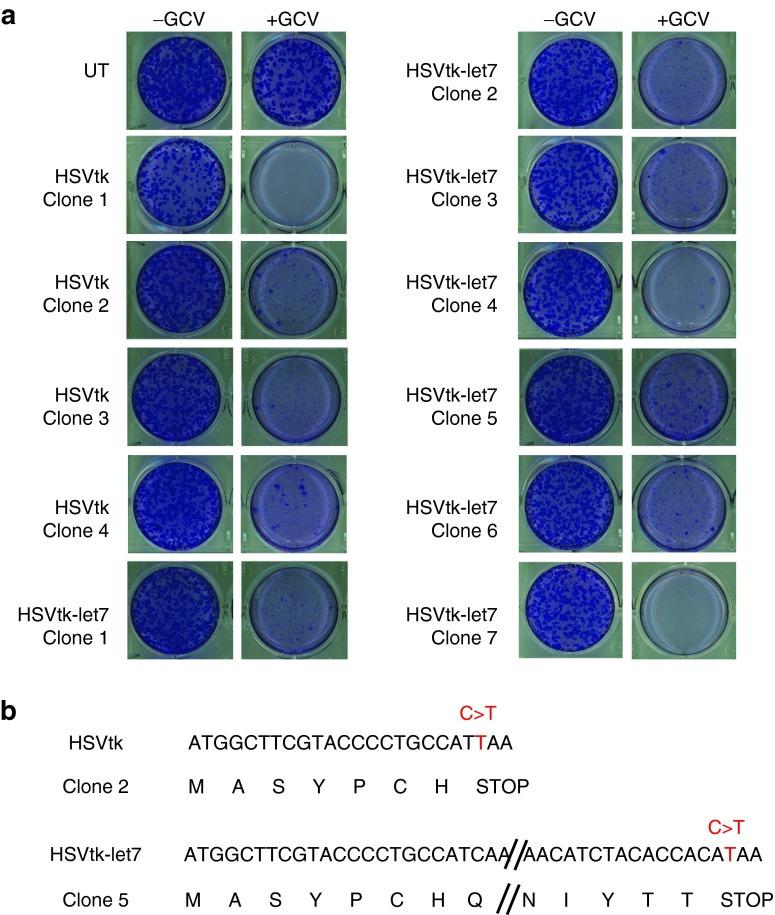
Human pluripotent stem cells (hPSCs) hold great promise for cell therapy. However, a major concern is the risk of tumor formation by residual undifferentiated cells contaminating the hPSC-derived cell product. Suicide genes could safeguard against such adverse events by enabling elimination of cells gone astray, but the efficacy of this approach has not yet been thoroughly tested. Here, we engineered a lentivirally encoded herpes simplex virus thymidine kinase (HSVtk) with expression restricted to undifferentiated hPSCs through regulation by the let7 family of miRNAs. We show that induced pluripotent stem cells (iPSCs) expressing a let7-regulated HSVtk transgene are selectively killed by ganciclovir (GCV), whereas differentiated cells are fully protected. However, in contrast to previous studies, we find that in vivo GCV administration results in longer latency but does not prevent teratoma formation by iPSCs expressing either a constitutive or a let7-regulated HSVtk, without evidence of silencing of the HSVtk. Clonal analyses of iPSCs expressing HSVtk revealed frequent emergence of GCV resistance which, at least in some cases, could be attributed to preexisting inactivating mutations in the HSVtk coding sequence, selected for upon GCV treatment. Our findings have important consequences for the future use of suicide genes in hPSC-based cell therapies.
人类多能干细胞(hPSCs)在细胞治疗方面具有巨大潜力。然而,一个主要担忧是残留的未分化细胞污染hPSC衍生的细胞产物会有形成肿瘤的风险。自杀基因可通过清除误入歧途的细胞来预防此类不良事件,但这种方法的有效性尚未得到充分测试。在此,我们构建了一种经慢病毒编码的单纯疱疹病毒胸苷激酶(HSVtk),其表达通过let7家族的微小RNA(miRNAs)调控,仅限于未分化的hPSCs。我们发现,表达受let7调控的HSVtk转基因的诱导多能干细胞(iPSCs)会被更昔洛韦(GCV)选择性杀死,而分化细胞则完全受到保护。然而,与先前的研究不同,我们发现体内给予GCV会导致更长的潜伏期,但并不能阻止表达组成型或受let7调控的HSVtk的iPSCs形成畸胎瘤,且没有HSVtk沉默的证据。对表达HSVtk的iPSCs进行克隆分析发现,GCV耐药性频繁出现,至少在某些情况下,这可归因于HSVtk编码序列中预先存在的失活突变,这些突变在GCV处理后被选择出来。我们的研究结果对基于hPSC的细胞治疗中自杀基因的未来应用具有重要意义。


 Zotero 插件