
[68Ga]喷替沙氟-PET/CT用于小细胞肺癌趋化因子受体4表达成像——初步经验
[68Ga]Pentixafor-PET/CT for imaging of chemokine receptor 4 expression in small cell lung cancer--initial experience.
作者信息
Lapa Constantin, Lückerath Katharina, Rudelius Martina, Schmid Jan-Stefan, Schoene Alexander, Schirbel Andreas, Samnick Samuel, Pelzer Theo, Buck Andreas K, Kropf Saskia, Wester Hans-Jürgen, Herrmann Ken
机构信息
Department of Nuclear Medicine, University Hospital Würzburg, Würzburg, Germany.
Institute for Pathology, University of Würzburg, Würzburg, Germany.
出版信息
Oncotarget. 2016 Feb 23;7(8):9288-95. doi: 10.18632/oncotarget.7063.
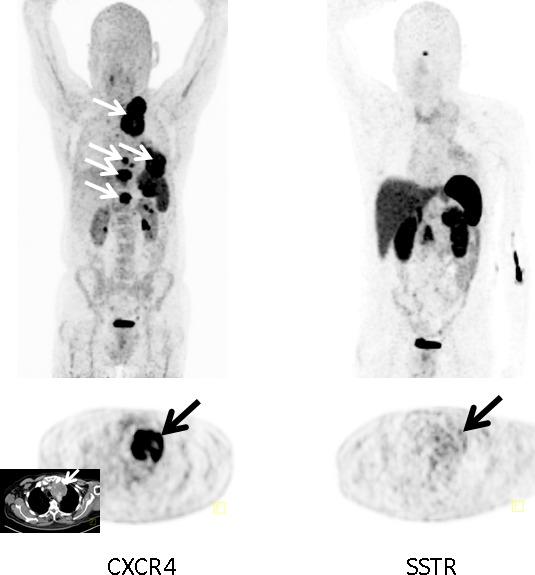
Chemokine receptor CXCR4 is a key factor for tumor growth and metastasis in several types of human cancer. This study investigated the feasibility of CXCR4-directed imaging of small cell lung cancer (SCLC) with positron emission tomography/computed tomography (PET/CT) using the radiolabelled chemokine ligand [68Ga]Pentixafor. 10 patients with primarily diagnosed (n=3) or pre-treated (n=7) SCLC (n=9) or large cell neuroendocrine carcinoma of the lung (LCNEC, n=1) underwent [68Ga]Pentixafor-PET/CT. 2-[18F]fluoro-2-deoxy-D-glucose ([18F]FDG, n=6) and/or somatostatin receptor (SSTR)-directed PET/CT with [68Ga]DOTATOC (n=5) and immunohistochemistry (n=10) served as standards of reference. CXCR4-PET was positive in 8/10 patients and revealed more lesions with significantly higher tumor-to-background ratios than SSTR-PET. Two patients who were positive on [18F]FDG-PET were missed by CXCR4-PET, in the remainder [68Ga]Pentixafor detected an equal (n=2) or higher (n=2) number of lesions. CXCR4 expression of tumor lesions could be confirmed by immunohistochemistry. Non-invasive imaging of CXCR4 expression in SCLC is feasible. [68Ga]Pentixafor as a novel PET tracer might serve as readout for confirmation of CXCR4 expression as prerequisite for potential CXCR4-directed treatment including receptor-radio(drug)peptide therapy.
趋化因子受体CXCR4是多种人类癌症中肿瘤生长和转移的关键因素。本研究使用放射性标记的趋化因子配体[68Ga]喷替沙福,通过正电子发射断层扫描/计算机断层扫描(PET/CT)研究了针对CXCR4的小细胞肺癌(SCLC)成像的可行性。10例初诊(n = 3)或经预处理(n = 7)的SCLC(n = 9)或肺大细胞神经内分泌癌(LCNEC,n = 1)患者接受了[68Ga]喷替沙福-PET/CT检查。2-[18F]氟-2-脱氧-D-葡萄糖([18F]FDG,n = 6)和/或使用[68Ga]奥曲肽的生长抑素受体(SSTR)导向的PET/CT(n = 5)以及免疫组织化学(n = 10)作为参考标准。CXCR4-PET在8/10例患者中呈阳性,与SSTR-PET相比,显示出更多具有显著更高肿瘤与背景比值的病灶。2例[18F]FDG-PET呈阳性的患者被CXCR4-PET漏诊,在其余患者中,[68Ga]喷替沙福检测到的病灶数量相等(n = 2)或更多(n = 2)。肿瘤病灶的CXCR4表达可通过免疫组织化学得到证实。SCLC中CXCR4表达的无创成像是可行的。[68Ga]喷替沙福作为一种新型PET示踪剂,可能作为确认CXCR4表达的检测手段,这是包括受体放射性(药物)肽治疗在内的潜在CXCR4导向治疗的前提条件。


 Zotero 插件