
上颈椎和上胸椎整复与松动术及运动疗法治疗颈源性头痛的多中心随机临床试验
Upper cervical and upper thoracic manipulation versus mobilization and exercise in patients with cervicogenic headache: a multi-center randomized clinical trial.
作者信息
Dunning James R, Butts Raymond, Mourad Firas, Young Ian, Fernandez-de-Las Peñas Cesar, Hagins Marshall, Stanislawski Thomas, Donley Jonathan, Buck Dustin, Hooks Todd R, Cleland Joshua A
机构信息
Alabama Physical Therapy & Acupuncture, Montgomery, AL, USA.
Nova Southeastern University, Ft. Lauderdale, FL, USA.
出版信息
BMC Musculoskelet Disord. 2016 Feb 6;17:64. doi: 10.1186/s12891-016-0912-3.
BACKGROUND
Although commonly utilized interventions, no studies have directly compared the effectiveness of cervical and thoracic manipulation to mobilization and exercise in individuals with cervicogenic headache (CH). The purpose of this study was to compare the effects of manipulation to mobilization and exercise in individuals with CH.
METHODS
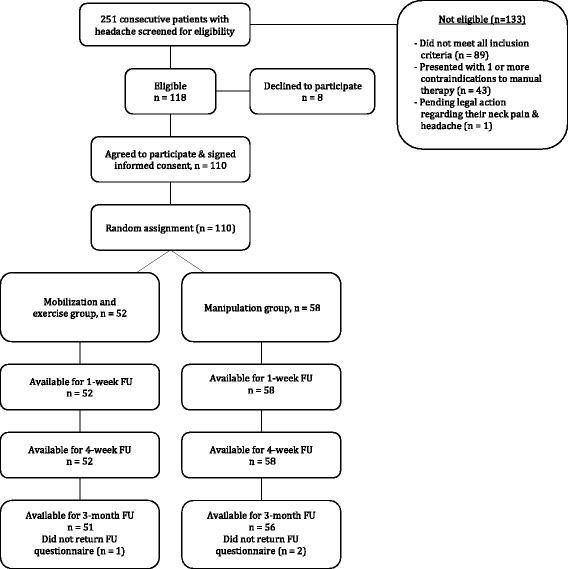
One hundred and ten participants (n = 110) with CH were randomized to receive both cervical and thoracic manipulation (n = 58) or mobilization and exercise (n = 52). The primary outcome was headache intensity as measured by the Numeric Pain Rating Scale (NPRS). Secondary outcomes included headache frequency, headache duration, disability as measured by the Neck Disability Index (NDI), medication intake, and the Global Rating of Change (GRC). The treatment period was 4 weeks with follow-up assessment at 1 week, 4 weeks, and 3 months after initial treatment session. The primary aim was examined with a 2-way mixed-model analysis of variance (ANOVA), with treatment group (manipulation versus mobilization and exercise) as the between subjects variable and time (baseline, 1 week, 4 weeks and 3 months) as the within subjects variable.
RESULTS
The 2X4 ANOVA demonstrated that individuals with CH who received both cervical and thoracic manipulation experienced significantly greater reductions in headache intensity (p < 0.001) and disability (p < 0.001) than those who received mobilization and exercise at a 3-month follow-up. Individuals in the upper cervical and upper thoracic manipulation group also experienced less frequent headaches and shorter duration of headaches at each follow-up period (p < 0.001 for all). Additionally, patient perceived improvement was significantly greater at 1 and 4-week follow-up periods in favor of the manipulation group (p < 0.001).
CONCLUSIONS
Six to eight sessions of upper cervical and upper thoracic manipulation were shown to be more effective than mobilization and exercise in patients with CH, and the effects were maintained at 3 months.
TRIAL REGISTRATION
NCT01580280 April 16, 2012.
背景
尽管颈椎和胸椎手法治疗是常用的干预措施,但尚无研究直接比较颈椎和胸椎手法治疗与松动术及运动疗法对颈源性头痛(CH)患者的疗效。本研究旨在比较手法治疗与松动术及运动疗法对CH患者的影响。
方法
110例CH患者被随机分为两组,分别接受颈椎和胸椎手法治疗(n = 58)或松动术及运动疗法(n = 52)。主要结局指标为采用数字疼痛评分量表(NPRS)测量的头痛强度。次要结局指标包括头痛频率、头痛持续时间、采用颈部功能障碍指数(NDI)测量的功能障碍、药物摄入量以及总体变化评分(GRC)。治疗期为4周,在初始治疗后1周、4周和3个月进行随访评估。主要目的采用两因素混合方差分析(ANOVA)进行检验,治疗组(手法治疗与松动术及运动疗法)作为组间变量,时间(基线、1周、4周和3个月)作为组内变量。
结果
2×4方差分析表明,在3个月随访时,接受颈椎和胸椎手法治疗的CH患者头痛强度(p < 0.001)和功能障碍(p < 0.001)的改善程度明显大于接受松动术及运动疗法的患者。在每个随访期,上颈椎和上胸椎手法治疗组的患者头痛频率更低,头痛持续时间更短(所有p值均< 0.001)。此外,在1周和4周随访期,患者自我感觉的改善情况明显更有利于手法治疗组(p < 0.001)。
结论
对于CH患者,6至8次上颈椎和上胸椎手法治疗比松动术及运动疗法更有效,且疗效在3个月时仍持续存在。
试验注册
NCT01580280,2012年4月16日。

 Zotero 插件