
自噬与胶质母细胞瘤放疗及替莫唑胺的治疗性相互作用:证据与待解决的问题
Therapeutic interactions of autophagy with radiation and temozolomide in glioblastoma: evidence and issues to resolve.
作者信息
Koukourakis Michael I, Mitrakas Achilleas G, Giatromanolaki Alexandra
机构信息
Department of Radiotherapy/Oncology, Democritus University of Thrace, PO Box 12, Alexandroupolis 68100, Greece.
Department of Pathology, Democritus University of Thrace, Alexandroupolis 68100, Greece.
出版信息
Br J Cancer. 2016 Mar 1;114(5):485-96. doi: 10.1038/bjc.2016.19. Epub 2016 Feb 18.
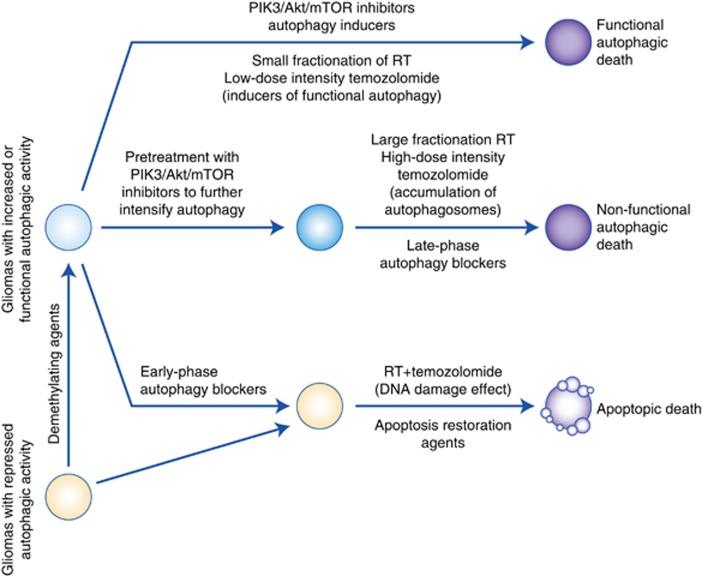
Glioblastoma is a unique model of non-metastasising disease that kills the vast majority of patients through local growth, despite surgery and local irradiation. Glioblastoma cells are resistant to apoptotic stimuli, and their death occurs through autophagy. This review aims to critically present our knowledge regarding the autophagic response of glioblastoma cells to radiation and temozolomide (TMZ) and to delineate eventual research directions to follow, in the quest of improving the curability of this incurable, as yet, disease. Radiation and TMZ interfere with the autophagic machinery, but whether cell response is driven to autophagy flux acceleration or blockage is disputable and may depend on both cell individuality and radiotherapy fractionation or TMZ schedules. Potent agents that block autophagy at an early phase of initiation or at a late phase of autolysosomal fusion are available aside to agents that induce functional autophagy, or even demethylating agents that may unblock the function of autophagy-initiating genes in a subset of tumours. All these create a maze, which if properly investigated can open new insights for the application of novel radio- and chemosensitising policies, exploiting the autophagic pathways that glioblastomas use to escape death.
胶质母细胞瘤是一种非转移性疾病的独特模型,尽管进行了手术和局部放疗,但绝大多数患者仍因局部生长而死亡。胶质母细胞瘤细胞对凋亡刺激具有抗性,其死亡通过自噬发生。本综述旨在批判性地阐述我们关于胶质母细胞瘤细胞对放疗和替莫唑胺(TMZ)的自噬反应的知识,并勾勒出后续可能的研究方向,以寻求提高这种目前仍无法治愈的疾病的治愈率。放疗和TMZ会干扰自噬机制,但细胞反应是被驱动至自噬通量加速还是阻断仍存在争议,这可能取决于细胞个体差异以及放疗分割方案或TMZ给药方案。除了诱导功能性自噬的药物,甚至是可能在一部分肿瘤中解除自噬起始基因功能阻断的去甲基化药物之外,还有能在自噬起始早期或自溶酶体融合后期阻断自噬的强效药物。所有这些构成了一个迷宫,如果能进行恰当研究,可为应用新的放疗和化疗增敏策略开辟新的思路,利用胶质母细胞瘤用于逃避死亡的自噬途径。
 Zotero 插件