
RSC重塑复合物介导的逐步核小体易位
Stepwise nucleosome translocation by RSC remodeling complexes.
作者信息
Harada Bryan T, Hwang William L, Deindl Sebastian, Chatterjee Nilanjana, Bartholomew Blaine, Zhuang Xiaowei
机构信息
Graduate Program in Biophysics, Harvard University, Cambridge, United States.
Howard Hughes Medical Institute, Harvard University, Cambridge, United States.
出版信息
Elife. 2016 Feb 19;5:e10051. doi: 10.7554/eLife.10051.
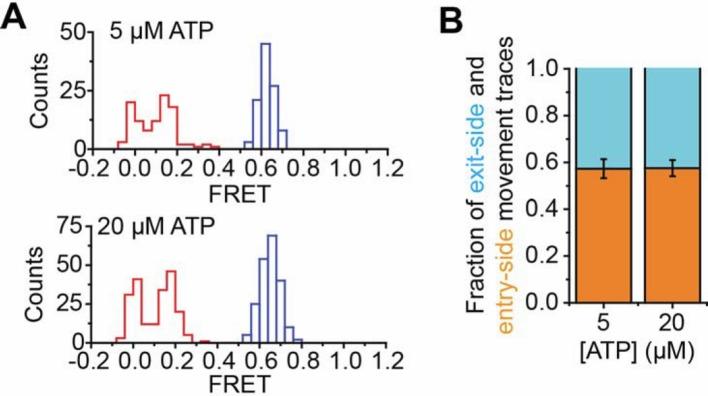
The SWI/SNF-family remodelers regulate chromatin structure by coupling the free energy from ATP hydrolysis to the repositioning and restructuring of nucleosomes, but how the ATPase activity of these enzymes drives the motion of DNA across the nucleosome remains unclear. Here, we used single-molecule FRET to monitor the remodeling of mononucleosomes by the yeast SWI/SNF remodeler, RSC. We observed that RSC primarily translocates DNA around the nucleosome without substantial displacement of the H2A-H2B dimer. At the sites where DNA enters and exits the nucleosome, the DNA moves largely along or near its canonical wrapping path. The translocation of DNA occurs in a stepwise manner, and at both sites where DNA enters and exits the nucleosome, the step size distributions exhibit a peak at approximately 1-2 bp. These results suggest that the movement of DNA across the nucleosome is likely coupled directly to DNA translocation by the ATPase at its binding site inside the nucleosome.
SWI/SNF家族重塑因子通过将ATP水解产生的自由能与核小体的重新定位和结构重组相偶联来调节染色质结构,但这些酶的ATP酶活性如何驱动DNA在核小体上的移动仍不清楚。在这里,我们使用单分子荧光共振能量转移(FRET)来监测酵母SWI/SNF重塑因子RSC对单核小体的重塑。我们观察到,RSC主要在核小体周围转运DNA,而H2A-H2B二聚体没有大量位移。在DNA进入和离开核小体的位点,DNA主要沿着或靠近其经典缠绕路径移动。DNA的转运以逐步方式发生,并且在DNA进入和离开核小体的两个位点,步长分布在大约1-2个碱基对处呈现一个峰值。这些结果表明,DNA在核小体上的移动可能直接与ATP酶在核小体内部其结合位点处的DNA转运相偶联。


 Zotero 插件