
正常生理状态下前胸腺素α的亚细胞分布:免疫组织化学与蛋白质印迹法的比较视角
Subcellular dissemination of prothymosin alpha at normal physiology: immunohistochemical vis-a-vis western blotting perspective.
作者信息
Kijogi Caroline Mwendwa, Khayeka-Wandabwa Christopher, Sasaki Keita, Tanaka Yoshimasa, Kurosu Hiroshi, Matsunaga Hayato, Ueda Hiroshi
机构信息
Department of Molecular Microbiology and Immunology, Division of Immunology, Graduate School of Biomedical Sciences, Nagasaki University, Nagasaki, Japan.
Institute of Tropical Medicine and Infectious Diseases-KEMRI (ITROMID-KEMRI), Nairobi, Kenya.
出版信息
BMC Physiol. 2016 Mar 1;16:2. doi: 10.1186/s12899-016-0021-4.
BACKGROUND
The cell type, cell status and specific localization of Prothymosin α (PTMA) within cells seemingly determine its function. PTMA undergoes 2 types of protease proteolytic modifications that are useful in elucidating its interactions with other molecules; a factor that typifies its roles. Preferably a nuclear protein, PTMA has been shown to function in the cytoplasm and extracellularly with much evidence leaning on pathognomonic status. As such, determination of its cellular distribution under normal physiological context while utilizing varied techniques is key to illuminating prospective validation of its distinct functions in different tissues. Differential distribution insights at normal physiology would also portent better basis for further clarification of its interactions and proteolytic modifications under pathological conditions like numerous cancer, ischemic stroke and immunomodulation. We therefore raised an antibody against the C terminal of PTMA to use in tandem with available antibody against the N terminal in a murine model to explicate the differences in its distribution in brain cell types and major peripheral organs through western blotting and immunohistochemical approaches.
RESULTS
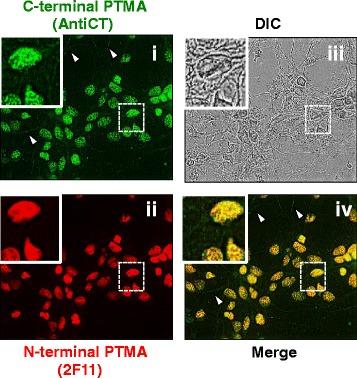
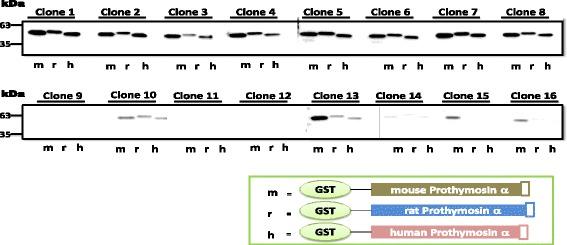
The newly generated antibody was applied against the N-terminal antibody to distinguish truncated versions of PTMA or deduce possible masking of the protein by other interacting molecules. Western blot analysis indicated presence of a truncated form of the protein only in the thymus, while immunohistochemical analysis showed that in brain hippocampus the full-length PTMA was stained prominently in the nucleus whereas in the stomach full-length PTMA staining was not observed in the nucleus but in the cytoplasm.
CONCLUSION
Truncated PTMA could not be detected by western blotting when both antibodies were applied in all tissues examined except the thymus. However, immunohistochemistry revealed differential staining by these antibodies suggesting possible masking of epitopes by interacting molecules. The differential localization patterns observed in the context of nucleic versus cytoplasmic presence as well as punctate versus diffuse pattern in tissues and cell types, warrant further investigations as to the forms of PTMA interacting partners.
背景
原胸腺素α(PTMA)在细胞内的细胞类型、细胞状态及特定定位似乎决定了其功能。PTMA经历两种蛋白酶水解修饰,这有助于阐明其与其他分子的相互作用,这一因素体现了其作用特点。PTMA通常是一种核蛋白,但也已证明它在细胞质和细胞外发挥作用,且有大量证据表明其与疾病特征状态有关。因此,利用多种技术确定其在正常生理环境下的细胞分布,对于阐明其在不同组织中独特功能的潜在验证至关重要。正常生理状态下的差异分布见解也将为进一步阐明其在多种癌症、缺血性中风和免疫调节等病理条件下的相互作用及蛋白水解修饰提供更好的基础。因此,我们制备了一种针对PTMA C末端的抗体,以便在小鼠模型中与现有的针对N末端的抗体联合使用,通过蛋白质印迹法和免疫组织化学方法来阐明其在脑细胞类型和主要外周器官中的分布差异。
结果
将新制备的抗体与N末端抗体一起使用,以区分PTMA的截短形式或推断该蛋白是否可能被其他相互作用分子掩盖。蛋白质印迹分析表明,仅在胸腺中存在该蛋白的截短形式,而免疫组织化学分析显示,在脑海马体中,全长PTMA在细胞核中染色明显,而在胃中,未在细胞核中观察到全长PTMA染色,而是在细胞质中。
结论
当两种抗体应用于除胸腺外的所有检测组织时,蛋白质印迹法无法检测到截短的PTMA。然而,免疫组织化学显示这些抗体的染色存在差异,表明表位可能被相互作用分子掩盖。在组织和细胞类型中观察到的核酸与细胞质存在以及点状与弥漫性模式的差异定位模式,需要进一步研究PTMA相互作用伙伴的形式。



 Zotero 插件