
身高、体重指数与社会经济地位:英国生物银行的孟德尔随机化研究
Height, body mass index, and socioeconomic status: mendelian randomisation study in UK Biobank.
作者信息
Tyrrell Jessica, Jones Samuel E, Beaumont Robin, Astley Christina M, Lovell Rebecca, Yaghootkar Hanieh, Tuke Marcus, Ruth Katherine S, Freathy Rachel M, Hirschhorn Joel N, Wood Andrew R, Murray Anna, Weedon Michael N, Frayling Timothy M
机构信息
Genetics of Complex Traits, Institute of Biomedical and Clinical Science, University of Exeter Medical School, Royal Devon and Exeter Hospital, Exeter EX2 5DW, UK European Centre for Environment and Human Health, University of Exeter Medical School, The Knowledge Spa, Truro TR1 3HD, UK.
Genetics of Complex Traits, Institute of Biomedical and Clinical Science, University of Exeter Medical School, Royal Devon and Exeter Hospital, Exeter EX2 5DW, UK.
出版信息
BMJ. 2016 Mar 8;352:i582. doi: 10.1136/bmj.i582.
OBJECTIVE
To determine whether height and body mass index (BMI) have a causal role in five measures of socioeconomic status.
DESIGN
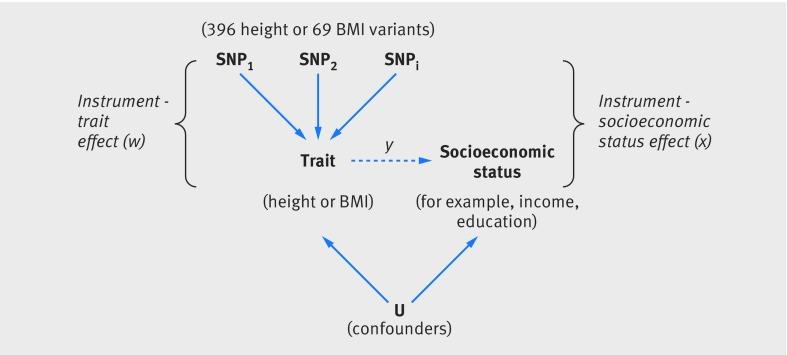
Mendelian randomisation study to test for causal effects of differences in stature and BMI on five measures of socioeconomic status. Mendelian randomisation exploits the fact that genotypes are randomly assigned at conception and thus not confounded by non-genetic factors.
SETTING
UK Biobank.
PARTICIPANTS
119,669 men and women of British ancestry, aged between 37 and 73 years.
MAIN OUTCOME MEASURES
Age completed full time education, degree level education, job class, annual household income, and Townsend deprivation index.
RESULTS
In the UK Biobank study, shorter stature and higher BMI were observationally associated with several measures of lower socioeconomic status. The associations between shorter stature and lower socioeconomic status tended to be stronger in men, and the associations between higher BMI and lower socioeconomic status tended to be stronger in women. For example, a 1 standard deviation (SD) higher BMI was associated with a £210 (€276; $300; 95% confidence interval £84 to £420; P=6 × 10(-3)) lower annual household income in men and a £1890 (£1680 to £2100; P=6 × 10(-15)) lower annual household income in women. Genetic analysis provided evidence that these associations were partly causal. A genetically determined 1 SD (6.3 cm) taller stature caused a 0.06 (0.02 to 0.09) year older age of completing full time education (P=0.01), a 1.12 (1.07 to 1.18) times higher odds of working in a skilled profession (P=6 × 10(-7)), and a £1130 (£680 to £1580) higher annual household income (P=4 × 10(-8)). Associations were stronger in men. A genetically determined 1 SD higher BMI (4.6 kg/m(2)) caused a £2940 (£1680 to £4200; P=1 × 10(-5)) lower annual household income and a 0.10 (0.04 to 0.16) SD (P=0.001) higher level of deprivation in women only.
CONCLUSIONS
These data support evidence that height and BMI play an important partial role in determining several aspects of a person's socioeconomic status, especially women's BMI for income and deprivation and men's height for education, income, and job class. These findings have important social and health implications, supporting evidence that overweight people, especially women, are at a disadvantage and that taller people, especially men, are at an advantage.
目的
确定身高和体重指数(BMI)在社会经济地位的五项指标中是否具有因果作用。
设计
孟德尔随机化研究,以检验身高和BMI差异对社会经济地位五项指标的因果效应。孟德尔随机化利用了受孕时基因型随机分配这一事实,因此不会受到非遗传因素的混淆。
研究背景
英国生物银行。
研究对象
119,669名年龄在37至73岁之间的英国血统男女。
主要观察指标
完成全日制教育的年龄、学位水平教育、职业类别、家庭年收入和汤森贫困指数。
结果
在英国生物银行的研究中,观察发现身材较矮和BMI较高与社会经济地位较低的多项指标相关。身材较矮与社会经济地位较低之间的关联在男性中往往更强,而BMI较高与社会经济地位较低之间的关联在女性中往往更强。例如,男性BMI每增加1个标准差(SD),家庭年收入就会降低210英镑(276欧元;300美元;95%置信区间84英镑至420英镑;P = 6×10⁻³);女性家庭年收入则会降低1890英镑(1680英镑至2100英镑;P = 6×10⁻¹⁵)。基因分析提供的证据表明,这些关联部分是因果关系。基因决定的身高每高1个标准差(6.3厘米),完成全日制教育的年龄就会大0.06岁(0.02至0.09岁)(P = 0.01),从事熟练职业的几率高出1.12倍(1.07至1.18倍)(P = 6×10⁻⁷),家庭年收入高出1130英镑(680英镑至1580英镑)(P = 4×10⁻⁸)。这些关联在男性中更强。基因决定的BMI每高1个标准差(4.6千克/米²),仅在女性中会导致家庭年收入降低2940英镑(1680英镑至4200英镑;P = 1×10⁻⁵),贫困水平高出0.10个标准差(0.04至0.16个标准差)(P = 0.001)。
结论
这些数据支持了身高和BMI在决定一个人社会经济地位的多个方面发挥重要的部分作用的证据,特别是女性的BMI对收入和贫困的影响,以及男性的身高对教育、收入和职业类别的影响。这些发现具有重要的社会和健康意义,支持了超重人群尤其是女性处于劣势,而身材较高的人尤其是男性具有优势的证据。
 Zotero 插件