
纤维蛋白原浓缩物治疗后创伤患者前七天的纤维蛋白原水平:一项回顾性研究。
Fibrinogen levels in trauma patients during the first seven days after fibrinogen concentrate therapy: a retrospective study.
作者信息
Schlimp Christoph J, Ponschab Martin, Voelckel Wolfgang, Treichl Benjamin, Maegele Marc, Schöchl Herbert
机构信息
Ludwig Boltzmann Institute for Experimental and Clinical Traumatology, AUVA Research Centre, Vienna, Austria.
Department of Anaesthesiology and Intensive Care, AUVA Trauma Centre, Academic Teaching Hospital of the Paracelsus Medical University, Franz Rehrl Platz 5, 5020, Salzburg, Austria.
出版信息
Scand J Trauma Resusc Emerg Med. 2016 Mar 12;24:29. doi: 10.1186/s13049-016-0221-8.
BACKGROUND
Fibrinogen concentrate (FC) is increasingly used as first line therapy in bleeding trauma patients. It remains unproven whether FC application increases post-traumatic plasma fibrinogen concentration (FIB) in injured patients, possibly constituting a prothrombotic risk. Thus, we investigated the evolution of FIB following trauma in patients with or without FC therapy.
METHODS
At the AUVA Trauma Centre, Salzburg, we performed a retrospective study of patients admitted to the emergency room and whose FIB levels were documented thereafter up to day 7 post-trauma. Patients were categorized into those with (treatment group) or without (control group) FC therapy during the first 24 h after hospital admission. A subgroup analysis was carried out to investigate the influence of the amount of FC given.
RESULTS
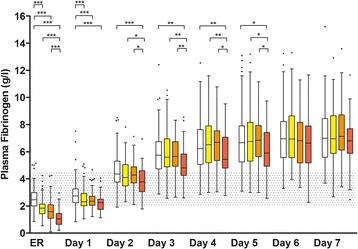
The study enrolled 435 patients: treatment group, n = 242 (56 %); control group, n = 193 (44%), with median Injury Severity Score of 34 vs. 22 (P < 0.001) and massive transfusion rate of 18.4% vs. 0.2% (P < 0.001). In the treatment group (median FC dose 6 g), FIB was lower on admission and up to day 2 compared with the control group. In patients receiving high (≥10 g) doses of FC, FIB was lower up to day 5 as compared to controls. At other timepoints, FIB did not differ significantly between the groups. In the treatment vs. the control group, other coagulation parameters such as prothrombin time index and platelet count were consistently lower, while activated partial thromboplastin time was consistently prolonged at most timepoints. Inflammatory parameters such as C-reactive protein, interleukin-6 and procalcitonin were generally lower in controls.
DISCUSSION
The rise of FIB levels from day 2 onwards in our study can be attributed to an upregulated fibrinogen synthesis in the liver, occurring in both study groups as part of the acute phase response after tissue injury.
CONCLUSIONS
The treatment of severe trauma patients with FC during bleeding management in the first 24 h after hospital admission does not lead to higher FIB levels post-trauma beyond that occurring naturally due to the acute phase response.
背景
纤维蛋白原浓缩物(FC)越来越多地被用作出血性创伤患者的一线治疗药物。FC的应用是否会增加受伤患者创伤后血浆纤维蛋白原浓度(FIB)仍未得到证实,这可能构成血栓形成风险。因此,我们研究了接受或未接受FC治疗的患者创伤后FIB的变化情况。
方法
在萨尔茨堡的AUVA创伤中心,我们对入住急诊室且此后直至创伤后第7天有FIB水平记录的患者进行了一项回顾性研究。患者被分为入院后最初24小时内接受FC治疗(治疗组)或未接受FC治疗(对照组)的患者。进行了亚组分析以研究给予FC的量的影响。
结果
该研究纳入了435例患者:治疗组,n = 242例(56%);对照组,n = 193例(44%),损伤严重程度评分中位数分别为34和22(P < 0.001),大量输血率分别为18.4%和0.2%(P < 0.001)。在治疗组(FC剂量中位数为6 g)中,入院时及直至第2天FIB水平低于对照组。接受高剂量(≥10 g)FC的患者,直至第5天FIB水平低于对照组。在其他时间点,两组之间FIB无显著差异。在治疗组与对照组中,其他凝血参数如凝血酶原时间指数和血小板计数持续较低,而活化部分凝血活酶时间在大多数时间点持续延长。炎症参数如C反应蛋白、白细胞介素-6和降钙素原在对照组中通常较低。
讨论
在我们的研究中,从第2天起FIB水平的升高可归因于肝脏中纤维蛋白原合成上调,这在两个研究组中均作为组织损伤后急性期反应的一部分而发生。
结论
在入院后最初24小时出血管理期间用FC治疗严重创伤患者,创伤后FIB水平不会高于急性期反应自然产生的水平。


 Zotero 插件