
NEMO通过依赖和不依赖NF-κB的功能预防RIP激酶1介导的上皮细胞死亡和慢性肠道炎症。
NEMO Prevents RIP Kinase 1-Mediated Epithelial Cell Death and Chronic Intestinal Inflammation by NF-κB-Dependent and -Independent Functions.
作者信息
Vlantis Katerina, Wullaert Andy, Polykratis Apostolos, Kondylis Vangelis, Dannappel Marius, Schwarzer Robin, Welz Patrick, Corona Teresa, Walczak Henning, Weih Falk, Klein Ulf, Kelliher Michelle, Pasparakis Manolis
机构信息
Institute for Genetics, University of Cologne, 50674 Cologne, Germany; Cologne Excellence Cluster on Cellular Stress Responses in Aging-Associated Diseases (CECAD), University of Cologne, 50931 Cologne, Germany; Center for Molecular Medicine (CMMC), University of Cologne, 50931 Cologne, Germany.
Centre for Cell Death, Cancer and Inflammation (CCCI), UCL Cancer Institute, University College London, 72 Huntley Street, London WC1E 6D, UK.
出版信息
Immunity. 2016 Mar 15;44(3):553-567. doi: 10.1016/j.immuni.2016.02.020.
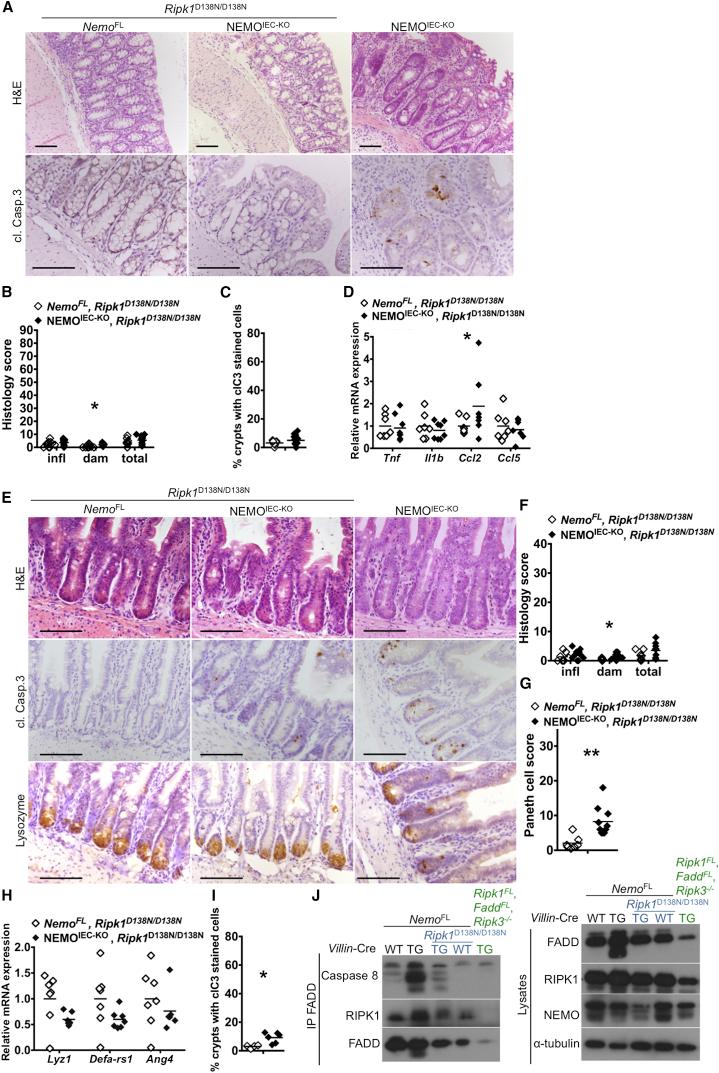
Intestinal epithelial cells (IECs) regulate gut immune homeostasis, and impaired epithelial responses are implicated in the pathogenesis of inflammatory bowel diseases (IBD). IEC-specific ablation of nuclear factor κB (NF-κB) essential modulator (NEMO) caused Paneth cell apoptosis and impaired antimicrobial factor expression in the ileum, as well as colonocyte apoptosis and microbiota-driven chronic inflammation in the colon. Combined RelA, c-Rel, and RelB deficiency in IECs caused Paneth cell apoptosis but not colitis, suggesting that NEMO prevents colon inflammation by NF-κB-independent functions. Inhibition of receptor-interacting protein kinase 1 (RIPK1) kinase activity or combined deficiency of Fas-associated via death domain protein (FADD) and RIPK3 prevented epithelial cell death, Paneth cell loss, and colitis development in mice with epithelial NEMO deficiency. Therefore, NEMO prevents intestinal inflammation by inhibiting RIPK1 kinase activity-mediated IEC death, suggesting that RIPK1 inhibitors could be effective in the treatment of colitis in patients with NEMO mutations and possibly in IBD.
肠道上皮细胞(IECs)调节肠道免疫稳态,上皮反应受损与炎症性肠病(IBD)的发病机制有关。在IECs中特异性敲除核因子κB(NF-κB)必需调节因子(NEMO)会导致潘氏细胞凋亡,回肠中抗菌因子表达受损,以及结肠细胞凋亡和结肠中微生物群驱动的慢性炎症。IECs中RelA、c-Rel和RelB联合缺陷会导致潘氏细胞凋亡,但不会引起结肠炎,这表明NEMO通过不依赖NF-κB的功能预防结肠炎症。抑制受体相互作用蛋白激酶1(RIPK1)激酶活性或通过死亡结构域蛋白(FADD)和RIPK3联合缺陷可预防上皮NEMO缺陷小鼠的上皮细胞死亡、潘氏细胞丢失和结肠炎发展。因此,NEMO通过抑制RIPK1激酶活性介导的IEC死亡来预防肠道炎症,这表明RIPK1抑制剂可能对治疗NEMO突变患者的结肠炎有效,也可能对IBD有效。


 Zotero 插件