
2型糖尿病青少年的心肺功能障碍与脂联素
Cardiopulmonary Dysfunction and Adiponectin in Adolescents With Type 2 Diabetes.
作者信息
Bjornstad Petter, Truong Uyen, Dorosz Jennifer L, Cree-Green Melanie, Baumgartner Amy, Coe Gregory, Pyle Laura, Regensteiner Judith G, Reusch Jane E B, Nadeau Kristen J
机构信息
Department of Pediatric Endocrinology, University of Colorado School of Medicine, Aurora, CO
Division of Pediatric Cardiology, University of Colorado School of Medicine, Aurora, CO.
出版信息
J Am Heart Assoc. 2016 Mar 18;5(3):e002804. doi: 10.1161/JAHA.115.002804.
BACKGROUND
Myocardial mechanics are altered in adults with obesity and type 2 diabetes (T2D); insulin resistance and adipokines have been implicated as important risk factors for cardiovascular disease, but these relationships are poorly described in adolescents. We hypothesized that obese adolescents and adolescents with T2D would have abnormal cardiac function compared to lean adolescents. In addition, we hypothesized that insulin sensitivity (IS), adiposity, and adipokines would be associated with altered cardiac strain and cardiopulmonary fitness in adolescents with T2D.
METHODS AND RESULTS
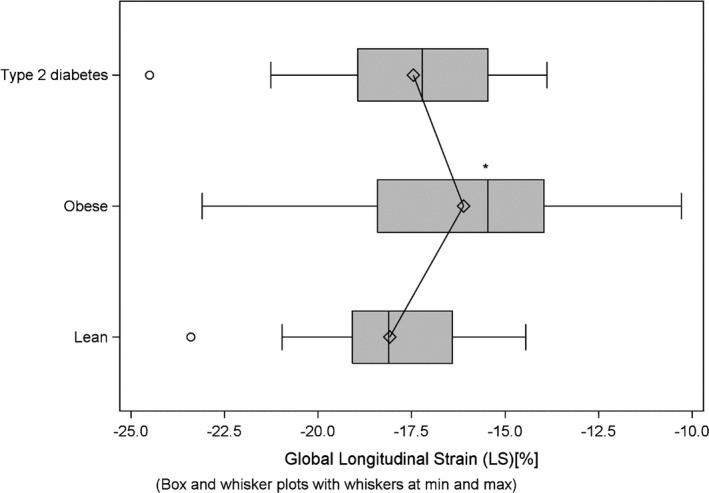
Adolescents (15±2 years) with T2D (n=37), obesity without diabetes (n=41), and lean controls (n=31) of similar age and pubertal stage underwent echocardiography with speckle tracking, assessment of IS by hyperinsulinemic-euglycemic clamp, body composition by dual-energy x-ray absorptiometry, peak oxygen consumption (VO2peak) by cycle ergometry, adiponectin, and leptin. Compared to lean and to obese controls, adolescents with T2D had significantly lower cardiac circumferential strain (CS) (-18.9±4.6 [T2D] versus -21.5±3.5 [obese] versus -22.0±4.2% [lean], P=0.04) and VO2peak (37.6±7.5 [T2D] versus 43.4±8.2 [obese] versus 47.6±8.6 mL/lean kg/min [lean], P<0.0001). In T2D youth, VO2peak was associated with CS, and the association remained significant after adjusting for age, sex, and IS (β±SE: -0.73±0.26, P=0.02). Among adolescents with T2D, CS was also associated with adiponectin, longitudinal strain with leptin, and VO2peak with adiponectin and IS.
CONCLUSIONS
Adolescents with T2D had abnormal CS and reduced VO2peak compared to obese and lean controls, which may represent the earliest evidence of cardiac functional impairment in T2D. Low adiponectin, rather than conventional risk factors and IS, correlated with CS, while both adiponectin and IS related to cardiopulmonary fitness.
背景
肥胖和2型糖尿病(T2D)成年患者的心肌力学发生改变;胰岛素抵抗和脂肪因子被认为是心血管疾病的重要危险因素,但这些关系在青少年中鲜有描述。我们推测,与瘦青少年相比,肥胖青少年和T2D青少年的心脏功能会异常。此外,我们推测胰岛素敏感性(IS)、肥胖程度和脂肪因子与T2D青少年的心脏应变改变和心肺适能相关。
方法和结果
对年龄和青春期阶段相似的T2D青少年(15±2岁,n=37)、无糖尿病的肥胖青少年(n=41)和瘦对照组(n=31)进行斑点追踪超声心动图检查、通过高胰岛素-正常血糖钳夹评估IS、通过双能X线吸收法评估身体成分、通过功率自行车运动测试评估峰值耗氧量(VO2peak)、检测脂联素和瘦素。与瘦对照组和肥胖对照组相比,T2D青少年的心脏圆周应变(CS)显著降低(-18.9±4.6 [T2D] 对比 -21.5±3.5 [肥胖] 对比 -22.0±4.2% [瘦],P=0.04),VO2peak也显著降低(37.6±7.5 [T2D] 对比 43.4±8.2 [肥胖] 对比 47.6±8.6 mL/瘦体重·分钟 [瘦],P<0.0001)。在T2D青少年中,VO2peak与CS相关,在调整年龄、性别和IS后,这种关联仍然显著(β±SE:-0.73±0.26,P=0.02)。在患有T2D的青少年中,CS也与脂联素相关,纵向应变与瘦素相关,VO2peak与脂联素和IS相关。
结论
与肥胖和瘦对照组相比,T2D青少年的CS异常且VO2peak降低,这可能是T2D中心脏功能损害的最早证据。低脂联素而非传统危险因素和IS与CS相关,而脂联素和IS均与心肺适能相关。




 Zotero 插件