
创伤和损伤严重程度评分在韩国钝性创伤人群中的适用性及使用评分预测指标的新模型建议
The Applicability of Trauma and Injury Severity Score for a Blunt Trauma Population in Korea and a Proposal of New Models Using Score Predictors.
作者信息
Jung Kyoungwon, Huh Yo, Lee John Cook-Jong, Kim Younghwan, Moon Jonghwan, Youn Seok Hwa, Kim Jiyoung, Kim Juryang, Kim Hyoju
机构信息
Division of Trauma Surgery, Department of Surgery, Ajou University School of Medicine, Suwon, Korea.
Ajou Regional Trauma Center, Ajou University Hospital, Suwon, Korea.
出版信息
Yonsei Med J. 2016 May;57(3):728-34. doi: 10.3349/ymj.2016.57.3.728.
PURPOSE
The purpose of this study was to verify the utility of existing Trauma and Injury Severity Score (TRISS) coefficients and to propose a new prediction model with a new set of TRISS coefficients or predictors.
MATERIALS AND METHODS
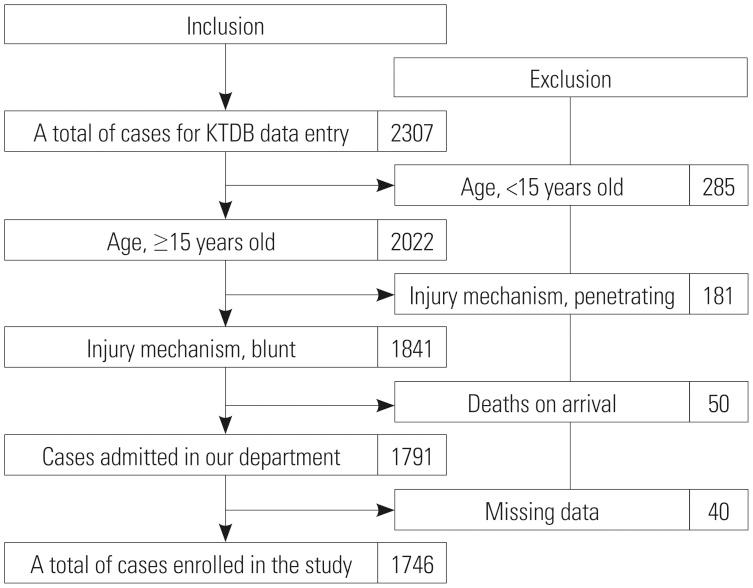
Of the blunt adult trauma patients who were admitted to our hospital in 2014, those eligible for Korea Trauma Data Bank entry were selected to collect the TRISS predictors. The study data were input into the TRISS formula to obtain "probability of survival" values, which were examined for consistency with actual patient survival status. For TRISS coefficients, Major Trauma Outcome Study-derived values revised in 1995 and National Trauma Data Bank-derived and National Sample Project-derived coefficients revised in 2009 were used. Additionally, using a logistic regression method, a new set of coefficients was derived from our medical center's database. Areas under the receiver operating characteristic (ROC) curve (AUC) for each prediction ability were obtained, and a pairwise comparison of ROC curves was performed.
RESULTS
In the statistical analysis, the AUCs (0.879-0.899) for predicting outcomes were lower than those of other countries. However, by adjusting the TRISS score using a continuous variable rather than a code for age, we were able to achieve higher AUCs [0.913 (95% confidence interval, 0.899 to 0.926)].
CONCLUSION
These results support further studies that will allow a more accurate prediction of prognosis for trauma patients. Furthermore, Korean TRISS coefficients or a new prediction model suited for Korea needs to be developed using a sufficiently sized sample.
目的
本研究的目的是验证现有创伤和损伤严重程度评分(TRISS)系数的效用,并提出一个具有一组新的TRISS系数或预测指标的新预测模型。
材料与方法
选取2014年入住我院的成年钝性创伤患者中符合韩国创伤数据库录入条件者,收集TRISS预测指标。将研究数据输入TRISS公式以获得“生存概率”值,并检查其与患者实际生存状况的一致性。对于TRISS系数,使用了1995年修订的重大创伤结局研究得出的值以及2009年修订的国家创伤数据库得出的系数和国家样本项目得出的系数。此外,使用逻辑回归方法从我们医疗中心的数据库中得出一组新的系数。获得每个预测能力的受试者操作特征(ROC)曲线下面积(AUC),并对ROC曲线进行两两比较。
结果
在统计分析中,预测结局的AUC(0.879 - 0.899)低于其他国家。然而,通过使用连续变量而非年龄代码来调整TRISS评分,我们能够获得更高的AUC [0.913(95%置信区间,0.899至0.926)]。
结论
这些结果支持进一步开展研究,以便更准确地预测创伤患者的预后。此外,需要使用足够大的样本量来开发适合韩国的TRISS系数或新的预测模型。


 Zotero 插件