
过氧化物酶体增殖物激活受体-α和受体-γ在高草酸尿症啮齿动物肾脏晶体形成中的不同作用
Differential Roles of Peroxisome Proliferator-Activated Receptor-α and Receptor-γ on Renal Crystal Formation in Hyperoxaluric Rodents.
作者信息
Taguchi Kazumi, Okada Atsushi, Hamamoto Shuzo, Unno Rei, Kobayashi Takahiro, Ando Ryosuke, Tozawa Keiichi, Gao Bing, Kohri Kenjiro, Yasui Takahiro
机构信息
Department of Nephrourology, Nagoya City University Graduate School of Medical Sciences, 1 Kawasumi, Mizuho-cho, Mizuho-ku, Nagoya 4678601, Japan.
China-Japan Kidney Stone Research Center, Key Laboratory of Environment and Population Health of Liaoning Education Ministry, Shenyang Medical College, 146 Huanghe North Street, Shenyang 110034, China.
出版信息
PPAR Res. 2016;2016:9605890. doi: 10.1155/2016/9605890. Epub 2016 Feb 28.
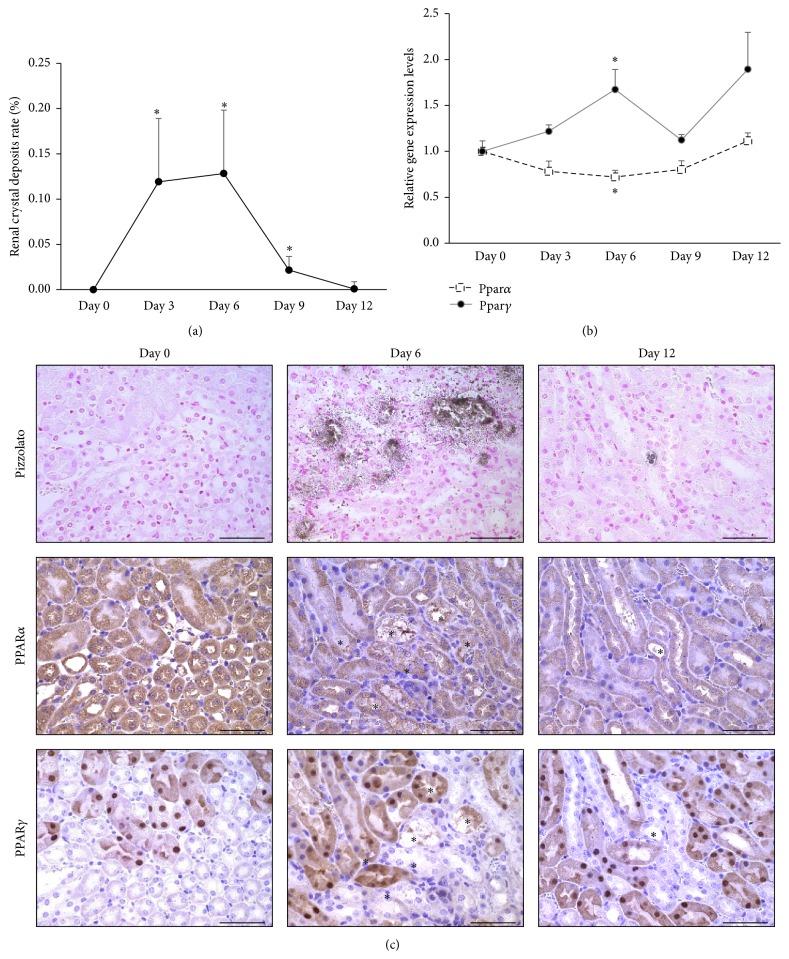
Peroxisome proliferator-activated receptors (PPARs) and related inflammatory and oxidative molecule expression were investigated in a hyperoxaluric rodent model to evaluate the in vivo efficacy of PPAR agonists in preventing renal crystal formation. PPAR expression was examined in a mouse hyperoxaluria kidney stone model induced by daily intra-abdominal glyoxylate injection. Therapeutic effects of the PPARα agonist fenofibrate and PPARγ agonist pioglitazone were also assessed in a 1% ethylene glycol-induced rat model of hyperoxaluria. Crystal formation, inflammation, cell injury, apoptosis, and oxidative stress were compared to those of vehicle-treated controls. Quantitative reverse transcription-polymerase chain reaction revealed that PPARα and PPARγ expression decrease and increase, respectively, during crystal formation in hyperoxaluric kidneys. In addition, PPARα localized to the cytoplasm of both proximal and distal tubular cells, whereas PPARγ accumulated in the nucleus of proximal tubular cells. Furthermore, renal crystal formation was significantly less prevalent in pioglitazone-treated rats but higher in the fenofibrate-treated and fenofibrate/pioglitazone-cotreated groups compared to controls, thus indicating that pioglitazone, but not fenofibrate, markedly decreased cell inflammation, oxidative stress, and apoptosis. Collectively, the results demonstrated that PPARγ suppressed renal crystal formation via its antioxidative and anti-inflammatory effects; however, the renotoxicity of PPARα may elicit the opposite effect.
在高草酸尿啮齿动物模型中研究过氧化物酶体增殖物激活受体(PPARs)以及相关炎症和氧化分子的表达,以评估PPAR激动剂在预防肾结晶形成方面的体内疗效。在通过每日腹腔注射乙醛酸诱导的小鼠高草酸尿肾结石模型中检测PPAR表达。还在1%乙二醇诱导的大鼠高草酸尿模型中评估了PPARα激动剂非诺贝特和PPARγ激动剂吡格列酮的治疗效果。将结晶形成、炎症、细胞损伤、凋亡和氧化应激与载体处理的对照组进行比较。定量逆转录-聚合酶链反应显示,在高草酸尿性肾脏结晶形成过程中,PPARα表达降低,而PPARγ表达增加。此外,PPARα定位于近端和远端肾小管细胞的细胞质中,而PPARγ则聚集在近端肾小管细胞的细胞核中。此外,与对照组相比,吡格列酮治疗的大鼠肾结晶形成明显较少,而非诺贝特治疗组和非诺贝特/吡格列酮联合治疗组的肾结晶形成较多,这表明吡格列酮而非非诺贝特能显著降低细胞炎症、氧化应激和凋亡。总体而言,结果表明PPARγ通过其抗氧化和抗炎作用抑制肾结晶形成;然而,PPARα的肾毒性可能会产生相反的效果。



 Zotero 插件