
去势抵抗性前列腺癌中对第二代雄激素受体拮抗剂恩杂鲁胺的获得性耐药。
Acquired resistance to the second-generation androgen receptor antagonist enzalutamide in castration-resistant prostate cancer.
作者信息
Kregel Steven, Chen James L, Tom Westin, Krishnan Venkatesh, Kach Jacob, Brechka Hannah, Fessenden Tim B, Isikbay Masis, Paner Gladell P, Szmulewitz Russell Z, Vander Griend Donald J
机构信息
Committee on Cancer Biology, The University of Chicago, Chicago, IL, USA.
Department of Biomedical Informatics and Internal Medicine, The Ohio State University, Columbus, OH, USA.
出版信息
Oncotarget. 2016 May 3;7(18):26259-74. doi: 10.18632/oncotarget.8456.
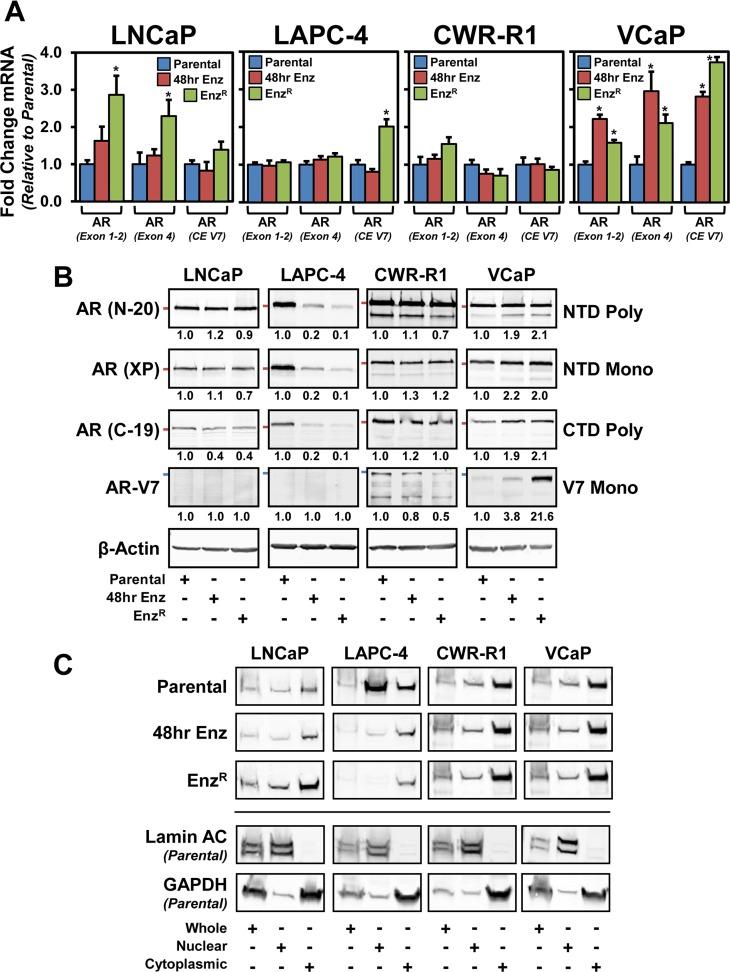
Enzalutamide (MDV3100) is a second generation Androgen Receptor (AR) antagonist with proven efficacy in the treatment of castration resistant prostate cancer (CRPC). The majority of treated patients, however, develop resistance and disease progression and there is a critical need to identify novel targetable pathways mediating resistance. The purpose of this study was to develop and extensively characterize a series of enzalutamide-resistant prostate cancer cell lines. Four genetically distinct AR-positive and AR-pathway dependent prostate cancer cell lines (CWR-R1, LAPC-4, LNCaP, VCaP) were made resistant to enzalutamide by long-term culture (> 6 months) in enzalutamide. Extensive characterization of these lines documented divergent in vitro growth characteristics and AR pathway modulation. Enzalutamide-resistant LNCaP and CWR-R1 cells, but not LAPC-4 and VCAP cells, demonstrated increased castration-resistant and metastatic growth in vivo. Global gene expression analyses between short-term enzalutamide treated vs. enzalutamide-resistant cells identified both AR pathway and non-AR pathway associated changes that were restored upon acquisition of enzalutamide resistance. Further analyses revealed very few common gene expression changes between the four resistant cell lines. Thus, while AR-mediated pathways contribute in part to enzalutamide resistance, an unbiased approach across several cell lines demonstrates a greater contribution toward resistance via pleiotropic, non-AR mediated mechanisms.
恩杂鲁胺(MDV3100)是第二代雄激素受体(AR)拮抗剂,在去势抵抗性前列腺癌(CRPC)治疗中已证实具有疗效。然而,大多数接受治疗的患者会产生耐药性和疾病进展,因此迫切需要确定介导耐药性的新的可靶向通路。本研究的目的是建立并全面表征一系列恩杂鲁胺耐药的前列腺癌细胞系。通过在恩杂鲁胺中进行长期培养(>6个月),使四种基因不同的AR阳性且依赖AR通路的前列腺癌细胞系(CWR-R1、LAPC-4、LNCaP、VCaP)对恩杂鲁胺产生耐药性。对这些细胞系的全面表征记录了不同的体外生长特性和AR通路调节情况。恩杂鲁胺耐药的LNCaP和CWR-R1细胞(而非LAPC-4和VCAP细胞)在体内表现出去势抵抗性和转移性生长增加。短期恩杂鲁胺处理的细胞与恩杂鲁胺耐药细胞之间的全基因表达分析确定了AR通路和非AR通路相关的变化,这些变化在获得恩杂鲁胺耐药性后得以恢复。进一步分析显示,四种耐药细胞系之间几乎没有共同的基因表达变化。因此,虽然AR介导的通路部分导致了恩杂鲁胺耐药性,但对多个细胞系采用无偏倚方法表明,通过多效性、非AR介导的机制对耐药性的贡献更大。




 Zotero 插件