
两个不同的电压感应结构域控制CaV1.1钙通道中电流激活的电压敏感性和动力学。
Two distinct voltage-sensing domains control voltage sensitivity and kinetics of current activation in CaV1.1 calcium channels.
作者信息
Tuluc Petronel, Benedetti Bruno, Coste de Bagneaux Pierre, Grabner Manfred, Flucher Bernhard E
机构信息
Department of Pharmacology and Toxicology, Institute of Pharmacy, University of Innsbruck, A-6020 Innsbruck, Austria.
Department of Physiology and Medical Physics, Medical University Innsbruck, A-6020 Innsbruck, Austria.
出版信息
J Gen Physiol. 2016 Jun;147(6):437-49. doi: 10.1085/jgp.201611568. Epub 2016 May 16.
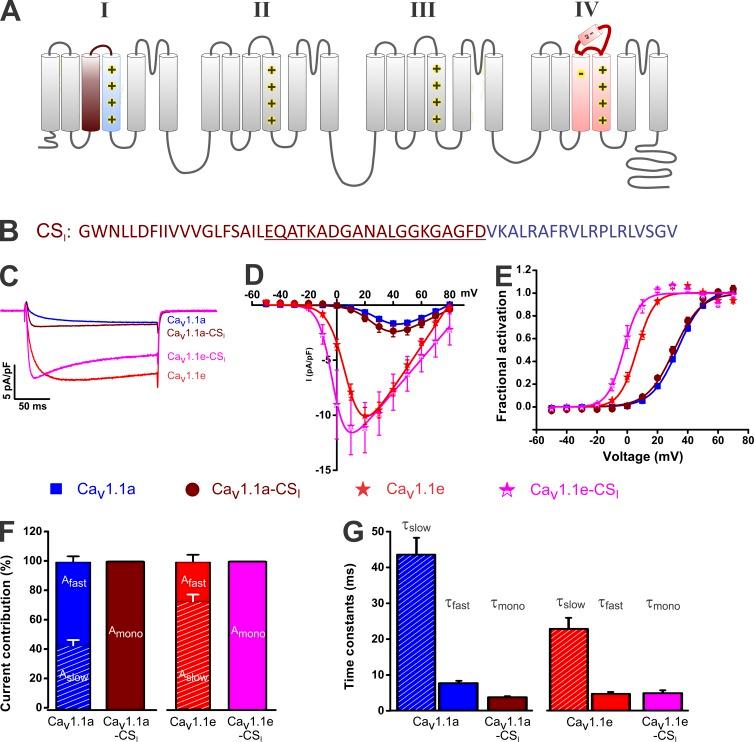
Alternative splicing of the skeletal muscle CaV1.1 voltage-gated calcium channel gives rise to two channel variants with very different gating properties. The currents of both channels activate slowly; however, insertion of exon 29 in the adult splice variant CaV1.1a causes an ∼30-mV right shift in the voltage dependence of activation. Existing evidence suggests that the S3-S4 linker in repeat IV (containing exon 29) regulates voltage sensitivity in this voltage-sensing domain (VSD) by modulating interactions between the adjacent transmembrane segments IVS3 and IVS4. However, activation kinetics are thought to be determined by corresponding structures in repeat I. Here, we use patch-clamp analysis of dysgenic (CaV1.1 null) myotubes reconstituted with CaV1.1 mutants and chimeras to identify the specific roles of these regions in regulating channel gating properties. Using site-directed mutagenesis, we demonstrate that the structure and/or hydrophobicity of the IVS3-S4 linker is critical for regulating voltage sensitivity in the IV VSD, but by itself cannot modulate voltage sensitivity in the I VSD. Swapping sequence domains between the I and the IV VSDs reveals that IVS4 plus the IVS3-S4 linker is sufficient to confer CaV1.1a-like voltage dependence to the I VSD and that the IS3-S4 linker plus IS4 is sufficient to transfer CaV1.1e-like voltage dependence to the IV VSD. Any mismatch of transmembrane helices S3 and S4 from the I and IV VSDs causes a right shift of voltage sensitivity, indicating that regulation of voltage sensitivity by the IVS3-S4 linker requires specific interaction of IVS4 with its corresponding IVS3 segment. In contrast, slow current kinetics are perturbed by any heterologous sequences inserted into the I VSD and cannot be transferred by moving VSD I sequences to VSD IV. Thus, CaV1.1 calcium channels are organized in a modular manner, and control of voltage sensitivity and activation kinetics is accomplished by specific molecular mechanisms within the IV and I VSDs, respectively.
骨骼肌CaV1.1电压门控钙通道的可变剪接产生了两种门控特性差异很大的通道变体。两种通道的电流激活都很缓慢;然而,在成年剪接变体CaV1.1a中插入外显子29会导致激活电压依赖性向右偏移约30 mV。现有证据表明,重复序列IV中的S3-S4连接子(包含外显子29)通过调节相邻跨膜片段IVS3和IVS4之间的相互作用来调节该电压传感结构域(VSD)中的电压敏感性。然而,激活动力学被认为是由重复序列I中的相应结构决定的。在这里,我们对用CaV1.1突变体和嵌合体重构的发育不全(CaV1.1缺失)肌管进行膜片钳分析,以确定这些区域在调节通道门控特性中的具体作用。使用定点诱变,我们证明IVS3-S4连接子的结构和/或疏水性对于调节IV VSD中的电压敏感性至关重要,但它本身不能调节I VSD中的电压敏感性。在I和IV VSD之间交换序列结构域表明,IVS4加上IVS3-S4连接子足以赋予I VSD类似CaV1.1a的电压依赖性,而IS3-S4连接子加上IS4足以将类似CaV1.1e的电压依赖性转移到IV VSD。来自I和IV VSD的跨膜螺旋S3和S4的任何不匹配都会导致电压敏感性向右偏移,表明IVS3-S4连接子对电压敏感性的调节需要IVS4与其相应的IVS3片段进行特异性相互作用。相比之下,缓慢的电流动力学受到插入I VSD中的任何异源序列的干扰,并且不能通过将VSD I序列转移到VSD IV来转移。因此,CaV1.1钙通道以模块化方式组织,电压敏感性和激活动力学的控制分别由IV和I VSD内的特定分子机制完成。



 Zotero 插件