
2013 - 2015年中国三次主要流行波期间人感染甲型H7N9流感病毒情况
Human Infection with Influenza A(H7N9) Virus during 3 Major Epidemic Waves, China, 2013-2015.
作者信息
Wu Peng, Peng Zhibin, Fang Vicky J, Feng Luzhao, Tsang Tim K, Jiang Hui, Lau Eric H Y, Yang Juan, Zheng Jiandong, Qin Ying, Li Zhongjie, Leung Gabriel M, Yu Hongjie, Cowling Benjamin J
出版信息
Emerg Infect Dis. 2016 Jun;22(6):964-72. doi: 10.3201/eid2206.151752.
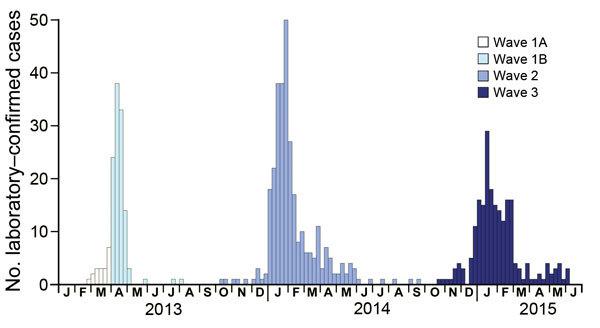
Since March 2013, a novel influenza A(H7N9) virus has caused 3 epidemic waves of human infection in mainland China. We analyzed data from patients with laboratory-confirmed influenza A(H7N9) virus infection to estimate the risks for severe outcomes after hospitalization across the 3 waves. We found that hospitalized patients with confirmed infections in waves 2 and 3 were younger and more likely to be residing in small cities and rural areas than were patients in wave 1; they also had a higher risk for death, after adjustment for age and underlying medical conditions. Risk for death among hospitalized patients during waves 2 and 3 was lower in Jiangxi and Fujian Provinces than in eastern and southern provinces. The variation in risk for death among hospitalized case-patients in different areas across 3 epidemic waves might be associated with differences in case ascertainment, changes in clinical management, or virus genetic diversity.
自2013年3月以来,一种新型甲型H7N9流感病毒在中国大陆引发了3波人间感染疫情。我们分析了实验室确诊的甲型H7N9流感病毒感染患者的数据,以评估3波疫情期间住院后出现严重后果的风险。我们发现,与第1波患者相比,第2波和第3波确诊感染的住院患者更年轻,且更有可能居住在小城市和农村地区;在调整年龄和基础疾病后,他们的死亡风险也更高。在第2波和第3波疫情期间,江西省和福建省住院患者的死亡风险低于东部和南部省份。3波疫情期间不同地区住院病例患者的死亡风险差异可能与病例发现差异、临床管理变化或病毒基因多样性有关。



 Zotero 插件