
呼吸道合胞病毒全基因组测序确定了G基因C末端序列重复的趋同进化。
Respiratory Syncytial Virus whole-genome sequencing identifies convergent evolution of sequence duplication in the C-terminus of the G gene.
作者信息
Schobel Seth A, Stucker Karla M, Moore Martin L, Anderson Larry J, Larkin Emma K, Shankar Jyoti, Bera Jayati, Puri Vinita, Shilts Meghan H, Rosas-Salazar Christian, Halpin Rebecca A, Fedorova Nadia, Shrivastava Susmita, Stockwell Timothy B, Peebles R Stokes, Hartert Tina V, Das Suman R
机构信息
Infectious Diseases Group, J. Craig Venter Institute, Rockville, MD, USA.
Bioinformatics Group, J. Craig Venter Institute, Rockville, MD, USA.
出版信息
Sci Rep. 2016 May 23;6:26311. doi: 10.1038/srep26311.
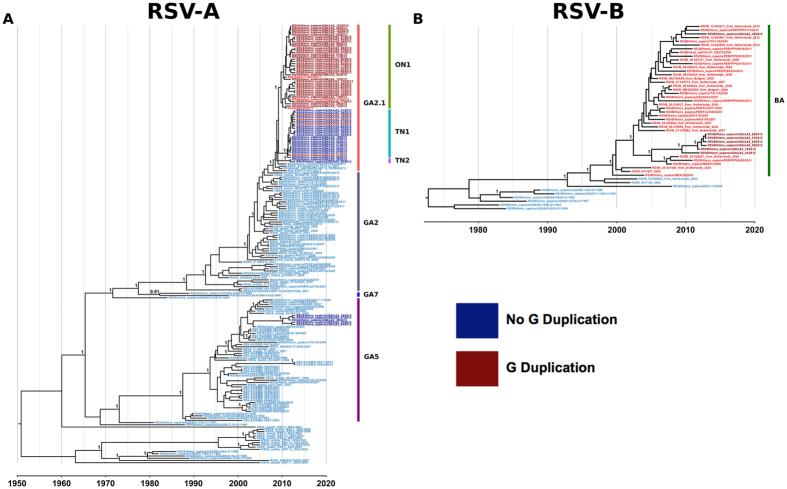
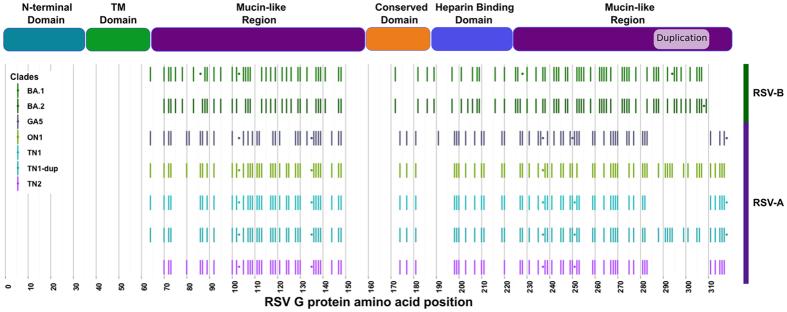
Respiratory Syncytial Virus (RSV) is responsible for considerable morbidity and mortality worldwide and is the most important respiratory viral pathogen in infants. Extensive sequence variability within and between RSV group A and B viruses and the ability of multiple clades and sub-clades of RSV to co-circulate are likely mechanisms contributing to the evasion of herd immunity. Surveillance and large-scale whole-genome sequencing of RSV is currently limited but would help identify its evolutionary dynamics and sites of selective immune evasion. In this study, we performed complete-genome next-generation sequencing of 92 RSV isolates from infants in central Tennessee during the 2012-2014 RSV seasons. We identified multiple co-circulating clades of RSV from both the A and B groups. Each clade is defined by signature N- and O-linked glycosylation patterns. Analyses of specific RSV genes revealed high rates of positive selection in the attachment (G) gene. We identified RSV-A viruses in circulation with and without a recently reported 72-nucleotide G gene sequence duplication. Furthermore, we show evidence of convergent evolution of G gene sequence duplication and fixation over time, which suggests a potential fitness advantage of RSV with the G sequence duplication.
呼吸道合胞病毒(RSV)在全球范围内导致了相当高的发病率和死亡率,是婴儿最重要的呼吸道病毒病原体。RSV A组和B组病毒内部及之间广泛的序列变异性,以及RSV多个进化枝和亚进化枝共同传播的能力,可能是导致群体免疫逃逸的机制。目前,RSV的监测和大规模全基因组测序有限,但这将有助于确定其进化动态和选择性免疫逃逸位点。在本研究中,我们对田纳西州中部2012 - 2014年RSV流行季期间92例婴儿的RSV分离株进行了全基因组二代测序。我们从A组和B组中鉴定出多个共同传播的RSV进化枝。每个进化枝由标志性的N - 糖基化和O - 糖基化模式定义。对特定RSV基因的分析显示,附着(G)基因存在高频率的正选择。我们鉴定出了循环中的带有和不带有最近报道的72个核苷酸G基因序列重复的RSV - A病毒。此外,我们展示了随着时间推移G基因序列重复和固定的趋同进化证据,这表明具有G序列重复的RSV可能具有适应性优势。


 Zotero 插件