
建立一个多标志物定量聚合酶链反应(qPCR)检测板,用于对转移性乳腺癌患者姑息治疗过程中血样中的循环肿瘤细胞进行分子特征分析。
Establishment of a multimarker qPCR panel for the molecular characterization of circulating tumor cells in blood samples of metastatic breast cancer patients during the course of palliative treatment.
作者信息
Bredemeier Maren, Edimiris Philippos, Tewes Mitra, Mach Pawel, Aktas Bahriye, Schellbach Doreen, Wagner Jenny, Kimmig Rainer, Kasimir-Bauer Sabine
机构信息
Department of Gynecology and Obstetrics, University Hospital Essen, University of Duisburg-Essen, Essen, Germany.
Department of Medical Oncology, West German Cancer Center, University Hospital Essen, University of Duisburg-Essen, Essen, Germany.
出版信息
Oncotarget. 2016 Jul 5;7(27):41677-41690. doi: 10.18632/oncotarget.9528.
BACKGROUND
Circulating tumor cells (CTC) are discussed to be an ideal surrogate marker for individualized treatment in metastatic breast cancer (MBC) since metastatic tissue is often difficult to obtain for repeated analysis. We established a nine gene qPCR panel to characterize the heterogeneous CTC population in MBC patients including epithelial CTC, their receptors (EPCAM, ERBB2, ERBB3, EGFR) CTC in Epithelial-Mesenchymal-Transition [(EMT); PIK3CA, AKT2), stem cell-like CTC (ALDH1) as well as resistant CTC (ERCC1, AURKA] to identify individual therapeutic targets.
RESULTS
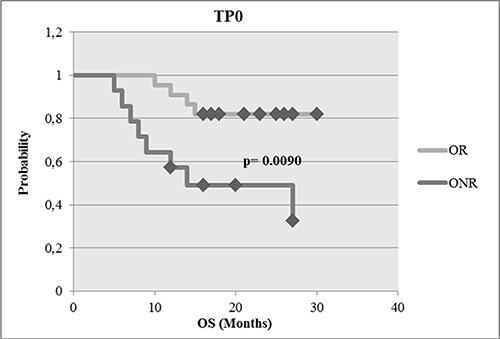
At TP0, at least one marker was detected in 84%, at TP1 in 74% and at TP2 in 79% of the patients, respectively. The expression of ERBB2, ERBB3 and ERCC1 alone or in combination with AURKA was significantly associated with therapy failure. ERBB2 + CTC were only detected in patients not receiving ERBB2 targeted therapies which correlated with no response. Furthermore, patients responding at TP2 had a significantly prolonged overall-survival than patients never responding (p = 0.0090).
PATIENTS AND METHODS
2 × 5 ml blood of 62 MBC patients was collected at the time of disease progression (TP0) and at two clinical staging time points (TP1 and TP2) after 8-12 weeks of chemo-, hormone or antibody therapy for the detection of CTC (AdnaTest EMT-2/StemCell Select™, QIAGEN Hannover GmbH, Germany). After pre-amplification, multiplex qPCR was performed. Establishment was performed using various cancer cell lines. PTPRC (Protein tyrosine phosphatase receptor type C) and GAPDH served as controls.
CONCLUSIONS
Monitoring MBC patients using a multimarker qPCR panel for the characterization of CTC might help to treat patients accordingly in the future.
背景
由于转移性乳腺癌(MBC)患者往往难以获取转移组织进行重复分析,循环肿瘤细胞(CTC)被认为是个体化治疗的理想替代标志物。我们建立了一个九基因qPCR检测板,以表征MBC患者中异质性的CTC群体,包括上皮性CTC、其受体(EPCAM、ERBB2、ERBB3、EGFR)、处于上皮-间质转化(EMT)状态的CTC(PIK3CA、AKT2)、干细胞样CTC(ALDH1)以及耐药性CTC(ERCC1、AURKA),以确定个体治疗靶点。
结果
在TP0时,分别有84%的患者检测到至少一种标志物,TP1时为74%,TP2时为79%。单独或与AURKA联合的ERBB2、ERBB3和ERCC1的表达与治疗失败显著相关。仅在未接受ERBB2靶向治疗的患者中检测到ERBB2+CTC,这与无反应相关。此外,在TP2时有反应的患者的总生存期明显长于从未有反应的患者(p=0.0090)。
患者和方法
在疾病进展时(TP0)以及在化疗、激素或抗体治疗8-12周后的两个临床分期时间点(TP1和TP2),收集62例MBC患者的2×5ml血液,用于检测CTC(AdnaTest EMT-2/StemCell Select™,德国QIAGEN汉诺威有限公司)。预扩增后,进行多重qPCR。使用各种癌细胞系进行检测板的建立。PTPRC(蛋白酪氨酸磷酸酶受体C型)和GAPDH作为对照。
结论
使用多标志物qPCR检测板监测MBC患者的CTC特征,未来可能有助于对患者进行相应治疗。


 Zotero 插件