
通过合作实现理解:医学生和物理治疗学徒进行团队学习——德国曼海姆大学医学中心引入跨专业学习
Comprehension through cooperation: Medical students and physiotherapy apprentices learn in teams - Introducing interprofessional learning at the University Medical Centre Mannheim, Germany.
作者信息
Mette Mira, Dölken Mechthild, Hinrichs Jutta, Narciß Elisabeth, Schüttpelz-Brauns Katrin, Weihrauch Ute, Fritz Harald M
机构信息
Medical Faculty Mannheim, Heidelberg University, Department of Undergraduate Education and Educational Development, Mannheim, Germany.
University Medical Centre Mannheim, School of Physiotherapy, Mannheim, Germany.
出版信息
GMS J Med Educ. 2016 Apr 29;33(2):Doc31. doi: 10.3205/zma001030. eCollection 2016.
AIM
In order to better prepare future health care professionals for interprofessional cooperation, interprofessional learning sessions for medical students and physiotherapy apprentices were developed at the University Medical Centre Mannheim, Germany. The experience gained from designing, implementing and evaluating these learning sessions is presented and discussed.
METHOD
A total of 265 medical students and 43 physiotherapy apprentices attended five interprofessional learning sessions. Of these, 87-100% responded to closed and open-ended questions on a self-developed questionnaire (24 items). The responses regarding self-reported learning gains, benefit, motivation and satisfaction with the sessions were analyzed separately by professions.
RESULTS
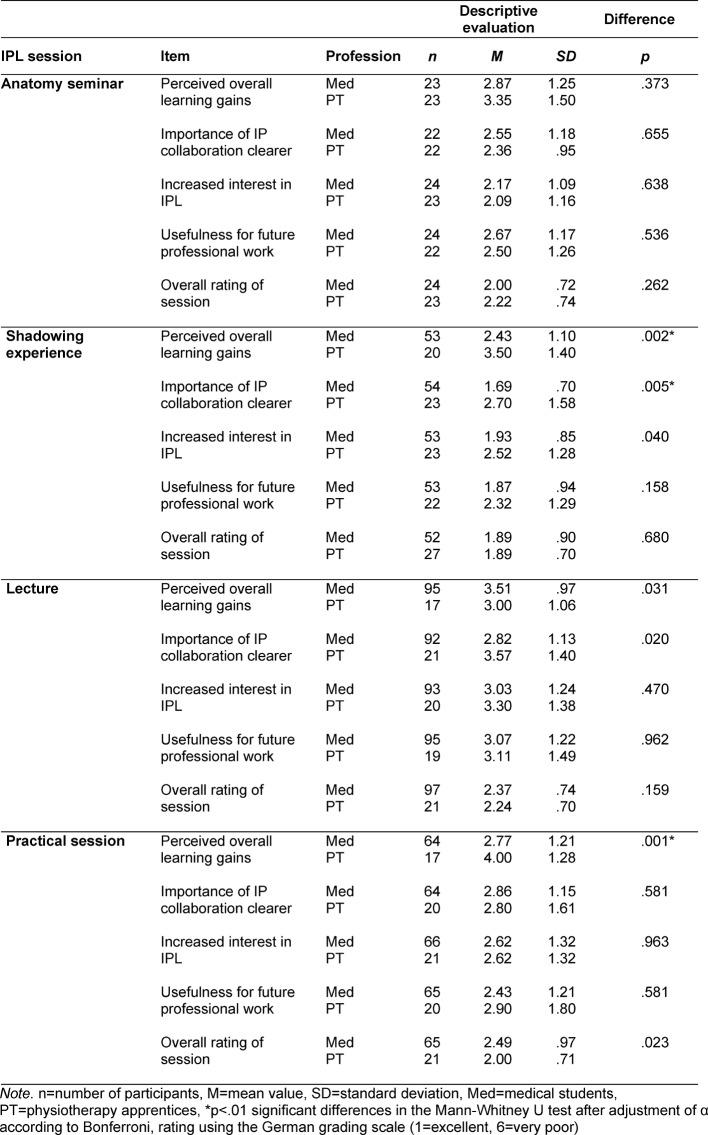
The learning sessions were well received by both groups. More than 75% of all participants were of the opinion that they could not have learned the new material in a better way. Significant differences between the medical students and the physiotherapy apprentices were mainly found with regard to perceived learning gains, which physiotherapy apprentices reported as being lower. Positive aspects of interprofessionalism were most often emphasized in the responses to the open-ended questions. Most frequently criticized were organizational aspects and a lack of perceived learning gains.
CONCLUSION
The introduction of interprofessional learning entails great effort in terms of organizational and administrative challenges. However, the project is considered worthwhile because the interprofessional aspects of the learning sessions were indeed valued by the participants. Permanently including and expanding interprofessional learning in the curricula of both professions longitudinally is therefore something to strive for.
目的
为了让未来的医护专业人员更好地为跨专业合作做好准备,德国曼海姆大学医学中心为医学生和物理治疗学徒开展了跨专业学习课程。本文介绍并讨论了在设计、实施和评估这些学习课程中获得的经验。
方法
共有265名医学生和43名物理治疗学徒参加了五次跨专业学习课程。其中,87%-100%的人对一份自行编制的问卷(24个项目)中的封闭式和开放式问题做出了回应。对关于自我报告的学习收获、益处、动机以及对课程满意度的回答,按专业分别进行了分析。
结果
两组对学习课程的反响都很好。超过75%的参与者认为他们无法以更好的方式学习新材料。医学生和物理治疗学徒之间的显著差异主要体现在感知到的学习收获方面,物理治疗学徒报告的学习收获较低。在对开放式问题的回答中,跨专业合作的积极方面被提及最多。最常被批评的是组织方面以及缺乏感知到的学习收获。
结论
引入跨专业学习在组织和管理方面面临巨大挑战。然而,该项目被认为是值得的,因为学习课程的跨专业方面确实受到了参与者的重视。因此,值得努力将跨专业学习长期纳入并扩展到两个专业的课程中。




 Zotero 插件